

Most UK clinic owners don't set out to buy "membership software." They set out to stop chasing failed card payments. Or to stop losing members in month three. Or to stop juggling one tool for bookings, another for billing, a third for member tracking, and a fourth for marketing emails, none of which talk to each other.
The problem isn't tool count. It's that none of those tools were built for recurring revenue. They were built for one-off appointments, with a "memberships" tab bolted on later.
If you're evaluating Clinic Membership software this quarter, the five features below are the ones that separate a platform built around recurring revenue from a generic practice-management tool with a loyalty module attached. Each one maps to a real pound figure your clinic is either earning or leaving on the table.
1. Automated recurring billing, including failed-card retry
This is the floor, not the ceiling. Any tool that calls itself "membership software" will take a card on file and charge it monthly. What separates the serious platforms is what happens when that card fails.
Cards expire. Banks decline. Members go dark. If your platform doesn't automatically retry the charge, notify the member, pause the benefit, and flag the case for your front desk. You're running a manual chase operation dressed up as a recurring-revenue business.
Automated retry logic, dunning sequences, and a clean member-facing "update your card" link are now considered standard. Clinics that have switched from manual to automated billing report revenue uplifts in the low-30% range alongside a double-digit cost reduction on admin time (Convesio / PayAtlas, 2026). If the vendor you're evaluating can't walk you through the failed-card sequence in 60 seconds, that's your answer.
2. A full member record, tier, benefits, and the 12-month treatment schedule
Every member on your books should have one central record that answers three simple questions: what did they buy, what's included, and what's on their schedule for the next 12 months? Not a paper list at reception. Not a spreadsheet that's two weeks out of date. Not "I'll check with the nurse who did her consultation."
A proper Clinic Membership platform records, at the member level: the membership tier they're on, the benefits and entitlements that come with that tier, what they've purchased (plus any add-ons), and the treatment schedule across the 12 months of their plan. That's it. It's the membership record, not a clinical chart, clinical notes still live in your PMS or records system where they belong.
Why this one-record-per-member approach matters: the front desk stops chasing information between tools, the clinician sees the full benefit picture in seconds, and the owner can answer questions like "what does she still have due this year?" without opening three tabs.
Two things go wrong when the record is split across tools: the team treats members from memory (which risks double-delivered benefits), and members skip high-margin services while burning through cost-heavy ones, because nobody has a single view of what's scheduled versus what's still unredeemed. Both are covered in our earlier piece on the hidden cost of fragmented tools.
When you demo a platform, ask to see the member profile page. You should see: the membership tier, the benefits included in that tier, what they've purchased, the 12-month treatment schedule, billing history, and the active payment method. If those aren't on one screen, the software is working harder against your team than for it.
3. Payment health and retention signals
Around 35% of first-time aesthetic patients never return (American Med Spa Association). Most of those never-returners didn't cancel angrily. They drifted. They let a payment fail, booked fewer visits, and quietly went away.
A platform built for recurring revenue treats payment health as a first-class metric, not something buried three clicks deep in an accounting tab. The member's billing history should live alongside their membership record, so when the front desk sees a card has failed, the context (what plan they're on, what's due on their schedule) is already in front of them.
Alongside payment history, watch these retention benchmarks against your own member base:
- Visit-frequency drift. Members on a membership plan visit the clinic around 2.9 times a year on average (ProspyrMed, 2026); members trending towards once-a-year behaviour are about to churn.
- Treatment-cycle rhythm. Most aesthetics treatment cycles run roughly every three months: a member who hasn't booked or redeemed across a full cycle is a useful prompt to pick up the phone.
- Plan mix and churn trend. If your dashboard shows cancellations creeping up on a single plan tier, the problem is usually the plan design, not the members.
A Bain / Harvard Business Review analysis found a 5% retention uplift can translate into a 25%–95% profit swing, and it typically costs five to twenty-five times more to acquire a new patient than to keep an existing one (Bain & Company). If your membership software can't tell you which members are lapsing on visits or payments, you're making the expensive mistake in both directions.
Our UK retention-tips guide walks through what to do once you've spotted a member starting to drift.
4. A two-minute onboarding flow, not a sixteen-step checklist
We've written a full UK onboarding playbook elsewhere (read it here). Here's the product-side test: how long does it take, inside the software you're evaluating, to convert a consultation into an active, paying, benefit-eligible member?
If the honest answer is "our team needs training, there's a form, we email the T&Cs separately, the card goes through a different portal, and we text them the member number by hand": the software is making onboarding the weakest link in your retention chain.
What to look for on the demo: a single checkout link you can send from the consultation room that collects signed T&Cs, takes payment, issues the member number, books the first benefit appointment, and triggers the welcome email. If that isn't one flow, members will quietly leak between the cracks before they've had their first membership visit.
5. One dashboard, not four browser tabs
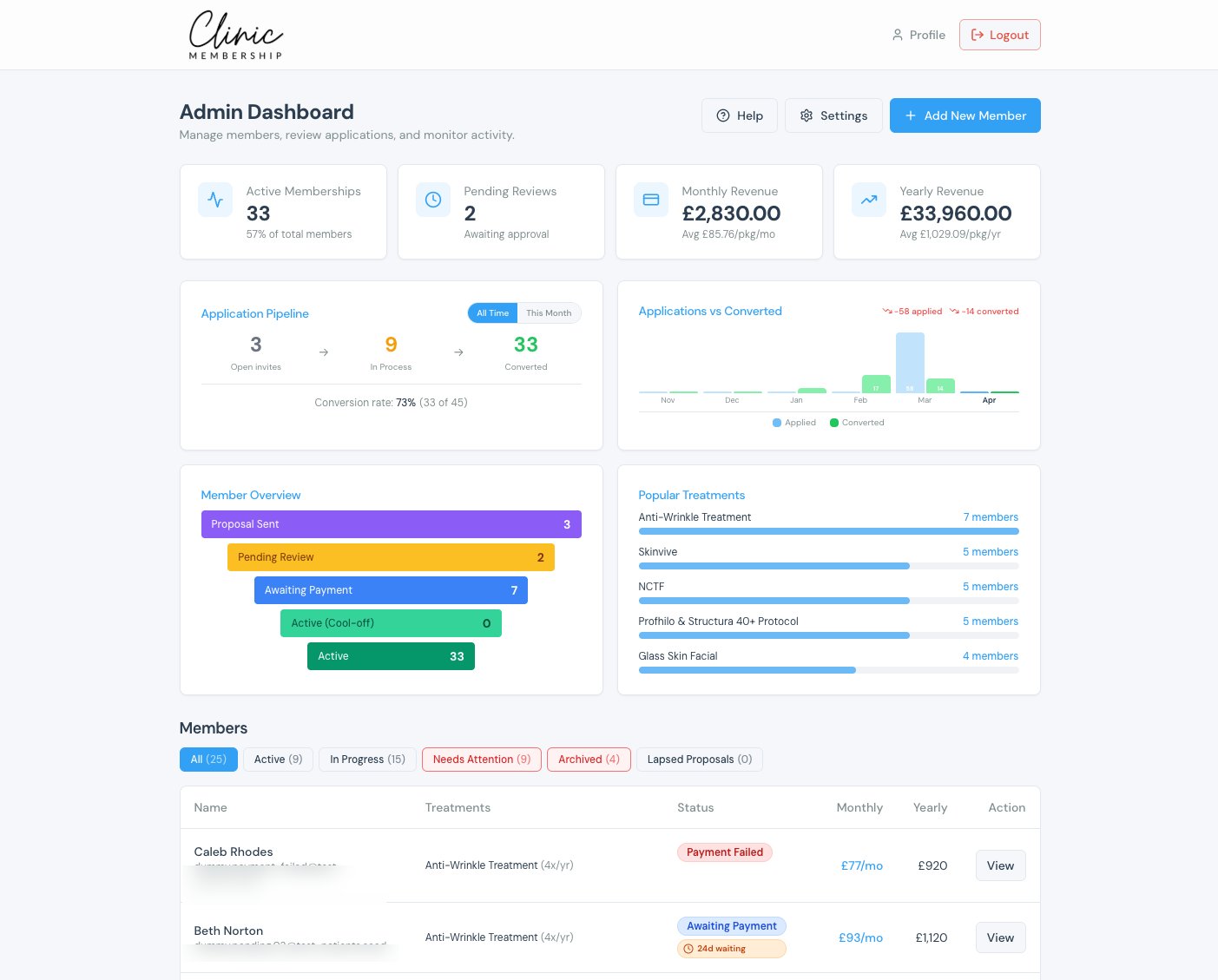
This is the Product Value test that matters most for UK operators running lean. A proper membership-first platform puts the following on one screen:
- Monthly recurring revenue (MRR), so you can see the number that actually matters without a spreadsheet.
- Active members and churn: how many are on the books, and how that's trending.
- A subscription breakdown by plan, so you can see which tiers are growing and which are stalling.
- Payment history per member, accessible without digging through Stripe separately.
- Export to CSV when you want to go deeper in your own tools.
If your current setup forces you to open your booking system, your payments dashboard, your email platform, and a spreadsheet to answer the question "how are memberships going this month?". You're paying a tool-stack tax every Monday morning.
Clinics that consolidate onto a membership-first platform report the obvious: fewer tools to pay for, fewer passwords to share, and (crucially) one source of truth when a member calls in asking about their balance. The macro picture on why UK clinics are moving this way is consistent: recurring-revenue models grew fastest among UK aesthetic clinics that ran the operation from a single dashboard, not a stitched-together stack.
The compounding bit
None of these five features matters in a single month. They compound.
A clinic that retains 5% more members than last year, automates the billing so payment failures don't leak another 3%, and trims two hours a week off reception admin doesn't just do 8% better. Year two, year three, and year four, the gap between that clinic and a fragmented-tool neighbour becomes structural. The membership book becomes an asset, not a line item.
That's the real test of Clinic Membership software: not what it does this month, but what it compounds into by month thirty-six.
What to do next
If you're evaluating platforms this quarter, take the five features above into every demo and score each vendor 0–2 on each one. Ten points is the floor for a recurring-revenue platform; anything under six is a booking tool with a loyalty sticker.
If you'd like to see what a membership-first dashboard actually looks like, our pricing and features page walks through each of the five capabilities above with screenshots, and the numbers behind them.