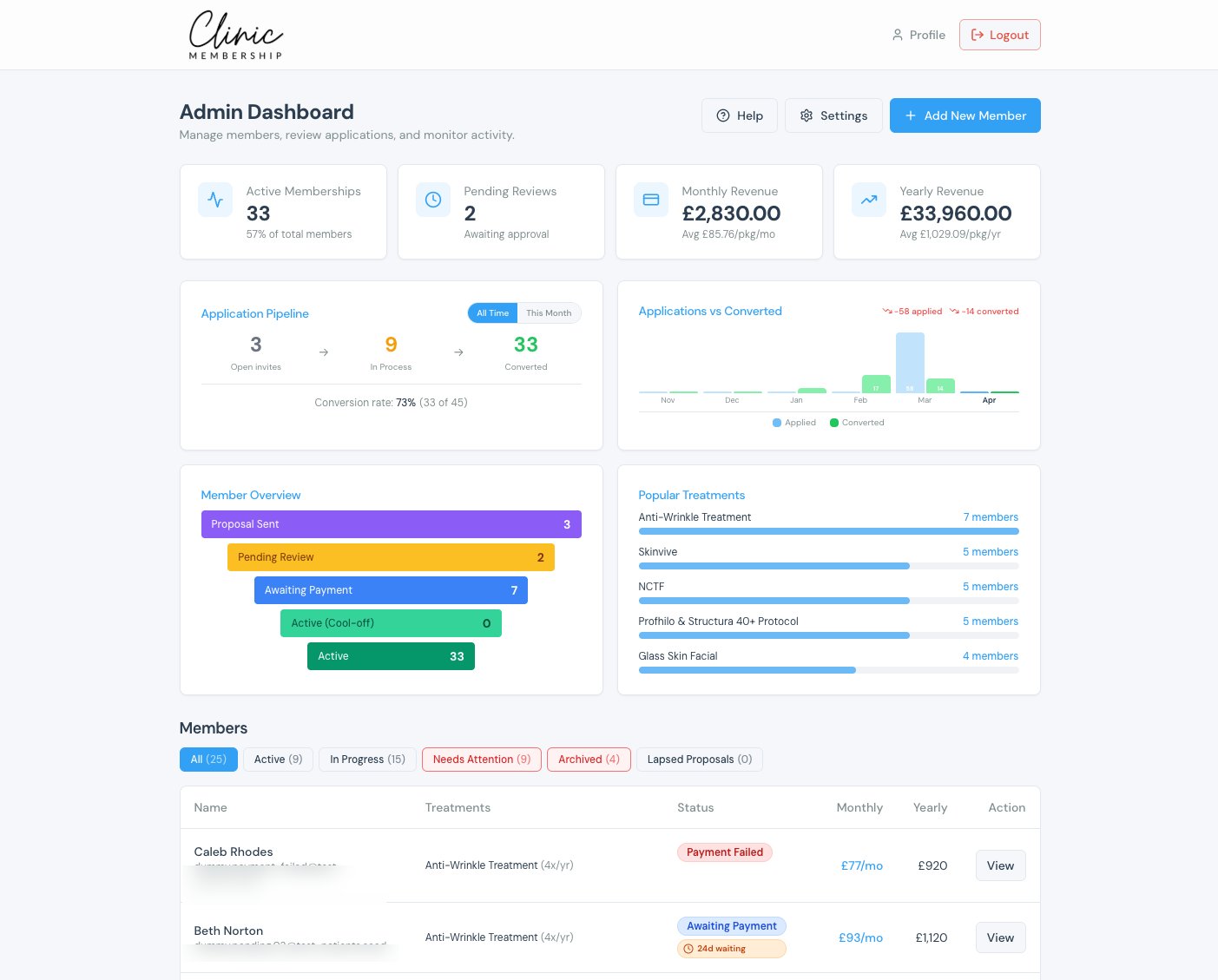


Most UK aesthetic clinics are still billing treatment by treatment. The ones growing fastest in 2026 are not.
They have moved to memberships: predictable monthly income, clients who visit more often, and a model that keeps working through the quiet months. Skytale Group's 2026 Aesthetics Industry Report calls memberships the number-one growth lever for independent aesthetic clinics this year.
Here is the honest bit: this is not a platform problem. You do not need to replatform your whole stack to get recurring revenue working. What you need is a playbook.
Below is the five-step playbook UK aesthetic clinics are actually running in 2026 to turn one-off bookings into monthly income. No theory. Real numbers, real sources, real UK clinics. If you are opening fresh this year, read first why new UK aesthetic clinics should build recurring revenue from day one.
Step 1 - How to pick the membership tier structure
Most UK clinics over-engineer this and stall before they ship anything. Keep it simple. Two tiers is usually enough to start: one entry tier that covers a core monthly benefit, and one premium tier that adds higher allowances.
If you want a three-tier structure, make sure each tier is meaningfully different. Bronze / Silver / Gold only works when the step up between tiers is obvious.
A useful UK benchmark: The Aesthetics Clinic in Kent advertises memberships from GBP37 per month at its entry tier, built on a treatment-credit model.
Step 2 - How to price it against UK benchmarks
The single biggest mistake is pricing the first tier too high. If a member has to think about the monthly charge, they cancel at the first unexpected bill.
For most UK aesthetics clinics in 2026, the entry tier sits between GBP30 and GBP60 per month. The Kent example above sits at GBP37. Other UK clinics such as Aesthetic Health, which runs active membership and loyalty programmes, cluster their entry tiers in a similar band.
Your premium tier is where economics work harder. A GBP99-GBP149 tier with a quarterly treatment or meaningful treatment credit converts occasional clients into genuinely frequent ones. Members visit 2.9 times per year on average, versus 1.0 for ad-hoc clients (ProspyrMed 2026).
Step 3 - Billing, SCA, and failed-payment recovery
This is where most memberships quietly leak revenue. Get it right once and you do not think about it again.
- UK SCA (3D Secure) compliance: recurring charges must be set up with a compliant card-on-file mandate at enrolment.
- Automated failed-payment recovery: software, not front desk, should retry and notify members automatically.
- Clear cancellation path: members who can see how to cancel without friction tend to cancel less.
It costs 5 to 25 times more to acquire a new client than keep one (industry-standard retention economics), so every recovered failed payment matters.
Step 4 - Sell the first 20 members (activation playbook)
You do not need broad marketing for the first twenty. You need a soft launch to clients who already trust you.
- Shortlist clients who have booked three or more times in the last twelve months.
- Send each one a personalised message with a founding-member price.
- Ask directly in person at their next appointment.
- Set a soft cap on founding-member pricing and hold it.
The first twenty members are your proof of concept. If twenty loyal clients say yes, the model works. If only five say yes, fix tier structure or pricing before public rollout.
Step 5 - Retention mechanics that keep members
Selling a membership is easy. Keeping one requires a routine.
- Treatment credits that roll over: members should not lose value because they missed a month.
- Automatic member-only pricing: never make members ask for their discount.
- Self-service portal: pause, swap, upgrade, and card updates without phone calls.
- Quarterly check-in: a short personal touch every three months outperforms generic automation.
Track one number: members who stay past month six. A 5% improvement in retention can drive a 25-95% increase in profit (Bain & Company / Harvard Business Review).
The compounding bit
A clinic with 100 members at GBP49 per month adds GBP58,800 of predictable annual revenue before a single treatment is billed on top. If members visit 2.9 times a year instead of 1, treatment revenue also compounds on top of that base.
Recurring revenue does not replace your existing business. It stabilises it, smooths quiet months, and gives you a model you can plan around.
Try it on your own clinic
Everything in this playbook works independently of the software you run. If your current setup already handles tiers, treatment credits, member pricing, SCA-compliant billing, and self-service, run it there.
If not, that is exactly what Clinic Membership is for.
Start your own UK-built clinic membership, your first 10 patients are free forever: see pricing.