
A consultation is thirty minutes. The relationship it sets up should last twelve months. The trick is what you lock in before the patient leaves the room.
Most UK aesthetics clinics still treat the consultation as a sales conversation. The patient says yes, pays for the first treatment, and walks out. Three weeks later somebody in reception is trying to remember whether to chase for session two. Six months later, the maintenance reminder does not land because nobody built a system to send it. That is the leak. AmSpa's framing on UK aesthetic patients puts roughly 35% as one-time visitors who never return - and most of them did not make a conscious decision to leave. The clinic's system just never held them.
A Clinic Membership reframes the consultation as a scheduling and billing conversation. Two mechanics carry the whole thing. Get them both into the room, and the patient leaves on a plan, not a transaction.
Mechanic 1: Lock the treatment schedule before the patient leaves
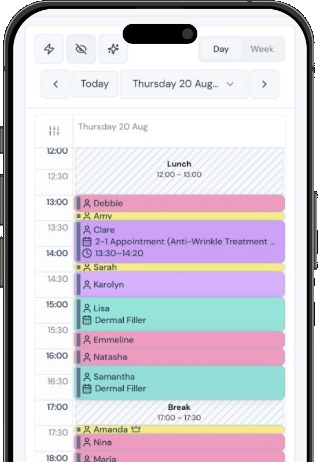
The moment a clinician recommends a course, the scheduling work should happen right then. Not in a follow-up email. Not next week. In the chair.
For a polynucleotide course, the UK protocol taught by Harley Academy in 2026 is three sessions two to four weeks apart, with maintenance every three to six months. Add it up: three sessions in the first twelve weeks, plus roughly eight maintenance visits over the following eighteen months. That is an eleven-visit relationship across an 18-month window, not a one-off booking. Skin boosters, filler maintenance and most regenerative courses follow the same shape - which is why yesterday's post on polynucleotides as a membership-shaped problem carried the economic case. Today's post is the operational one.
Schedule-lock is not about pressure. It is about respect for the clinician's plan. The clinical case for finishing a course is already strong. If the scheduling work in the room matches the clinical case on the notes, the drift problem is largely a problem the clinic has stopped creating. The patient walks out with dates, not hopes.
Mechanic 2: Bill it monthly, not per visit
Once the schedule is locked, the billing question becomes simple. A GBP 600 to GBP 2,700 polynucleotide course spread across a monthly card-on-file payment is a different decision for the patient than GBP 900 on a card at session two.
Automated recurring billing adds about 34% to revenue versus manual invoicing in industry benchmarks (Convesio / PayAtlas). Members visit 2.9 times more often than ad-hoc patients (ProspyrMed 2026). A 5% lift in retention is worth 25% to 95% more profit (Bain / Harvard Business Review), and retaining a patient costs a fraction of what it costs to acquire one - somewhere between one-fifth and one-twenty-fifth (Bain).
The card-on-file mandate is not a payment convenience. It is the commitment device. A patient on a monthly plan has already said yes to the twelve-month relationship. A patient paying at the till has said yes to today. The gap between those two decisions is where a year of revenue quietly disappears.
Why both mechanics have to run in one place
Schedule-lock without monthly billing is a diary full of appointments the patient never pays for. Monthly billing without schedule-lock is a card on file that pays for nothing specific - the fastest way to make a patient cancel.
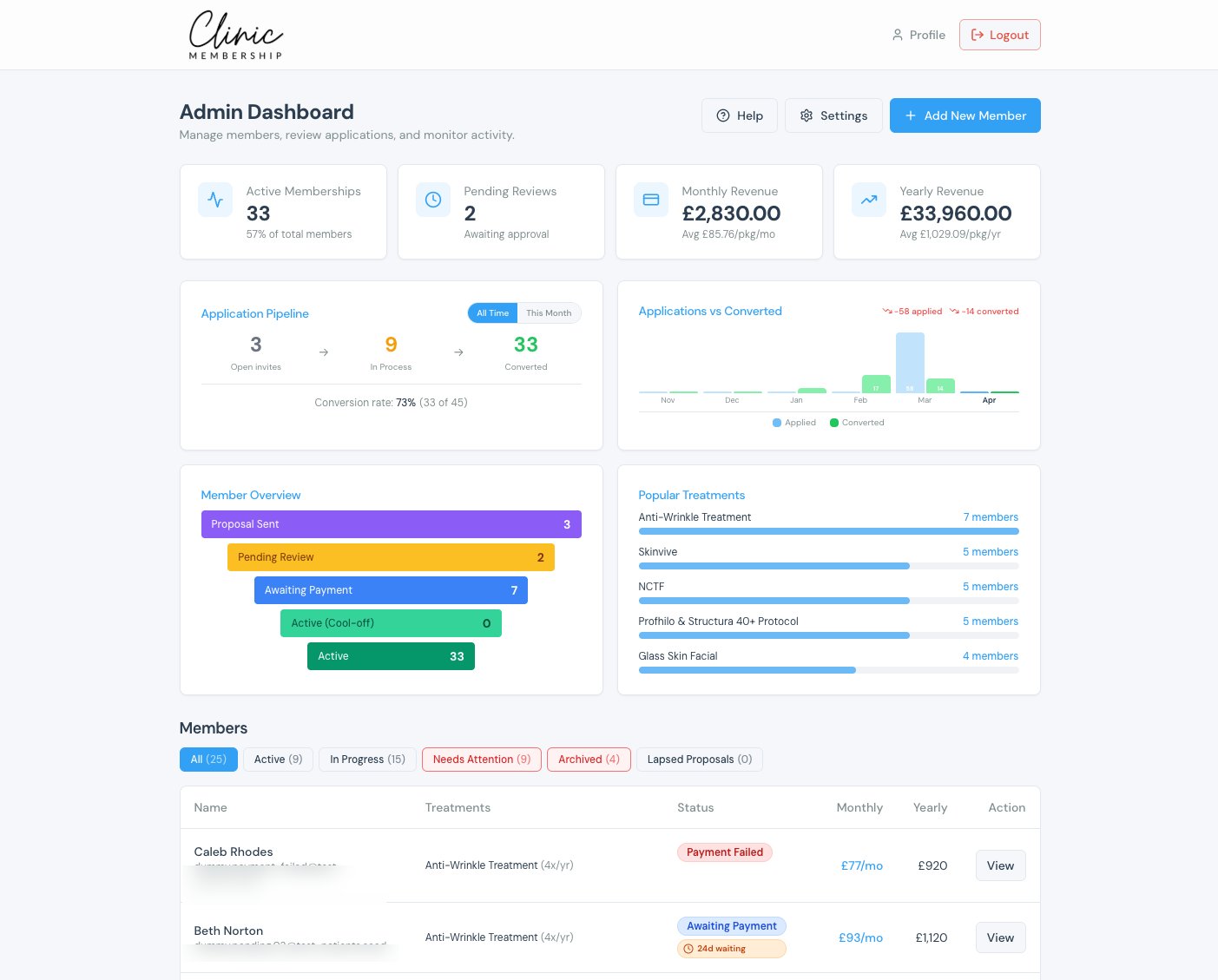
A Clinic Membership runs both mechanics in the same system. The treatment schedule sits alongside the billing plan. The maintenance reminder fires against the clinical protocol, not against a spreadsheet somebody forgot to update. The patient's notes, the benefit ledger and the monthly payment all live in one place. The consultation becomes the only time you have to do the scheduling work. Everything after that runs itself.
This is why an all-in-one booking system with memberships tacked on as an afterthought struggles here. The scheduling and billing layers need to be built for course-based protocols, not retrofitted around per-visit bookings. UK aesthetics is course-led. Most of the tools on the market are still visit-led, and the gap shows up in exactly the place a patient is most likely to drift.
What to do this week
Pick one course-based treatment your clinic already sells. Write down every visit in the full relationship - not just the first three. For a polynucleotide course under the Harley Academy protocol, that is three sessions in the first twelve weeks plus maintenance every three to six months for the next eighteen months. For skin boosters, it is a similar shape. For filler maintenance, it is the annual rhythm plus top-ups.
Then decide which of the two mechanics your current process is missing. Most UK clinics have one of the two - they schedule well but bill per visit, or they bill on a plan but leave the diary blank past session one. The gap between one mechanic and two is where the twelve-month relationship either holds or leaks.
If you want the twelve-month version of this in numbers, the 2026 recurring-revenue guide covers how the maths stacks across a full year. If you are onboarding the first wave of course members right now, the UK onboarding playbook covers the first ninety days, and the patient retention tips post covers the five UK-tested levers that keep them coming back.
Thirty minutes in the consultation room, done once, should buy an eleven-visit relationship that does not need chasing. That is the shift from transaction to plan - and it is exactly what a Clinic Membership is purpose-built to make.