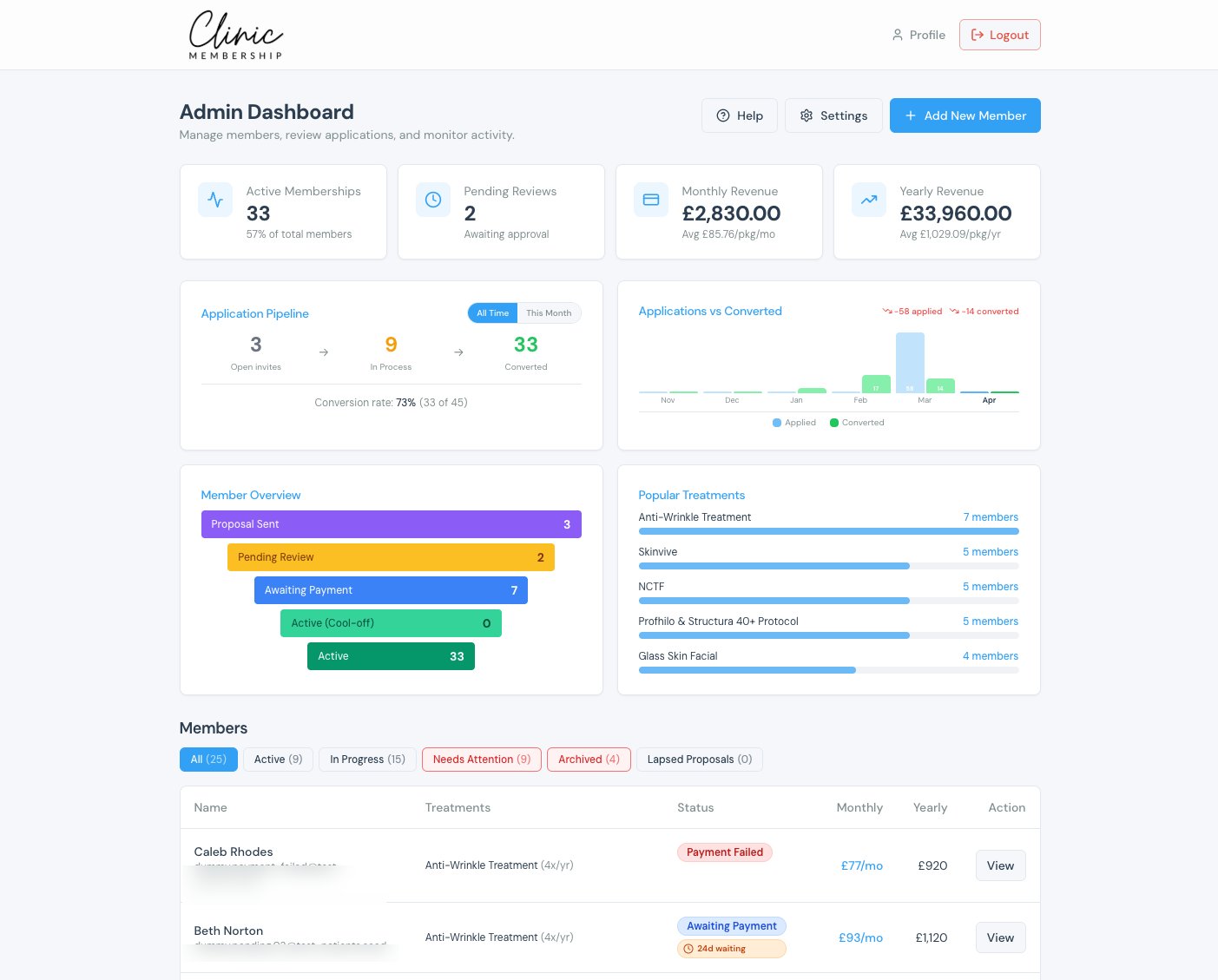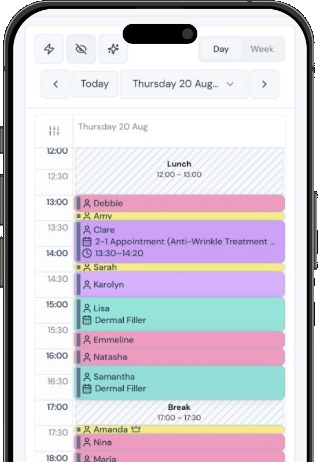


A "bank credit each month" plan and a Clinic Membership both bill on the same day. Both put the patient on a recurring payment. Both look like the same line on your P&L. They are not the same product.
The clinic membership plan vs credit plan question isn't a billing-cycle detail - it's a pricing-object decision. The pricing object is what the patient is actually buying: a balance of credit, or a treatment plan with a defined cadence.
Repeat patients spend roughly 67% more per visit than new ones (ProspyrMed, 2026). Whether your monthly plan captures that uplift or trips over it depends on the pricing object you've built. Not sure where to begin? Here's the walkthrough for launching a membership programme in a UK clinic.
The pricing object decides the conversation
A "bank credit each month" plan tells the patient: pay £X this month, redeem it later against whatever you choose. That sounds friendly. Here's what it actually does to a UK clinic.
First, it puts a liability on your books. Until the patient redeems that credit, the money sits as deferred revenue. You've collected the cash, but the obligation hasn't cleared.
Second, it creates use-it-or-lose-it pressure. The front-desk conversation drifts away from clinical outcomes and toward credit balances. "How much have I got left?" replaces "what's the next stage of my plan?" The relationship anchors on a number, not on the treatment journey.
Third, it leaves the patient choosing à la carte from the menu, visit by visit. There's no structural reason for them to come back monthly - only credit that hasn't been spent yet. And when a redemption-driven patient does come in, they tend to choose against your highest-cost consumables and skip your higher-margin services. The Direct Debit looks like recurring revenue. The contribution margin per visit doesn't behave like it.
The American Med Spa Association data tells the same baseline story: roughly 65% of patients come back, and around 35% never return after their first visit. A credit plan does almost nothing to change that ratio, because the relationship hasn't been redesigned - only the billing schedule has.
What a Clinic Membership cadence does to your P&L
A Clinic Membership rebuilds the patient relationship around a treatment plan, not a wallet. The patient is paying for a defined cadence of care - usually a bespoke package of treatments mapped over the year - not for a balance that has to be drawn down.
The numbers shift quickly once that's the case. Members visit roughly 2.9× more often than ad-hoc patients who only turn up when something prompts them (ProspyrMed, 2026). They also spend about 67% more per visit than brand-new patients (ProspyrMed, 2026). Both effects compound on the same patient at the same time: more visits, each one with a higher basket value.
The spend-uplift figure isn't a single-source claim. Independent UK industry sources put member spend roughly 35% above non-member spend, and the 35% figure is corroborated across six 2026 UK sources: PolicyBee, AntiWrinkleClinic, AestheticSource, MERIDIQ, Save Face, and Hamilton Fraser. The story they're all telling is the same: when the patient is paying for a relationship, they spend more inside it than they do outside it.
That isn't magic - it's structure. A membership packages a bespoke treatment plan into a monthly payment the patient has already mentally accepted. Sticker shock disappears. The drop-off between sessions narrows, because the next visit isn't a separate decision - it's part of the plan they already bought. And the front-desk conversation moves back where it belongs: "you're due for Stage Three next Tuesday - same time as last month?"
The twelve-month arc of a single patient is the easiest way to see this in practice. We walked through a £250 first visit becoming a £3,000+ year in a UK clinic - the relationship economics are the engine, not the marketing line. A credit plan does not compound the same way, because nothing in the plan tells the patient when to come back.
Where the margin gap shows up after 12 months
A year in, the gap between a credit plan and a Clinic Membership shows up in four places, all of them on the same row in the same set of accounts.
Repeat-client revenue share. At top-performing UK aesthetic clinics, around 65% of revenue comes from repeat patients (ProspyrMed, 2026). A credit plan only converts visit timing; it doesn't redesign the relationship, so the share doesn't move much.
Retention and churn. Top-performing UK clinics sit at 65%+ retention with under 10% annual churn; industry average sits closer to 50% (Hamilton Fraser and AcquisitionAesthetics, 2026). The structural delta isn't loyalty stamps - it's a treatment plan the patient is part-way through.
Compounding profit. A 5% retention lift can drive a 25-95% profit lift (Bain & Company / Harvard Business Review). The mechanism is fixed-cost dilution and rising lifetime value on the same patient. A credit plan doesn't pull this lever - it shuffles cash forward, then expires.
Acquisition cost. Acquiring a new patient costs 5-25× more than retaining an existing one (Bain & Company). When a membership extends the relationship by twelve months, you don't have to refill the top of the funnel at the same rate. When a credit plan expires, you do.
None of this is theoretical, but it's easier to see when you put it through a patient-lifetime calculation. Here's our walkthrough for calculating patient LTV at a UK aesthetic clinic.
The credit-account model leaves all four levers idle. A membership model pulls all four at once - which is why the margin gap doesn't show up in month one. It shows up by month twelve.
The five-question pricing audit for your current plan
Run this audit on whatever monthly plan you currently offer. Three or more "no" answers and you're probably looking at a credit plan in membership clothing.
- Is the patient paying for credit, or paying for a relationship? Credit is a balance. A relationship is a treatment plan with a defined cadence - that's what the recurring payment should be buying.
- Does your software treat memberships as the product, or as a feature? A booking system with a "memberships" tab usually treats memberships as the feature. A purpose-built engine treats them as the product.
- Is your bespoke treatment package built into the plan, or bolted on at checkout? If the package is constructed at the till each month, you don't have a plan - you have a recurring discount.
- Can your team see the recurring-revenue ledger per member, or only the credit balance? If the front desk only sees "credit remaining", you're running a credit account with a Direct Debit on the front.
- Is there a drift-signal flag on the member record, or only a payment-status field? Drift is a clinical signal. Payment status is a finance signal. You need both. Here's what an actual membership engine looks like.