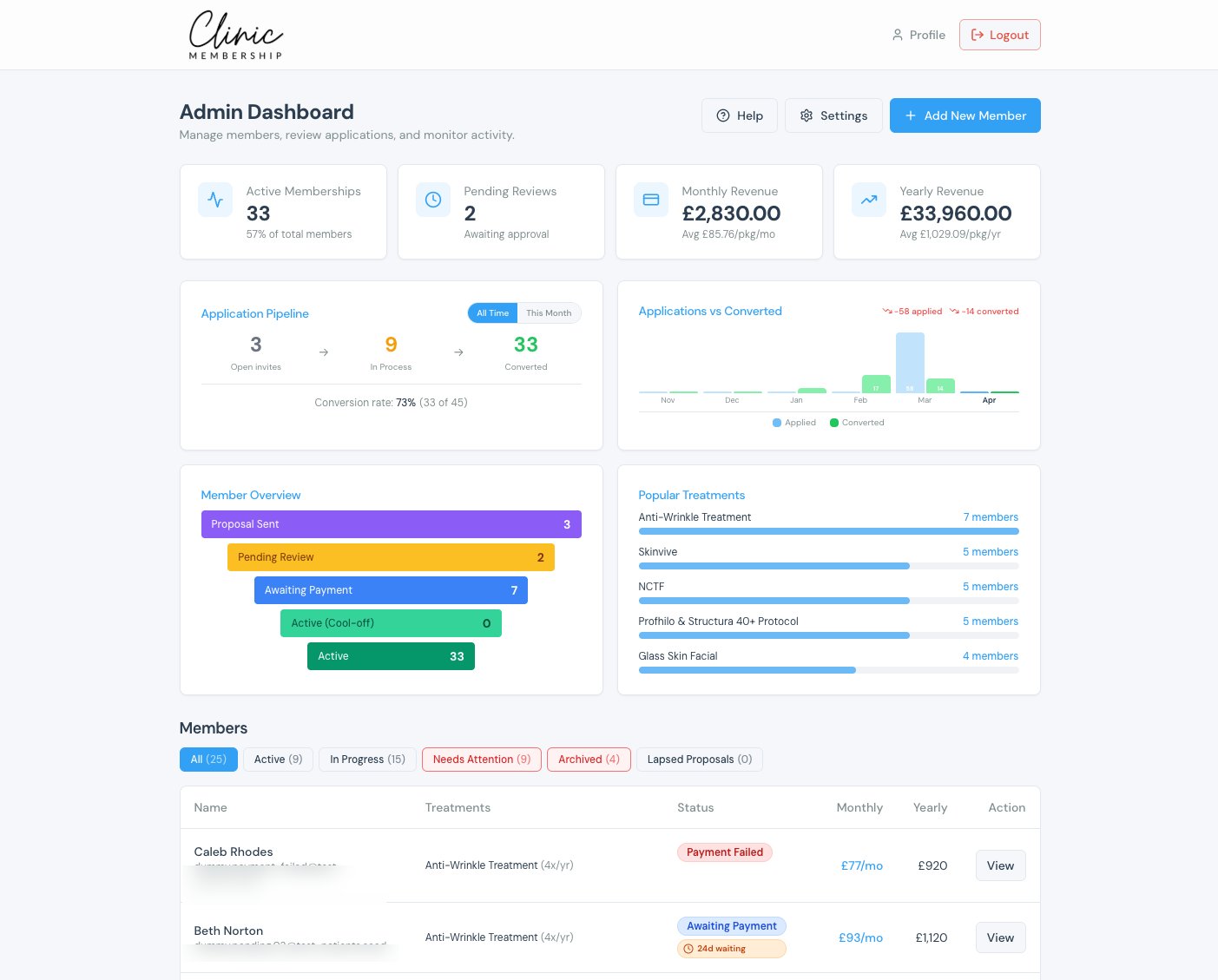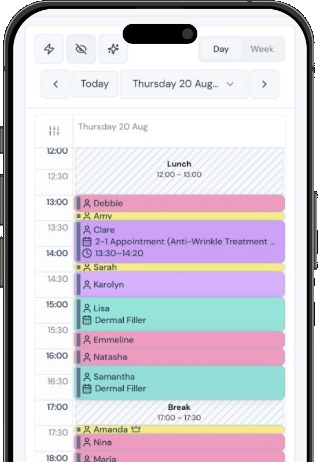


Most UK aesthetic clinics have a payments integration. Far fewer have a real membership engine. The two get mixed up so often that buying the first and calling it the second is the most expensive software mistake a UK clinic owner can make in 2026.
This is not a payments problem. It's a membership-routine problem. A payments integration moves money. A membership engine runs the routine that brings members back, holds their tier, catches their drift, redeems their credits, and reports the parts of your clinic that actually compound - month after month, with the consistency that makes the maths work. If you're starting from scratch, our quick-start guide to setting up a UK clinic membership programme covers the prerequisites; this post is about the engine the guide assumes you'll be running on.
Subscribed patients visit 2.9 times a year, against roughly once a year for ad-hoc patients (ProspyrMed 2026). That visit-frequency lift is the entire reason the membership model works in the first place - and it only shows up when the software running your membership behaves like an engine, not like a payment rail. Here's how to tell which one you're looking at, before you commit.
1. Look for tier structure that survives a real clinic month
A real Clinic Membership engine ships tier structure as a first-class object - not a label on a payment processor product code. Tiers should hold defined treatment cadences (toxin every 12 weeks, skin booster course every 6 weeks, polynucleotide course every 2-4 weeks), credit allowances that match those cadences, and pricing that reflects your real UK benchmarks rather than US-imported defaults.
If the only tier configuration you see in a demo is "name + price + payment processor SKU", you're looking at a payments integration. Real tier structure handles upgrade paths, downgrade paths, mid-cycle changes, and pause / resume rules - without an admin needing to write a manual workaround in the back office every time a member changes their mind.
The litmus test: ask the vendor how a member moving from Tier 2 to Tier 3 mid-cycle is handled. If the answer involves more than two clicks or a manual prorate calculation, the engine is bolted on, not built in.
2. Look for failed-payment recovery built into the engine, not bolted on after
Failed payments are the silent killer of clinic membership programmes. Cards expire. Bank limits trip. Strong Customer Authentication challenges fire - and every UK card payment processed since SCA enforcement is potentially exposed if the recovery logic isn't there. A payments integration sends the failed-payment email and waits for the member to fix it themselves. A real membership engine runs structured retry logic, sends graduated dunning communications, holds the member's tier in a "payment recovery" state for a defined window, and prompts the front desk only when human intervention is genuinely required.
The litmus test: ask the vendor what happens if a member's card fails on the first of the month. If the answer is "we send them an email" - that's not failed-payment recovery. That's a notification.
This is also where the structural-positioning case lives. We covered the structural argument on Monday in Membership-led UK aesthetic clinics in 2026: membership-first software is a different category from booking-first or payments-first software, and recovery logic is the seam where the difference becomes operational rather than theoretical.
3. Look for member-state tracking that catches drift before it becomes churn
Drift is the gap between what a member is paying for and what they're actually using. A member on a 149 GBP per month plan who hasn't booked in three months is drifting. A member on a polynucleotide course tier who skips session two of a three-session protocol is drifting. A member who only redeems against high-cost branded items while skipping the high-margin services is drifting in a different direction entirely - and it's costing you money.
A real Clinic Membership engine tracks visit cadence, redemption pattern, and tier-fit signals against the cadence you defined when you set up the tier. It surfaces the drift to your team before the cancel email lands. A payments integration doesn't track any of this. It tracks payments.
Last week's Thursday post listed the three retention numbers most UK clinics don't measure; today's post is the membership-engine shape that surfaces those numbers in the first place.
4. Look for treatment-credit handling that doesn't quietly cost you money
Treatment credits are the part of a membership programme where the maths gets dangerous. A member pays 149 GBP per month and accrues credits against future treatments. If those credits roll forever, you're sitting on a deferred-revenue liability that your accountant will eventually have an opinion about. If they expire silently, you're going to lose members on the day they realise. If members redeem only against the high-cost branded items while skipping the higher-margin services, your effective margin per member can drop below the level that makes the programme viable at all.
A real Clinic Membership engine handles credit accrual, expiration policy, redemption mix, and the use-it-or-lose-it logic that has to be visible to the member without feeling punitive. It also handles multi-protocol membership designs that pair regenerative cadences with corrective ones - without needing custom workarounds and without the credit ledger going sideways the first time a member upgrades mid-course.
The litmus test: ask the vendor what happens to credits when a member downgrades from Tier 3 to Tier 2 mid-cycle. If the answer is "we'll write a script for that" - the engine isn't ready.
5. Look for member-led reporting, not vendor-led dashboards
A payments integration reports on revenue. A real Clinic Membership engine reports on members - which is a different question entirely.
Member-led reporting answers the questions clinic owners actually ask in a real clinic month: how many members are at-risk this week; what's the rebooking rate by tier; which tiers are profitable at current pricing; which member cohorts are over-redeeming on low-margin services; how does this month's churn compare against the under-10% annual benchmark a high-performing UK clinic should be aiming for. Vendor-led dashboards report on what the software finds easy to count. Member-led reporting reports on what your clinic needs to know.
The litmus test: ask the vendor to show you the report that flags at-risk members before they cancel. If they have to run a custom export to build it - the engine is reporting on payments, not on members. Friday's post turned the rebooking-rate lever into a five-step playbook; the at-risk report is the upstream signal that tells you which lever to pull, and on which member cohort.
The compounding bit
Here's why the distinction matters at the level of the maths.
Members visit 2.9 times a year, against roughly once a year for ad-hoc patients (ProspyrMed 2026). Members spend roughly 35% more per visit than non-members across the UK aesthetic-clinic corpus (PolicyBee, AntiWrinkleClinic, AestheticSource, MERIDIQ, Save Face and Hamilton Fraser 2026 - six independent UK industry sources now corroborating the same figure at industry-narrative level). And a 5% lift in retention can boost profits by 25-95% (Bain & Company / Harvard Business Review).
If your software runs a real membership engine, those three multipliers compound together. If your software runs a payments integration, you get the payment, not the multipliers. The difference between getting paid and getting the multipliers compounds month after month - and after a year of compounding, it's the gap between a clinic that grows on its current member base and a clinic that has to keep buying new patients to stand still. (Illustrative, not a benchmark - actual outcomes vary by tier mix, basket size, and redemption pattern.)
Retention is the moat
It costs 5-25 times more to acquire a new patient than to retain an existing one (industry-standard retention economics). And the clinics with retention above 65% - well above the industry average around 50% - share one operational habit: they treat the cancellation conversation as a clinical signal, not a billing problem (Hamilton Fraser content hub 2026 + AcquisitionAesthetics 2026).
A payments integration doesn't move retention. A real membership engine is built around it. That's the test that matters.
Start your own UK-built clinic membership
If you're walking the floor at AM London on Friday, this is the operational shift to be thinking about: payments integrations are common; membership engines are rare; the difference compounds.
Start your own UK-built clinic membership - your first 10 patients are free forever -> clinicmembership.co.uk/pricing