

If you measure one number this month, measure your rebooking rate.
Yesterday's post laid out the three retention numbers most UK clinics don't measure. Of those three, rebooking is the most actionable in a single week. The industry average sits at 40-50%. The benchmark for clinics that report "improved revenue stability" sits above 65% (EQUALS3 + Cliniq Apps, 2026).
That is a 15-20 percentage-point gap. For a clinic with 600 patients on the books, closing it is the difference between roughly 270 patients booking again and 390 doing so. No new ad spend. No new lead funnel. Same patients, different system.
Here is what works, in the order we would tackle it.
1. Book the next visit before the current one ends
The biggest lever is the simplest. The rebooking conversation has to happen at the treatment chair - not in a follow-up email three weeks later.
Most UK clinics still rely on a "we'll text you when you're due" approach. The result is predictable. The patient leaves, life intervenes, and the booking lands in the inbox of someone who has already drifted. By the time they reply, the maintenance window has slipped.
The fix takes about ninety seconds. Before the patient stands up, the practitioner says: "Based on what we did today, your next appointment should be in eight weeks. I've got Tuesday the 24th at 10am or Friday the 27th at 2pm - which works?"
That isn't a sales script. It's clinical continuity. And it's the difference between a 45% rebooking rate and one that starts with a six. Onboarding sets the cadence; rebooking lives on it - which is why a proper onboarding programme for new members makes this routine rather than reactive.
2. Move repeat patients onto a Structured Treatment Plan
Once the first rebooking is in the diary, the next question becomes: how do you stop having to win the same conversation every eight weeks?
Patients on a Structured Treatment Plan are 2.5x more likely to rebook after their package ends than one-off patients (Alpine Analytix, 2026). That's the operational lever. A plan turns a series of independent decisions into one decision made well.
A Structured Treatment Plan, in plain terms, is a documented sequence of treatments - usually three to six sessions, sometimes spanning a year - agreed at consultation and paid for over time. It isn't a discount. It's a clinical pathway with a payment schedule attached.
The membership angle is straightforward. A monthly plan removes the sticker shock of paying for a year of care upfront and reduces drop-off between sessions. Patients budget for it the way they budget for a gym membership. The booking pattern stops being driven by whether the next GBP 350 lands in their account this week.
3. Make rebooking visible to the team
You cannot lift a number you do not see.
Most clinic software shows you today's calendar. It doesn't show you the percentage of last month's patients who already have a future appointment booked. That gap isn't a software limitation - it's a software choice. UK clinics that hit the 65%+ benchmark almost always have one screen that shows, at a glance, which patients have rebooked and which have not (EQUALS3 + Cliniq Apps, 2026).
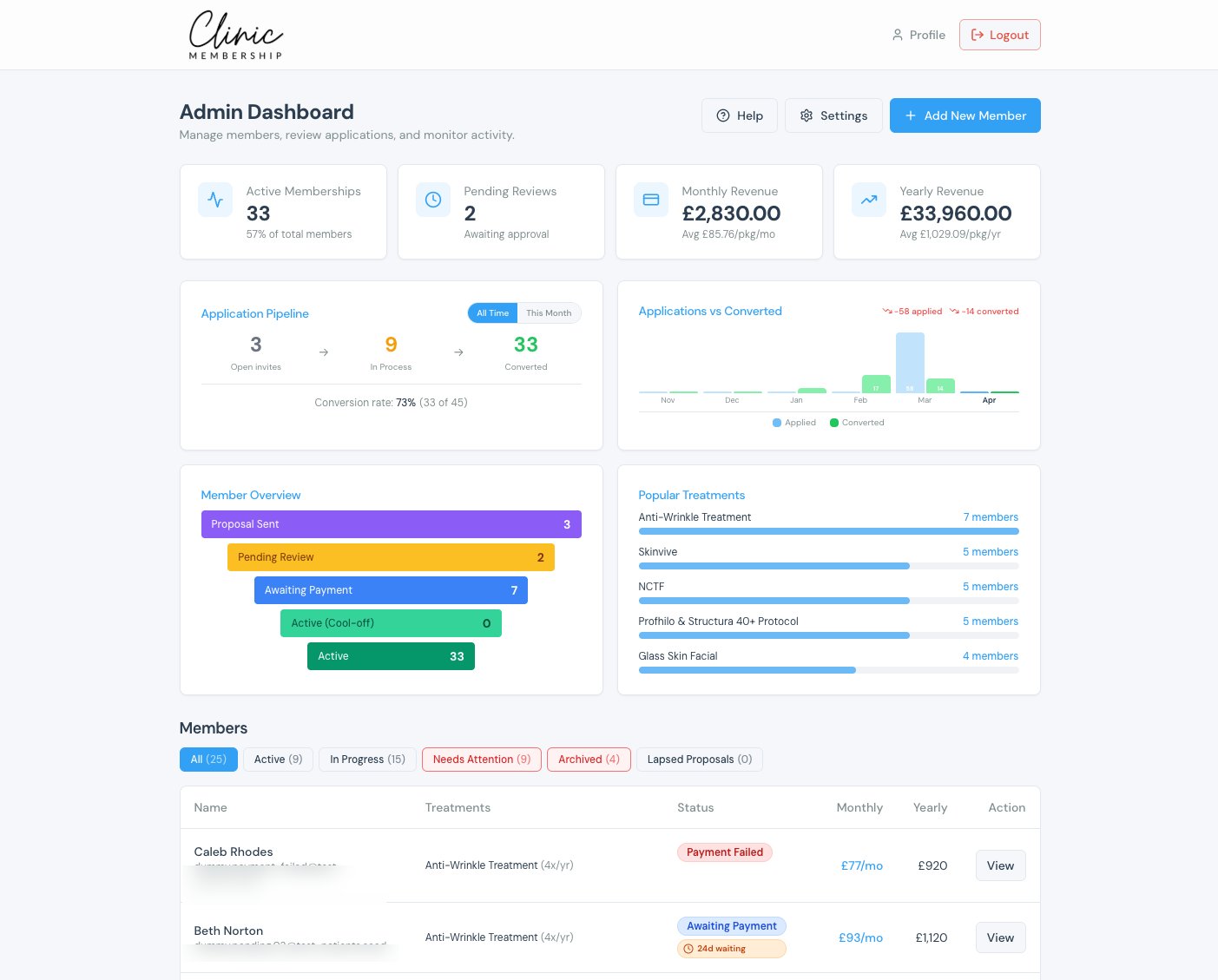
Build a membership-first clinic dashboard - even a simple one - and put rebooking rate on it. Once the team can see "we are at 47% this month, last month was 51%", behaviour changes. The conversation at the chair sharpens. The Friday review starts to mention the patients who haven't rebooked.
The number doesn't need to be perfect. It needs to be visible.
4. Re-engage the drifters before they go quiet
The patients you are losing aren't the ones who walk in and announce they're leaving. They're the ones who simply don't come back. The long-standing benchmark holds: about 65% of first-time aesthetic patients return; 35% never do (American Med Spa Association). Most of the 35% never tell you why.
It also shows up in cadence. Members visit roughly three times a year, where ad-hoc patients come back about once (ProspyrMed, 2026). The gap isn't really clinical - it's structural. Members have a reason to come in on a schedule; ad-hoc patients only have a reason when they remember.
The good news is that drifters are recoverable for a window - usually three to six months past the recommended interval - and a single well-timed message in that window does most of the heavy lifting. Not a discount. A clinical check-in. "Hi Sarah, you're a few weeks past where we'd usually see you for your next session. Want to book in for a quick review?"
The simple rule: nobody on the active list goes 90 days without a touchpoint. Five UK-tested ways to keep more of the patients you already have cover the rest.
5. Treat rebooking as a finance metric, not a marketing one
The reason most UK clinics under-invest in rebooking is positioning. It feels like a soft, marketing-adjacent number. It isn't. It's the cleanest revenue lever you have.
A 5% lift in retention can boost profits by 25-95% (Bain & Company / Harvard Business Review). Acquiring a new patient costs 5-25x what it costs to keep an existing one (Bain industry standard). UK patient acquisition costs sit at GBP 80-GBP 250 depending on market, location and treatment mix (Alpine Analytix, 2026). The average UK aesthetic patient lifetime value is GBP 4,775 (BoutiqueSEO UK, 2026).
Run the maths on your own numbers. A 15-point rebooking lift on a 600-patient base is roughly 90 additional return visits a year. Even at the modest end of the lifetime-value range, the annual revenue effect is material - and the underlying patients are already yours. Rebooking is also what makes January feel quiet - or not; when next visits are already in the diary in November, the post-Christmas dip flattens out.
What to do this week
Three actions. Each takes under an hour to set up.
First, count your rebooking rate manually for last month. Pull last month's appointments. Count how many of those patients have a future appointment in the diary. Divide one by the other. That's your starting number.
Second, write the rebooking script for your team and put it on a card behind every treatment chair. Three sentences. Said before the patient stands up.
Third, identify ten patients who have drifted three to six months past their recommended interval. Send each one a single check-in message this week. Track which of them book back in.
In a GBP 3.6 billion UK market growing at 8-9% a year (UCL / PolicyBee, 2026), the clinics that compound are the ones who stop trying to fill the bucket faster than it leaks. You don't need new software to start. You need the number on a wall, the script at the chair, and the discipline to look at it on Friday.
If you measure nothing else this month, measure rebooking. The other numbers follow.