
The UK aesthetics market is worth GBP 3.6 billion and growing at 8 to 9 percent a year (UCL / PolicyBee, 2026). Three of the four largest clinic-software platforms have made material moves in the last fortnight. None of those moves were on memberships.
That gap is now the most interesting positioning question in the category. Friday's post laid out the five steps to lift your rebooking rate from 45% to 65%. The post before that walked through the three retention numbers most UK clinics don't measure. Today's post is the structural reason both of those levers exist in the first place - and the reason no one is racing to build software around them.
Third-party comparison content has now hardened into a two-lane read of the market. One side is framed as "medical-grade clinic" software - heavy on records, compliance, and multi-location workflows. The other side is framed as "consumer marketplace" - heavy on discovery, profiles, and patient-side bookings. The standalone-membership lane sits between them, structurally uncontested.
The trend the industry just named
A year ago, "membership-led" was the contrarian framing in UK aesthetics. In May 2026 it is the standard one.
PolicyBee, Anti Wrinkle Clinic, AestheticSource, MERIDIQ, and Save Face have all converged on the same 2026 narrative inside the same twelve-month window: clinics are shifting "from pure pay-per-treatment to hybrid or membership-led models." That is now five UK industry sources in alignment. The position has gone from emerging trend to codified industry-narrative.
We have been writing about this for a year. The industry-narrative just landed in the same place. What is striking is that the product roadmaps of the largest platforms have not.
The lane the four largest platforms aren't racing in
In the last two weeks alone, three of the four largest aesthetic clinic platforms have shipped material updates.
One doubled down on its consumer marketplace, surpassing one million monthly downloads and rolling out searchable professional profiles. Another doubled down on the medical-grade end - a comparison-content cluster, multi-location support, and "regulated healthcare environments" messaging. A third released an AI-led documentation update aimed at solo specialists.
All three moves are real. None of them are membership moves.
That is because membership is a different shape of problem to booking. A booking platform has to make appointments easy. A consumer marketplace has to make discovery easy. A practice-management system has to make compliance and clinical records easy. Each of those is a defensible product on its own.
Membership crosses all three. The patient is paying every month whether they walk through the door or not, which means the software has to handle deferred revenue, retention signals, scheduled clinical reviews, dunning on failed cards, treatment-package logic, and the moment a patient drifts before they cancel. None of those are afterthoughts on an existing booking flow. They are the work.
That is why most of the larger platforms have shipped a membership "feature" rather than a standalone membership product. A toggle on the billing screen is not the same thing as software that catches a member three weeks before they go quiet. The lane sits empty because filling it properly is a redesign, not a release.
Why standalone-membership is structurally different
The numbers point in the same direction the narrative does.
Members visit roughly three times more often than ad-hoc patients (ProspyrMed, 2026). The 2026 benchmark from EQUALS3 and Cliniq Apps puts the rebooking-rate target at 65 percent or above within seven days, against an industry average of 40 to 50 percent (EQUALS3 + Cliniq Apps, 2026). Patients on a Structured Treatment Plan are two and a half times more likely to rebook after their package ends than patients without one (Alpine Analytix, 2026). A 5 percent lift in retention can boost profits by 25 to 95 percent (Bain & Company / Harvard Business Review).
The other side of the same coin is what every quiet patient costs. The 2026 BoutiqueSEO UK figure puts the average UK aesthetic patient lifetime value at GBP 4,775 (BoutiqueSEO UK, 2026). UK patient acquisition cost runs GBP 80 to GBP 250 depending on market, location, and treatment mix (Alpine Analytix, 2026). And 35 percent of first-visit patients never return at all (American Med Spa Association).
UK clinic owners are not asking for a fourth way to take a deposit. They are asking for software that turns a series of independent GBP 350 decisions into one decision, taken well, paid monthly. That is the demand sitting underneath the "hybrid or membership-led" narrative - and the reason the lever exists for clinics that want to act on it.
What "membership-first" changes about clinic software architecture
It is worth being specific about what changes when memberships stop being a feature and start being the spine of the software.
Three things move.
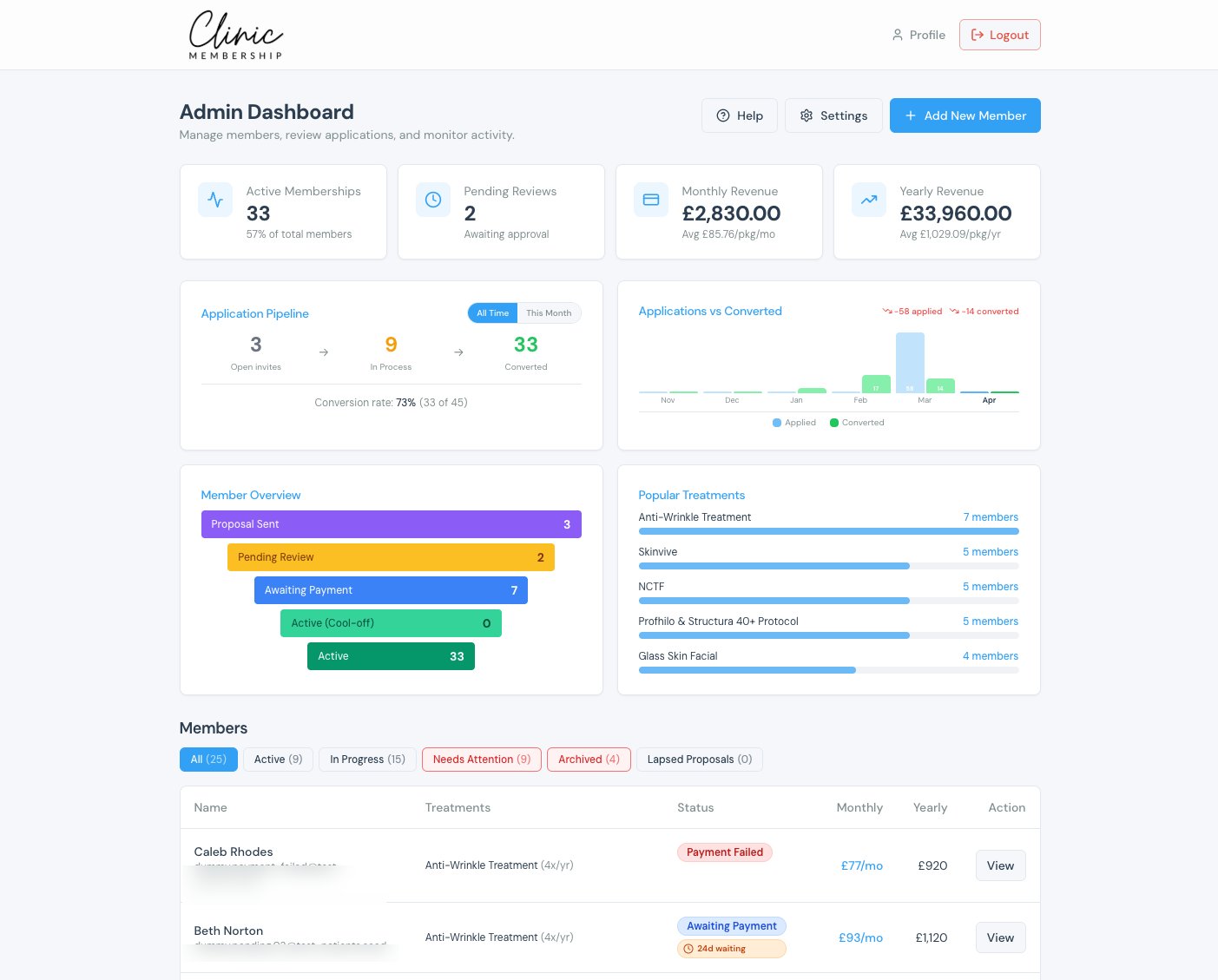
First, treatment packages get built into membership tiers, not bolted on as an extra layer. Structured Treatment Plans become the default shape of a patient relationship, not a one-off recommendation at the end of a consultation.
Second, rebooking moves from a follow-up task to a daily target. The team sees a single dashboard number every morning - today's rebooking rate against the 65 percent target - and can act on it before the week ends rather than three weeks later when the gap is already in the books.
Third, drift signals get built into the deferred-revenue ledger. The missed maintenance window, the unused benefit, the late card - these surface to the team while the patient is still a member, not after they cancel. Saving a quiet patient is structurally cheaper than acquiring a new one, and the software is the only place that intervention can be triggered consistently.
A booking platform with a subscription tab cannot do those three things together. They sit in different parts of the data model.
What changes when you treat memberships as the product, not a feature
If you are buying clinic software this quarter, the question is not "which platform has the best feature list." It is "which platform is racing in the lane I am about to operate in."
The largest platforms are racing. They are racing somewhere else.
The lane is empty because filling it well is hard. That is also exactly why it is worth filling.
See how Clinic Membership treats memberships as the product - clinicmembership.co.uk/pricing
Source: UCL / PolicyBee, 2026; ProspyrMed, 2026; EQUALS3 + Cliniq Apps, 2026; Alpine Analytix, 2026; Bain & Company / Harvard Business Review; BoutiqueSEO UK, 2026; American Med Spa Association.