
Most UK aesthetic clinics already sell polynucleotides as a course. A patient walks in for the first session, books the next two at three- to four-week intervals, and then drifts back six months later for a top-up.
What almost no UK clinic does (yet) is bill that same patient as a member.
That gap is a quiet but expensive one. A patient who pays for three sessions in cash, then waits six months to think about the next one, is not a member. They are a one-time customer with a calendar reminder. Patients on structured plans are 2.5 times more likely to rebook than those without one (ProspyrMed, 2026). The cadence is already in the treatment. The membership is just how you charge for it.
Here is a four-step playbook for turning a polynucleotide course into a clinic membership, designed for UK aesthetic clinics in 2026. If you want the wider category framing first: how UK clinics are pricing polynucleotides as a membership product, start there, then come back to this playbook for the operational steps.
Polynucleotides sit inside a wider shift toward regenerative aesthetics, longer protocols, maintenance cadences, and membership-shaped billing. Our overview of the regenerative aesthetics membership trend in the UK explains why clinics are packaging skin longevity treatments this way in 2026.
Step 1: Map the polynucleotide course cadence the patient is already paying for
Polynucleotides have one of the most predictable treatment cadences in UK aesthetics.
The consensus across UK training providers and clinical protocols is a course of three sessions, spaced three to four weeks apart, with maintenance every four to six months. For hair-growth protocols, some clinics extend the maintenance window to six to nine months (Illuminate Skin Clinics, January 2026). The wider consensus comes from Harley Academy, Interface Aesthetics, Dr Haus, DermaBalance and Dr Chike Clinics, all publishing aligned 2026 UK protocols.
That is not a marketing artefact. It is a clinical schedule, and your patient is already living inside it.
What this means in practice: if a patient starts a polynucleotide course on 1 May, they are clinically due back around 22 May, 12 June, and then sometime in October or November for maintenance. Six visits over roughly eighteen months is a membership cadence, even if you have not labelled it one.
Step one is to write that cadence down on a one-page handout you can give the patient at session one. The cadence belongs to the treatment. You are just making it visible.
Step 2: Re-price the course as the first three months of a membership
Most UK clinics price a polynucleotide course as a single up-front payment, usually with a small discount for paying in advance.
This is fine, but it forces a binary choice on the patient: pay everything now, or pay session-by-session and forget about session three. Neither option moves the patient towards a longer relationship.
The membership reframe: the course price stays the same, but the patient pays it as three monthly instalments, and those three instalments are the first three months of a six-month or twelve-month membership.
A few things change when you bill this way.
First, the patient mentally moves from "I bought a course" to "I'm a member." That is not a marketing trick. It is how the brain handles recurring billing. The card stays on file. The next month is not a decision; it is the default.
Second, the third session (the one that completes the clinical course) also becomes the first maintenance billing event. There is no awkward six-month gap. The relationship continues; the cadence shifts from three- to four-week intervals to a quieter four- to six-month rhythm.
Third, the price comparison your patient runs in their head changes. Three sessions at a few hundred pounds each sounds expensive in lump sum. The same total spread over months (and described as a membership) sounds like a plan, not a purchase. For a sense of where polynucleotide session pricing sits in the UK market today, our category overview walks through typical UK ranges.
Step 3: Use the third session as the conversion event, not the end of the course
This is the lever almost every clinic misses, and it is where the 2.5× rebooking lift starts to compound.
The third polynucleotide session is the natural conversion moment. It is the visit at which the patient has just seen the full effect of the protocol, the consultation room is open, the practitioner has the patient's attention, and the next clinical date is four to six months away.
What that means: the third session is not the end of the course. It is the first day of the maintenance phase, and it should be billed accordingly.
A practical playbook for the third session: the practitioner reviews the patient's progress, sets the maintenance interval (typically four to six months for skin protocols, six to nine months for hair-growth protocols), and confirms the next two booked dates. The patient leaves with a calendar invite, not a "we'll see you when you fancy it" hand-wave.
The card on file rolls automatically from the course-price instalments into a maintenance-tier membership at the same monthly amount, or a lower one if your pricing tiers it that way. The patient experiences zero billing friction. The clinic experiences zero rebooking work, exactly the structural behaviour a real membership engine is supposed to carry.
A six-month gap before maintenance is the longest stretch in a clinic's calendar where a patient can quietly disappear. A membership cadence closes the gap: the next charge, the next appointment and the next clinical milestone all share a date.
Step 4: Set up the audit trail so the membership is a real one, not just a label
A membership programme that lives only in the patient's mind is a marketing campaign, not a product.
For step four, you need three things in place that the clinic can audit.
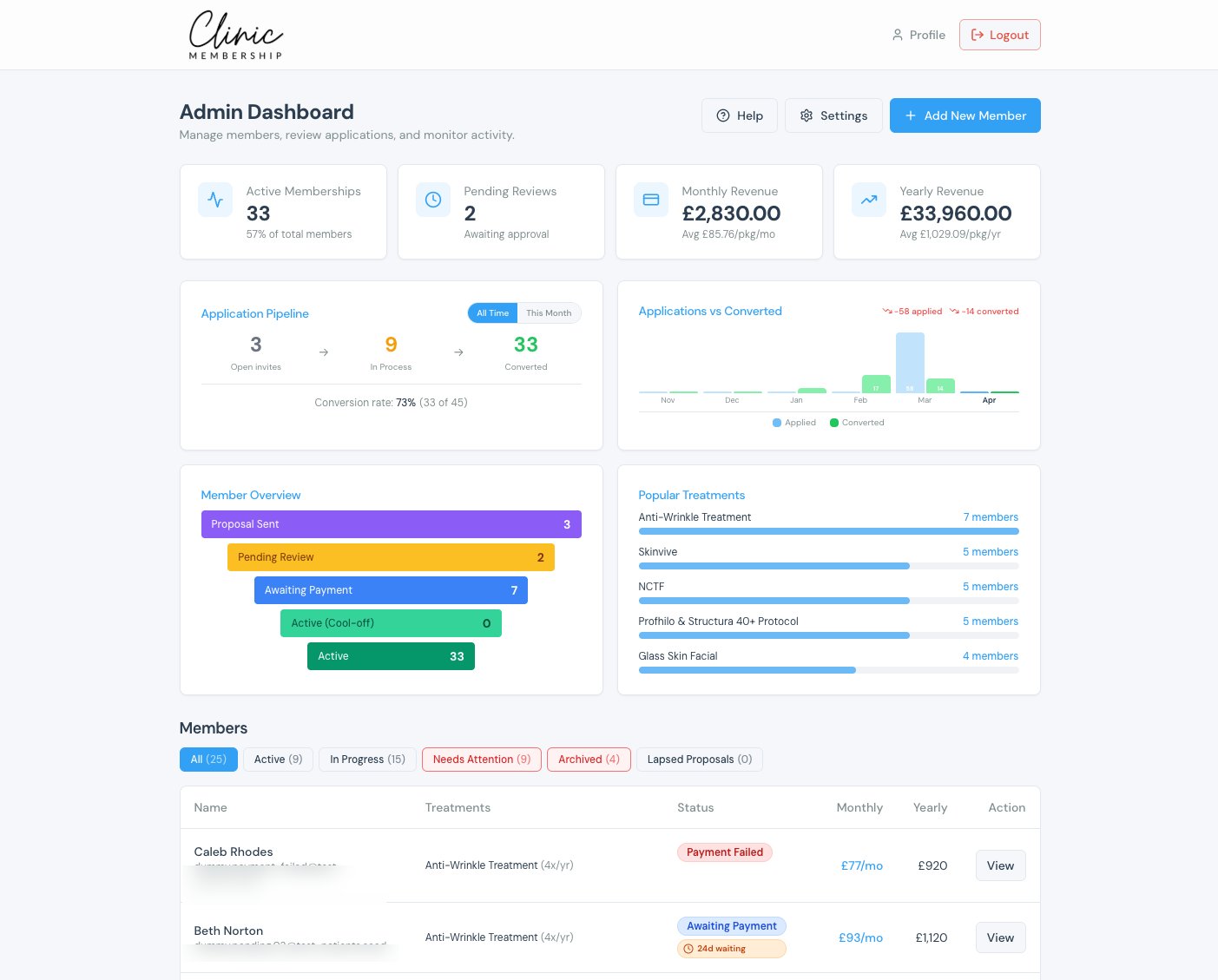
The first is a clear member record. The patient should appear in your software as an active member, with a tier, a price, a renewal date and an audit trail of every billing event. If the only record is "course of three booked", you do not have a membership; you have a calendar entry.
The second is a charging engine that handles the cadence. Recurring card payments collect on schedule, retry when a card fails, and surface a list of members whose payments need a nudge so reception can intervene before the relationship breaks. The engine should retry failed payments automatically.
The third is a drift signal. Drift, in a membership context, means a member who is paying but not visiting. For a polynucleotide course-to-membership, the drift signal is straightforward: a member who has paid two consecutive months of maintenance without booking a top-up appointment. Surface that list. Phone the patient. The cost of the call is far below the cost of replacing the membership.
This is also where the generic "banked credit each month" framing (common to salon-style and some aesthetics platforms) falls short for UK aesthetic clinics. A membership is not a prepaid balance the patient can run down at will. It is a relationship priced on cadence: the right number of treatments in the right window, billed as a single monthly amount. The audit trail should reflect that, not a mini-account ledger.
Why this is a Quick Tip, not a strategy essay
Three reasons.
The cadence is already in the treatment. You are not building a new product, just billing an existing one the way the patient already thinks. Polynucleotides are also the leading course-cadence treatment in 2026 UK aesthetics; Aesthetic Medicine London 2026 (8–9 May, Olympia London) ran a dedicated regenerative aesthetics stream with polynucleotides and PDRNs named as centre-stage themes, so the clinical momentum is in your favour. And no UK aesthetics platform has yet published a course-to-membership conversion playbook this specific.
If your clinic is already running polynucleotide courses, you have most of the ingredients. The membership is just how you bill them.
If your clinic is running polynucleotide courses, your billing should reflect what the patient already feels. That this is a relationship, not a chair fee. See how Clinic Membership compares at clinicmembership.co.uk/pricing.
Sources: Patients on structured plans 2.5× more likely to rebook: ProspyrMed, 2026. Polynucleotide course cadence (3 sessions, 3–4 weeks apart, maintenance every 4–6 months): Harley Academy 2026, Interface Aesthetics 2026, Dr Haus 2026, DermaBalance 2026, Dr Chike Clinics 2026. Hair-growth variant maintenance 6–9 months: Illuminate Skin Clinics, January 2026. Aesthetic Medicine London 2026 regenerative aesthetics stream: 8–9 May 2026, Olympia London.