
A UK beauty-and-wellness platform reached unicorn status this week. It picked up an eighty-million-dollar growth investment, crossed a one-billion-dollar valuation, and is now running scheduling, payments and business management for more than a hundred and thirty thousand businesses across hair, beauty, barbering, fitness and aesthetics. Thirty-five million appointments a month. Fifteen billion in annual gross merchandise volume. That is a serious, well-built piece of software, and the team behind it have earned the result.
So why are we, a small UK team, going the other way? Why build a standalone membership tool, only for UK aesthetic clinics, instead of bolting another feature onto an existing all-in-one?
This is the post that answers that.
The two architectures
There are two ways software can give an aesthetic clinic owner a membership programme.
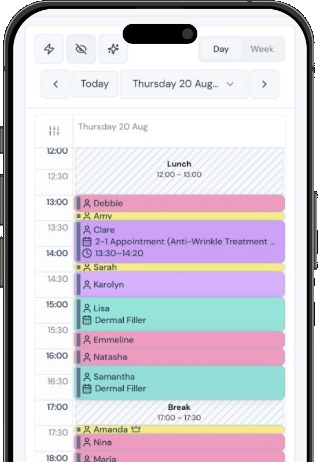
The first is the bolt-on. An all-in-one practice management system already does booking, payments, marketing, stock and notes. Memberships sit alongside everything else as one more module, usually a recurring-billing screen that runs Stripe in the background, with a "Memberships" tab in the menu. It works. It is also, structurally, the same as the loyalty card, the gift voucher and the prepaid credit account: a feature inside a feature stack.
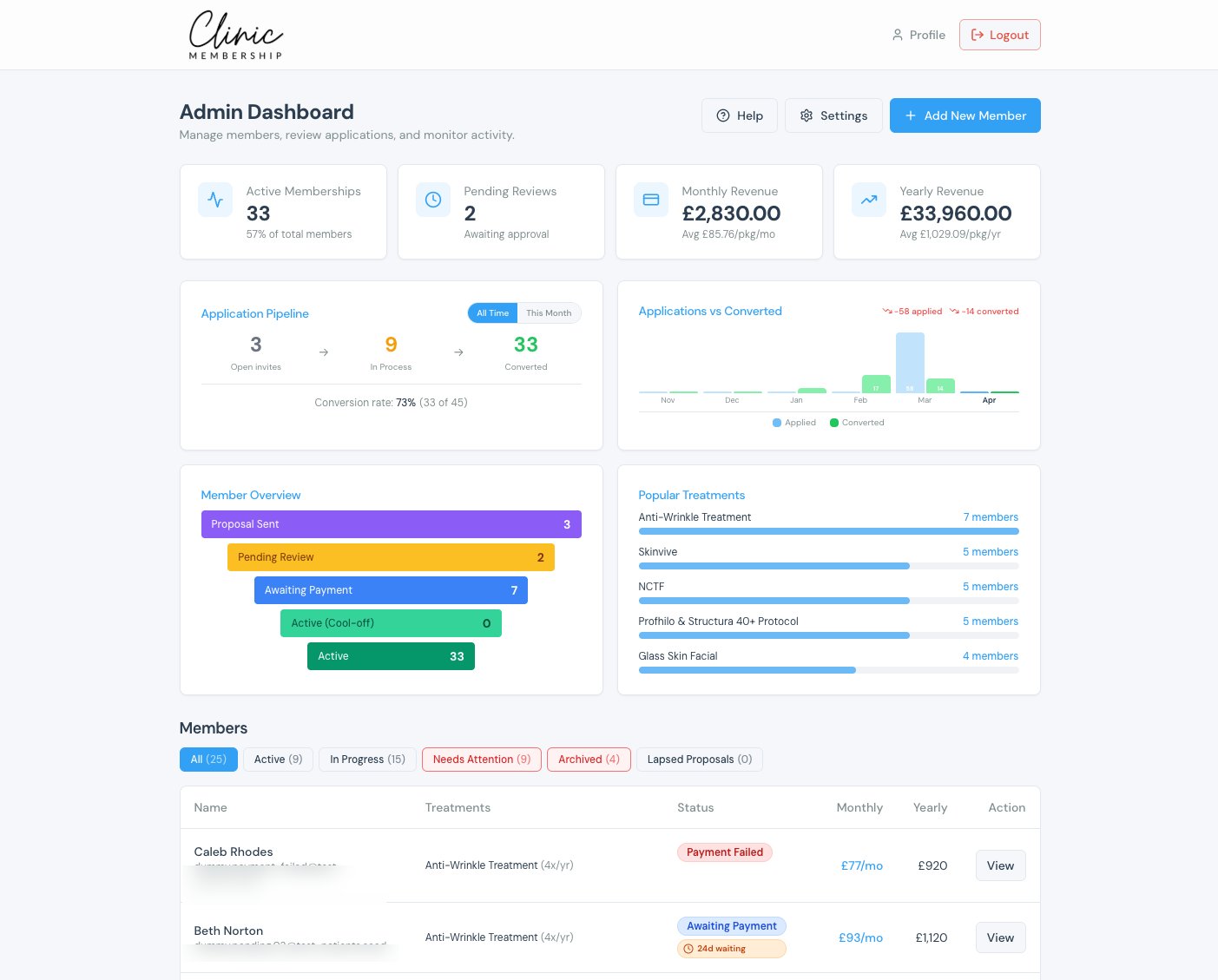
The second is the standalone. The whole product is built around one job: turning a one-off treatment into a recurring relationship the clinic can plan around. Billing is the surface. The architecture underneath is about visit cadence, lapsed-patient signals, plan economics, communications between appointments, and the operating week that those things imply.
Both can take a Direct Debit (DD). Only one is built to think about what happens between them.
The case for narrow
A general-purpose platform has to keep a barber, a yoga studio and a Harley Street injector all happy at the same time. That is a real constraint, not a criticism. It pulls the roadmap toward features every category needs (better calendars, faster checkout, generic marketing automations) and away from the features one category needs urgently (consent versioning by treatment, prepayment liability tracking, course-to-membership conversion logic, the specific cadence a regenerative protocol implies).
When the addressable market is everyone, the wide bets are rational. When the addressable market is the five-and-a-half thousand UK aesthetic clinics that exist today, the narrow bets are rational.
The whole UK aesthetic sector (every practitioner working in a clinic) is around nineteen and a half thousand people across about five and a half thousand clinics (UCL News, February 2026). That is not a category a platform spanning a hundred and thirty thousand businesses can credibly call its main audience. It is, however, a category a small standalone tool can build the entire product around.
That is the bet we are making.
What "standalone" actually does
Four things a standalone membership product can ship that a billing module inside a bigger stack rarely will, because they only matter if memberships are the main job.
Plan economics, not just plan billing. A bolt-on usually answers "what should we charge?" with a recurring-price field. A standalone tool can model the difference between a plan that pays for itself in three months and one that quietly underwrites the clinic for two years, by treatment cadence, by basket size, by deferred-revenue liability.
Between-appointment cadence. The reason a member shows up next quarter is not what happened on the chair. It is what happened in the six weeks between visits: the reminder, the personalised before-and-after, the unprompted check-in. A standalone product can make that the centre of the workflow, not a footnote in the marketing tab. We've written before about the membership engine vs the booking calendar . This is the practical end of that distinction.
Lapsed-member signal, not lapsed-member report. The bolt-on tells you who churned last month. The standalone tool tells you, today, which members are showing the early signals (fewer visits, unused benefits, late payments) and gives a small, sane action for each. Closer to the three retention numbers UK clinics don't measure than to a dashboard tile.
Silent-billing resilience. The least glamorous of the four, and the most expensive when it breaks. A standalone membership product treats failed cards, expired Direct Debits and silent drop-offs as a first-class event, retry logic, member-side prompts, dunning that sounds like a clinic rather than a debt collector. Inside a generic billing module these usually live as a CSV you download and a follow-up your reception team chases. Inside a real membership engine they run quietly in the background and only surface when a human actually needs to step in.
None of this is impossible inside an all-in-one. It is just unlikely to be the first thing the roadmap funds when the platform also has to ship a better calendar for barbers next quarter.
The UK aesthetics ground truth
UK aesthetic clinics are a genuine vertical, not a sub-sector of beauty and wellness. The treatments are clinical, the consent obligations are real, the retention curve is sharper, and the membership-led operating model is structurally different from the loyalty-card model that works for hair and beauty.
A platform built for everyone has to abstract those differences away. A small standalone tool built only for this category gets to keep them. That is not a moat against a one-billion-dollar competitor. They will keep building, and good for them. It is the reason we think the product is worth building anyway, even when the rational venture answer is "go wider, raise more, sell to everyone".
A unicorn going wide is a good story. A standalone tool going deep is a different story. UK aesthetic clinics deserve both options on the table.
Where to start
If you are running a UK aesthetic clinic and your membership programme currently lives inside a booking calendar, the test is simple. Open whichever software you use today. Ask yourself: would I describe what's on the screen as a membership product, or as a billing screen with the word "membership" written on it? The answer points to which architecture you're paying for.
If the answer is the second one, you can see how Clinic Membership is built differently on our pricing page.
Sources: TechCrunch, BusinessWire, Sifted and CityAM (21 May 2026); UCL News (February 2026).