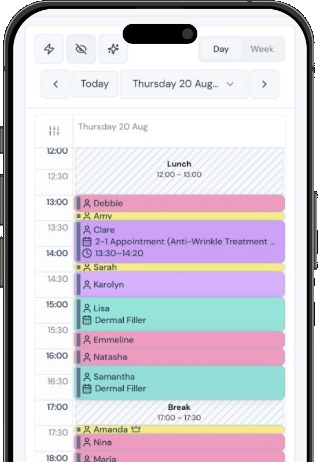


Every May, UK aesthetic clinics live the same week. The diary fills. Anti-wrinkle bookings climb. Skin-booster enquiries climb. Walk-ins arrive with a date in their head and a budget ready.
Eight UK 2026 sources: Hamilton Fraser, LPG Clinics Wholesale, AntiWrinkleClinic, PolicyBee, Marie Claire UK, Themediclinics, Stockbridge Clinic and Illusion Clinic: all describe the same May–July spike. It's structural, not anecdotal. Wedding season, summer holidays and social calendars drive a clinical demand peak that's repeatable year on year.
What most clinic owners read as a good problem is also something quieter: a retention test. The patients walking into your clinic this May are the patients who decide whether you have a January diary.
What the diary is actually showing you
The wedding-driven patient does not arrive the week before the wedding. They arrive three or four months out. As Marie Claire UK put it in 2026, patients now book "three to four months before the wedding allowing skin time to repair and regenerate." That sentence appears, near-verbatim, across most UK clinical write-ups of the season.
Work the runway backwards. Most UK weddings fall between June and October, with a long tail through to early autumn. Counting back the three-to-four-month skin-prep window, the planning runway sits roughly from February through July. The May–July visit spike you're feeling now is the late stage of that runway: patients finalising their plan before photos.
Then August lands. The cohort has the photos. The project is done. For any wedding-runway patient who never had a structural reason to come back, that's their last visit. By the time the cliff shows up in your reports, the cohort has already left.
This is the bit that hides in plain sight. Across the industry, the American Med Spa Association puts the generic non-return baseline at around 35% of first-time patients. In a wedding-runway cohort, that figure skews higher: the visit was tied to a single event, and the event has happened.
If you're trying to manage quiet periods clinic-wide, August is where the consequences show. May is where the cause sits. See our guide on quiet periods without discounting.
Why the busiest month is the retention test
Here's the structural insight: the clinics that don't see an August cliff aren't the clinics that ran the best August marketing. They're the clinics that converted May–July walk-ins into structured plans during the visit, not after.
The economics behind that sit in one cadence number. ProspyrMed's 2026 retention reporting puts member visit frequency at roughly 2.9× per year on average, against ad-hoc patients who tend to come back about once. That isn't a forecast or a synthesis. It's a descriptive cadence gap across UK and US clinic reporting. Members run on a rhythm. Ad-hoc patients run on a project.
Wedding-runway patients arrive at your clinic already running on a rhythm. They have to. The 3–4 month skin-prep window forces a cadence of two to four visits, three to four weeks apart. If that cadence ends with the wedding, you've trained a patient into your clinic's rhythm and then handed them an exit ramp.
The wider 2026 frame from UK industry writing makes the same point in plain language. AestheticSource has been describing the shift as patients "treating aesthetics like fitness: a consistent part of self-care, with regular clients having quarterly touch-ups or skin renewal sessions every 8–12 weeks." Wedding-runway patients are already operating at that 8–12 week cadence in their planning phase. The cadence does not need to change after the wedding. The billing does.
That reframes the diagnostic. The retention test isn't whether the patient comes back in August. It's whether each May–July visit contained a plan conversation that anchored the cadence beyond the date. See our piece on the three retention numbers UK clinics don't measure.
The 2026 UK market backdrop
Step back from the diary for a moment. The UK aesthetics market sits at roughly £3.6B and is growing 8–9% annually (UCL / PolicyBee 2026). The wedding-season corpus is one expression of that growth, but it's part of a wider shift in how UK clinics are framed in industry writing.
Six UK industry sources: PolicyBee, AntiWrinkleClinic, AestheticSource, MERIDIQ, Save Face and Hamilton Fraser, have codified the hybrid or membership-led model as 2026's market-standard framing. The model is no longer described as innovative or experimental. It's described as the operating shape of a clinic that intends to compound its patient base year on year.
That positioning matters here because it tells you the wedding-season retention test isn't a single-season tactic. It's how the market is now structurally read. See our piece on why UK aesthetic clinics are going membership-led in 2026. And the quiet-month side of the same coin is already well-trodden in UK clinic writing. See our piece on recurring revenue through the quiet months.
What this means for your operating week
The membership-shaped clinic isn't trying to smooth out August demand with discounts. It's trying to convert May–July walk-ins into structured plans before the planning window closes. Three structural lock-ins, none of them software-specific:
Treat every May–July consultation as a retention test. The wedding-runway patient is the warmest cohort you'll see all year. They're paying full sticker, they're committed to a cadence, and the conversation about what happens after the wedding is the conversation that defines next January's diary.
Make the plan conversation a default visit step, not an upsell. If the cadence question only comes up at the end (after the wedding outcome, with the patient reaching for their car keys) it lands as a sales prompt. If it sits in the middle of the visit, alongside the clinical plan, it becomes part of the care logic.
Build the 3–4 month planning runway into the membership cadence itself. Treatment packages aligned to skin-prep timelines, not arbitrary calendar months, give wedding-runway patients a structurally honest reason to continue. See our piece on lifting your rebooking rate.
The retention test isn't about which platform a clinic runs. It's about whether the membership cadence is the default visit logic or an add-on at the end.
The number to keep on the wall
Measure one thing differently this season: the conversion rate of wedding-runway patients into year-round members. Not the visit count. Not the spend. The conversion rate.
A clinic that converts 30% of its May–July cohort into a year-round membership is a different clinic by next January from one that converts 5%. Same diary in May. Different diary in November. Different again the following May, when the previous year's converts are now layered on top of the new wedding-runway cohort.
If your clinic is structured around the wedding-season retention test, your software should reflect that. See how Clinic Membership compares at clinicmembership.co.uk/pricing.
Sources: Wedding-season demand corpus: Hamilton Fraser content-hub 2026, LPG Clinics Wholesale 2026, AntiWrinkleClinic 2026, PolicyBee 2026, Marie Claire UK 2026, Themediclinics 2026, Stockbridge Clinic 2026, Illusion Clinic 2026. Visit-frequency cadence: ProspyrMed 2026. Non-return baseline: American Med Spa Association (industry standard, generic framing). UK aesthetics market size and growth: UCL / PolicyBee 2026. "Aesthetics like fitness" cadence frame: AestheticSource 2026. Hybrid / membership-led model framing: PolicyBee + AntiWrinkleClinic + AestheticSource + MERIDIQ + Save Face + Hamilton Fraser 2026.