

Every few weeks I see another clinic-software company add a buy-now-pay-later option, and I understand the appeal. A patient is sitting in the consultation, they want the treatment, and the price makes them hesitate. Spreading that one payment over a few instalments gets them to yes today. It is a genuinely useful tool, and I am not here to argue that financing a single treatment is a bad idea. But when we built Clinic Membership, we made a deliberate choice to put recurring billing at the centre of the business instead, and I want to explain why.
It comes down to a quieter question. Buy-now-pay-later (BNPL) solves the moment of the sale. It does almost nothing for the eleven months that follow. And in an aesthetics clinic, those eleven months are where the business actually lives or dies.
The difference between spreading a cost and building a relationship
BNPL spreads the cost of one treatment across a few weeks. A membership spreads a relationship across a year.
That is not a slogan. It is a description of two completely different cash-flow shapes. With pay-later financing, the patient still leaves after the single thing they came in for. The clinic has fronted the experience, the financier takes a cut, and the patient has no particular reason to come back until the next time something prompts them. You have made one sale slightly easier. You have not changed the pattern.
Recurring billing changes the pattern. When a patient joins a plan, they are not buying a treatment. They are committing to a course of care, paid in predictable instalments that the clinic keeps. The money arrives on the same day every month whether or not the diary is full that week. That is the foundation recurring revenue is built on, and it is the reason we made memberships the core of the platform rather than a bolt-on.
The numbers back up why this matters. Subscribed patients visit roughly 2.9 times a year, compared with about once a year for ad-hoc patients (ProspyrMed, 2026). And it costs somewhere between five and twenty-five times more to acquire a new patient than to keep an existing one (Bain & Company). A clinic that only optimises the first sale is paying the most expensive price in the business (acquisition) over and over again, and then handing a slice of each transaction to a financing partner on top.
Why I didn't want recurring billing to be an afterthought
There is a more practical reason we built around recurring billing, and it is less romantic. Manual payment chasing is one of the quiet drains on a clinic. Expired cards, failed renewals, members who go dark for a few months: every one of those is revenue that was promised and then leaked away, usually recovered (if at all) by a stressed receptionist with a spreadsheet and a phone.
Automating that side of the business is not a small efficiency. Clinics that move to automated billing see around a 34% increase in revenue alongside a 10–15% reduction in costs (Convesio / PayAtlas, 2026). That is not because automation is magic. It is because the leaks stop. Cards update themselves, failed payments retry, and the clinic owner finds out about a problem in time to fix it instead of three months too late.
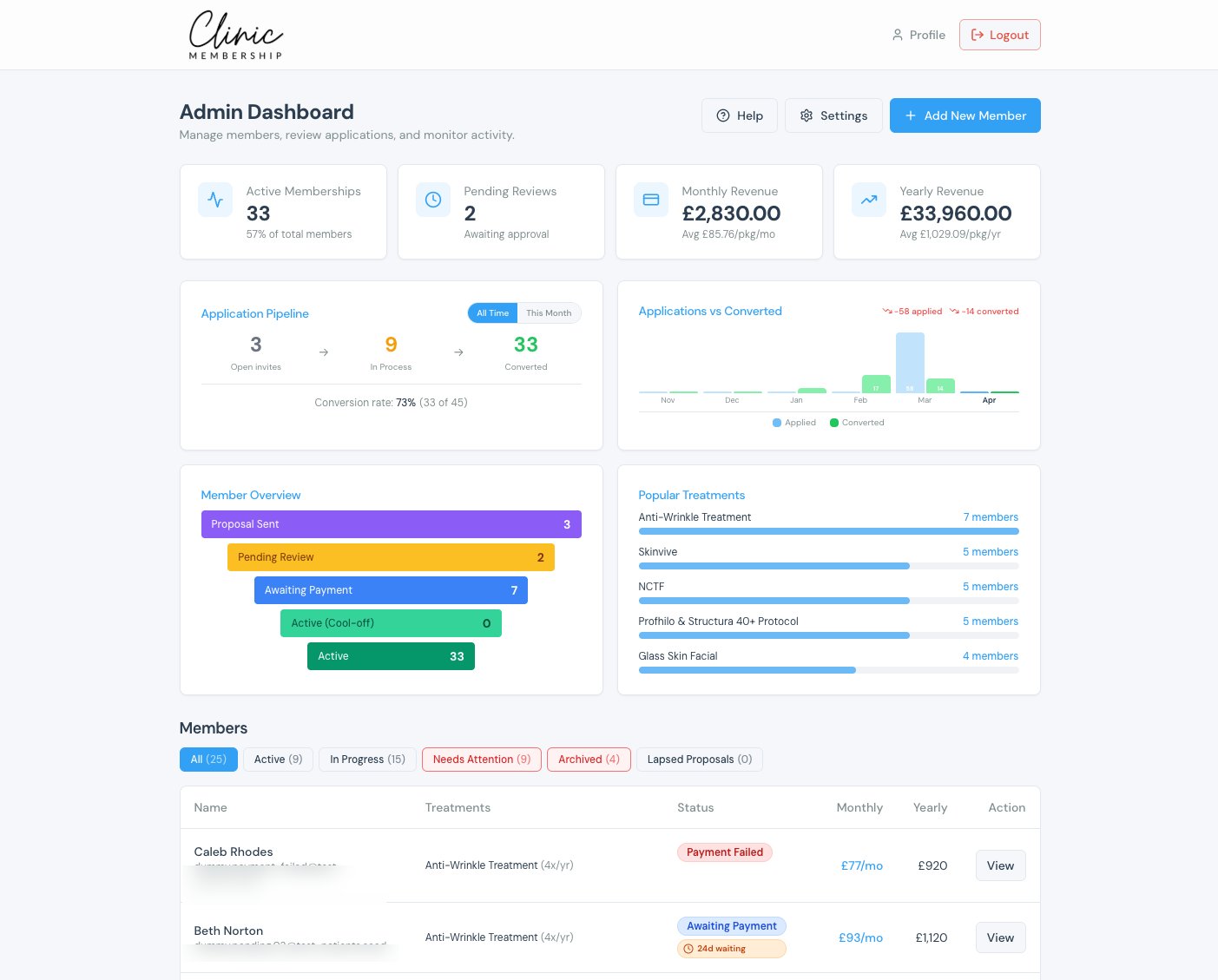
If billing is an afterthought (a payment box bolted onto a booking tool) none of that happens reliably. So we treated it as the spine of the product rather than a feature on a list. Stripe-backed subscriptions, point-of-sale checkout, invoices, card payments, failed-payment alerts with one-click recovery. The unglamorous plumbing that decides whether the money you earned actually lands.
Pay-later and memberships aren't enemies
I want to be fair to financing, because the honest position is that these two things are not in opposition. There is a real version of a clinic that uses both: pay-later to get a nervous first-timer through the door for their initial treatment, and a membership to turn that first visit into a year of structured, repeatable care. One is an acquisition tool. The other is a retention engine. The mistake is treating the acquisition tool as if it were a growth strategy.
What I kept noticing is that the loudest payment innovation in our corner of the market is almost entirely about the first transaction, financing it, splitting it, making it frictionless. Far less attention goes to the boring, compounding question of what happens on month two, month five, month nine. That is the gap we wanted to own, and it is the one I would encourage any clinic owner to think hardest about, whatever software they end up using.
The question I'd ask before adding a payment feature
If you are weighing up a new payment option for your clinic, the test I use is simple: does this make a single sale easier, or does it make the next twelve months more predictable? Both are valid. But only one of them changes the underlying economics of the clinic, and it is not the one being marketed at you most aggressively.
Pay-later is a fine answer to "how do I close this treatment today." Recurring billing is the answer to "how do I stop starting from zero every month." We built Clinic Membership for the second question, because in my experience that is the one that keeps clinic owners up at night.
If you want to see how that works in practice, bespoke plans, e-signed agreements, recurring billing and the reports that show you exactly where your recurring revenue is coming from. You can explore the full platform, see how we compare, read more on building recurring revenue, or check the plans on our pricing page.
: Ben, founder, Clinic Membership