

Most aesthetic treatments worth having aren't one-and-done. Skin boosters run as a course. Laser and skin rejuvenation need a series, then maintenance. Toxin has a natural three-to-four-month cadence. Yet a lot of UK clinics still bill all of it the same way they'd bill a single walk-in facial: one invoice, one card tap, see you when we see you.
That mismatch between how treatments actually work and how they get paid for is where revenue quietly leaks. If you've ever searched for how medspas handle membership and package billing for ongoing treatments, this is the plain-English version: what good billing looks like, and what to look for in the software that runs it.
Why ongoing treatments need their own billing logic
A course of treatment and a membership plan are not the same thing, and treating them as one is the first place clinics come unstuck.
A package is a fixed bundle bought up front, say, three skin-booster sessions paid in one go, drawn down over a few months. A membership is a recurring monthly plan that gives the patient ongoing value (a set of included treatments, a discount tier, priority booking) in exchange for a predictable monthly payment. Many clinics run both, and the strongest setups let a package roll naturally into a membership once the initial course finishes.
The reason this matters: subscribed patients visit 2.9 times a year on average, compared with the one-off pattern of ad-hoc bookings (ProspyrMed, 2026). More than 70% of aesthetic clinics now offer some form of subscription-based payment (Consulting Room / Anti Wrinkle Clinic, 2026), so the question for most owners isn't whether to do it, but how to bill it without creating a manual mess. Start with recurring billing versus BNPL for UK aesthetic clinics so you pick a subscription rail rather than a one-off finance product.
The four things membership and package billing has to get right
When you strip it back, billing for ongoing treatments comes down to four jobs. Most clinics nail one or two and improvise the rest in a spreadsheet.
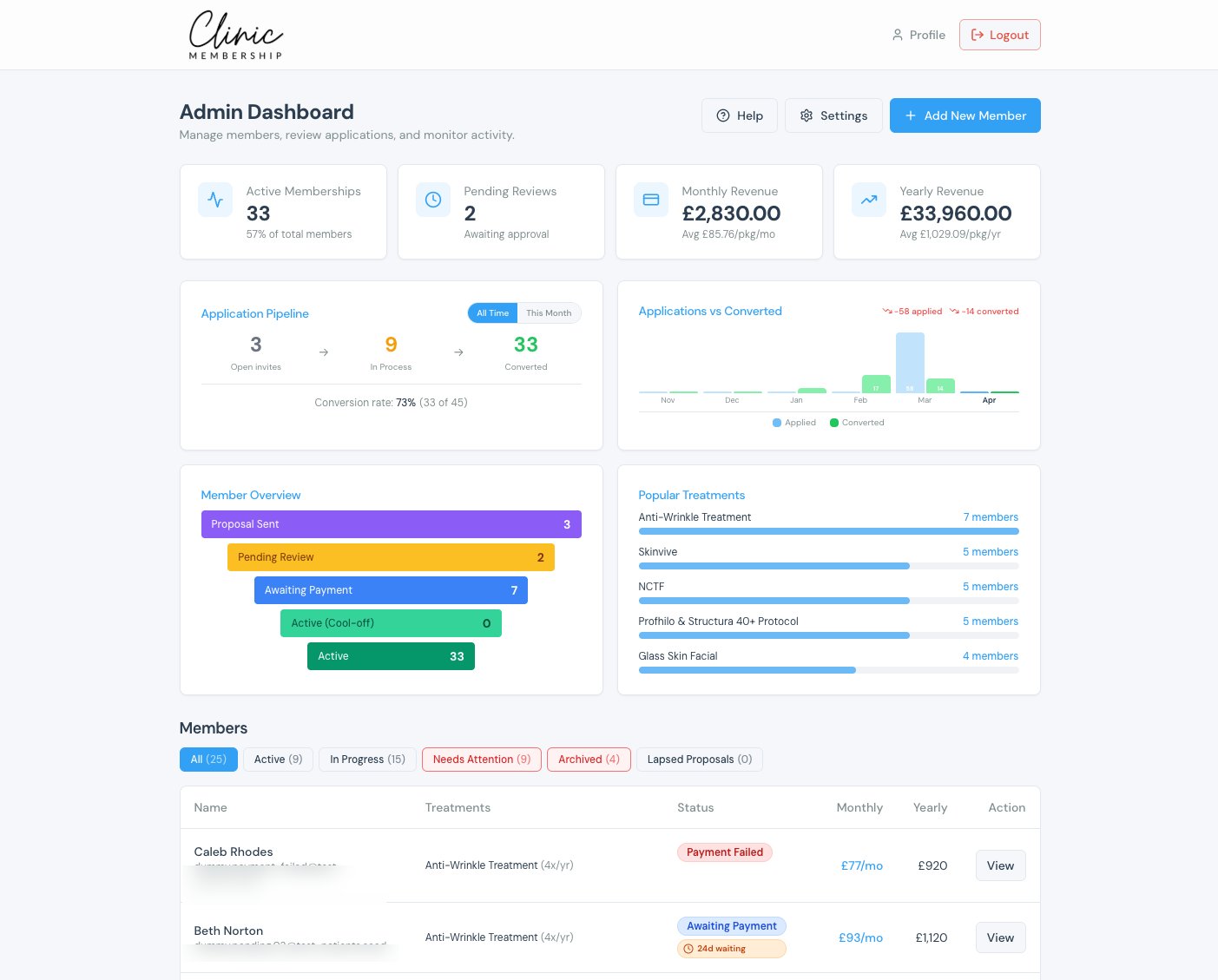
1. Recurring collection that doesn't need chasing. A monthly membership only works if the payment comes in by itself. That means stored payment details, automatic monthly collection, and (crucially) automated retries when a card expires or a payment fails. Failed payments are normal; chasing them by hand is where evenings disappear.
2. Tracking what's been used. If a patient pays £79 a month for a plan that includes two treatments, you need to know at a glance what they've redeemed and what's still owed to them. A member who pays for six months and books nothing isn't pure profit. It's a balance you owe them, and a retention risk hiding in plain sight.
3. Handling courses and maintenance separately. A skin-booster course of three sessions, then maintenance every few months, shouldn't look like three random invoices. It should be one package with a clear drawdown, and a clean prompt to convert into a maintenance plan at the end.
4. Clear terms the patient agreed to. Recurring billing in the UK needs consumer-friendly terms: what's included, how cancellation works, what happens to unused sessions. Getting this in writing protects the clinic and builds trust. (If you don't have one yet, a membership agreement template is the place to start.)
Where the all-in-one tools fall short
This is the part worth being honest about. Plenty of clinic platforms can take a payment. Far fewer were built around the membership as the core object.
In a lot of all-in-one systems, "membership" is really a loyalty or prepaid-credit feature bolted onto a booking diary, bank a bit of credit each month, spend it later. That's fine for a salon, but it isn't the same as a true clinical membership with included treatments, tiered plans, deferred-value tracking and proper recurring billing. The difference shows up the moment a card fails, a patient wants to pause a plan, or you try to see how much unredeemed value is sitting on your books.
That gap is exactly why purpose-built membership software exists, and why "membership" deserves to be a first-class part of your stack, not a checkbox. We go deeper on the trade-offs in why membership-first beats a four-app stack.
What "good" looks like in practice
A well-run setup for ongoing treatments tends to share the same shape:
- The patient signs up to a plan or buys a course online, with terms shown clearly before they confirm.
- Their card is stored securely; the monthly payment collects automatically, with retries handled in the background.
- Every included or pre-paid session is tracked, so both the clinic and the patient can see what's left.
- When a course ends, there's a simple nudge to roll it into a maintenance membership, turning a one-off project into year-round cadence.
- The clinic can see total recurring revenue and outstanding deferred value on one screen, not five.
Set up like this, the billing stops being admin and starts being a retention engine. And retention is the whole game: it costs five to twenty-five times more to win a new patient than to keep one you already have (Bain & Company), and roughly 35% of first-time patients never come back at all (American Med Spa Association, 2026). A plan that keeps people on a schedule is the most reliable lever you have against both numbers.
The bigger picture
None of this is niche any more. The UK aesthetics market is worth around £3.6 billion and growing 8–9% a year (UCL / industry reports, 2026), and patients increasingly treat skin and injectables like fitness: a standing part of self-care rather than a one-off. That behaviour shift is tailor-made for memberships: regular, planned, predictable. The clinics that win the next few years will be the ones whose billing matches the way their patients already want to be treated.
If you're weighing up how to handle membership and package billing for ongoing treatments, start by mapping your real treatment cadences, then choose software that bills the way those treatments actually run, not the way a generic booking tool assumes they do.
See how Clinic Membership is built specifically for this at clinicmembership.co.uk/pricing, plans start free. You can also compare the options in our best membership software for UK clinics guide.