

Running a membership programme is one of the smartest moves a UK aesthetics clinic can make. Memberships stabilise cash flow, boost patient lifetime value, and smooth out the seasonal revenue swings that hit so many clinics between January and March.
But how you manage that programme matters just as much as whether you have one.
Many clinic owners start with a spreadsheet. It makes sense at first. You already know Excel or Google Sheets, the cost is zero, and it feels quick to set up a simple tracker for your first handful of members. The problem is that spreadsheets have a hidden cost curve, and it gets steep fast.
In this post, we break down what spreadsheet-based membership management is really costing UK aesthetics clinics in 2026, and when it makes sense to switch to purpose-built clinic membership software.
The spreadsheet starting point
A typical clinic spreadsheet for membership tracking looks something like this: a list of members, their plan tier, start date, payment status, and perhaps a column for treatment credits remaining. Some clinics get more ambitious with conditional formatting, dropdown menus, and manual formulas to calculate renewal dates.
For one or two members, this is fine. But the moment your programme starts to grow (say, beyond 10 to 15 active members) the cracks start to show.
The five hidden costs of spreadsheet membership management
1. Admin time that doesn't scale
The first and most obvious cost is your time. Every new member means another row to update. Every monthly payment cycle means manually checking who has paid, who hasn't, and who needs a reminder. Every treatment visit means adjusting credit balances by hand.
UK clinic owners we speak to typically report spending between two and four hours per week on membership admin when they run things through spreadsheets. At even a modest £50 per hour for a clinic owner's time, that is £400 to £800 per month in time costs alone, often exceeding the monthly cost of dedicated membership software many times over.
2. Payment collection gaps
Spreadsheets cannot collect payments. They can only record them, assuming someone remembers to update the record. This creates two problems.
First, there is no automated recurring billing. Someone has to manually send invoices or payment links each month. If that task slips, revenue slips with it. Second, when payments fail (expired cards, insufficient funds), there is no automatic retry or dunning sequence. You either chase the member manually or absorb the loss.
Industry data shows that clinics using automated payment collection recover up to 15 percent more recurring revenue compared to those relying on manual processes. For a clinic with 50 members paying £79 per month, that gap represents nearly £7,000 per year in potentially lost revenue.
3. Errors and data integrity risks
Spreadsheets are fragile. A mistyped formula, an accidentally deleted row, or a copy-paste error can silently corrupt your data. You might not discover the problem until a member complains about being charged incorrectly or shows up for a treatment that your records say they have already used.
Research consistently shows that a significant percentage of spreadsheets contain errors, and the more complex the sheet, the higher the risk. For a membership programme that involves recurring payments, treatment credits, plan tiers, and renewal dates, the surface area for mistakes is substantial.
4. No member-facing experience
A spreadsheet lives on your computer. Your members cannot see it, interact with it, or use it to check their own balance, book a treatment, or update their payment details.
This means every member query: "How many treatments do I have left?" or "When does my membership renew?", turns into a back-and-forth message that consumes reception time. It also means you are missing the opportunity to deliver a branded, professional membership experience that reinforces the premium positioning most UK aesthetics clinics aim for.
In 2026, patients expect a self-service portal. They are accustomed to checking their gym membership, streaming subscriptions, and loyalty balances online. A spreadsheet cannot meet that expectation.
5. Compliance and audit exposure
With the UK government introducing new licensing requirements for aesthetic practitioners from July 2026, clinics face increasing pressure to demonstrate professional standards across all areas of operation. A spreadsheet offers no audit trail, no access controls, and no reliable record of who changed what and when.
Purpose-built membership software maintains a complete history of every member interaction, payment, plan change, and treatment redemption. If you ever need to demonstrate your membership programme's integrity (to a regulator, an accountant, or a disputes process) a proper system gives you that evidence instantly.
What clinic membership software actually costs
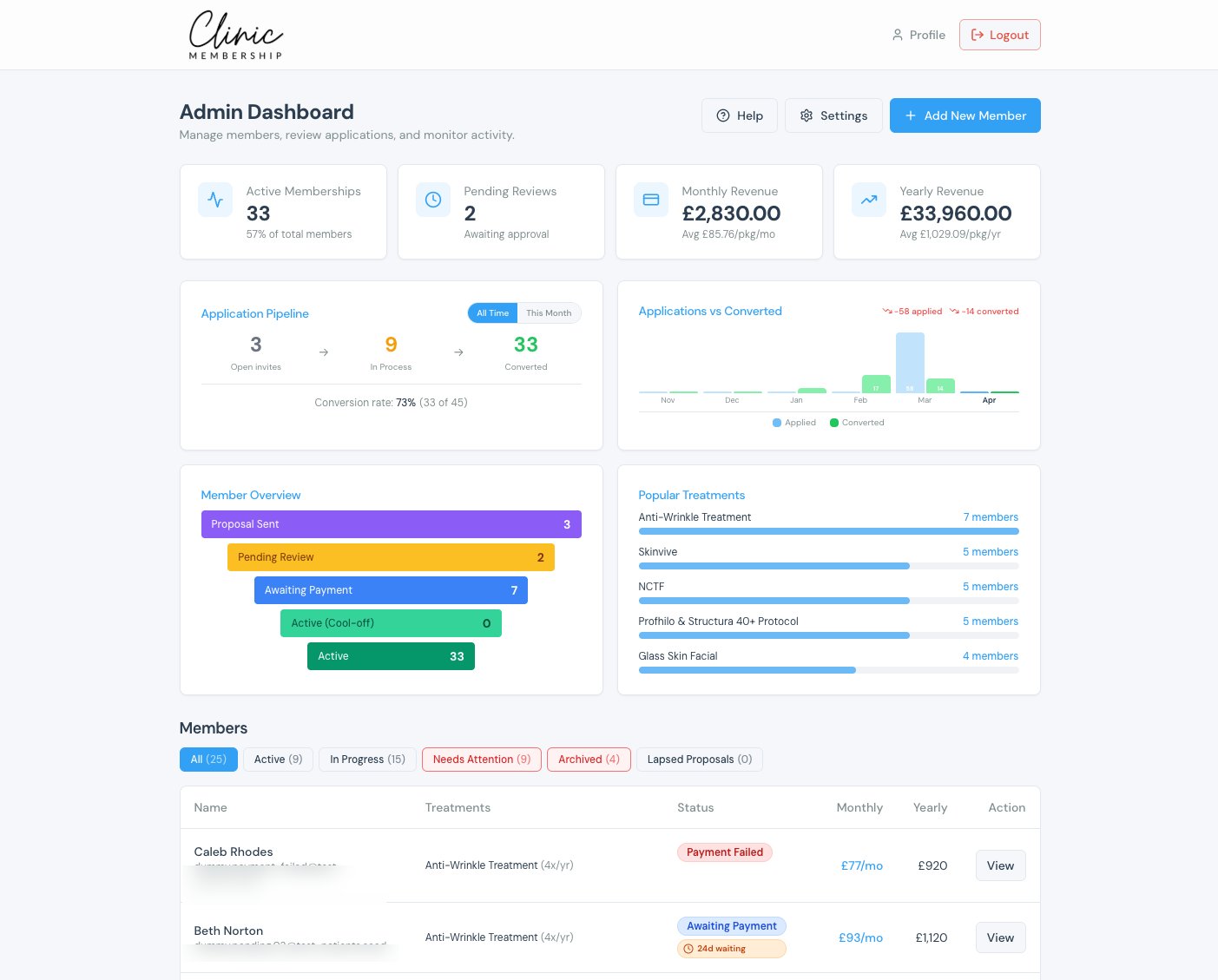
The irony of the spreadsheet approach is that dedicated clinic membership software is often far cheaper than the hidden costs it eliminates.
Many UK-focused platforms charge from about £75 to £200+ per month for membership tools, depending on features and scale, still typically less than one hour of a clinic owner's billed time.
When you factor in automated payment collection, reduced admin hours, fewer billing errors, and a professional member portal, the return on investment is typically clear within the first month of use.
When to make the switch
There is no shame in starting with a spreadsheet. Every system has a beginning. But there are clear signals that it is time to move to dedicated software:
- You have more than 10 active members and the admin is starting to feel like a second job.
- You have missed or delayed payments because the manual follow-up process broke down.
- You are spending more than two hours per week on membership admin.
- Your members are asking to check their balance or manage their plan online.
- You are preparing for the July 2026 licensing changes and want a clean, auditable system in place.
If any of these apply, the spreadsheet has likely already cost you more than a year of membership software.
The bottom line
Spreadsheets are free to use but expensive to run. For UK aesthetics clinics building membership programmes in 2026, the real question is not whether you can afford clinic membership software. It is whether you can afford not to have it.
The clinics that switch from manual tracking to purpose-built tools consistently report saving hours of admin time each week, collecting more recurring revenue, and delivering a better experience to their members.
If you are ready to move beyond the spreadsheet, Clinic Membership offers a free plan so you can start with your first 10 patients free forever and upgrade when you are ready: no setup fees, no per-member surcharges, and software built specifically for UK aesthetics clinics.