

I'll admit something. For the first stretch of running a clinic, the metric I checked most often was reviews. A five-star one would make my morning; a quiet week of none would make me uneasy. It felt like the pulse of the business.
It wasn't. Reviews tell you a patient liked their visit. They don't tell you whether your clinic is actually growing, holding steady, or quietly leaking revenue you won't notice until the quarter closes. Plenty of clinics with a wall of glowing reviews are losing more patients than they keep. The numbers that answer "are we growing?" are different, and most clinic owners never see them, because they're scattered across a booking app, a card terminal, a spreadsheet, and a memory.
So here's the short list I wish I'd watched from day one. Not a finance degree's worth of dashboards, five numbers, checked monthly, that tell you the truth.
1. Recurring revenue (your monthly baseline)
The single most useful number in an aesthetics clinic isn't last month's takings. It's the slice of revenue that arrives whether or not the diary is full: your recurring revenue, sometimes called MRR (monthly recurring revenue). It's what members pay you each month on a plan, before a single walk-in books.
Why it matters more than headline turnover: turnover bounces with the season. The UK aesthetics market is worth around £3.6 billion and growing 8–9% a year (UCL, 2026), but that growth hides a brutal rhythm at clinic level: a busy May and a dead August. Recurring revenue is the floor under that. When you can see your baseline climbing month on month, you know the business is compounding, not just having a good week.
If you can't put a single figure on your recurring revenue right now, that's the first gap to close.
2. Churn (the leak)
Churn is the percentage of members who cancel in a given month. It's the least glamorous number on this list and the one that quietly decides everything, because it works against your recurring revenue every single month.
The reason to obsess over it slightly: retention is where the profit hides. A 5% lift in retention can raise profits by anywhere from 25% to 95% (Bain & Company / HBR, 2026). That's not a rounding error. It's the difference between a clinic that grows and one that runs to stand still. You can't improve a number you don't measure, and most clinics genuinely do not know their monthly churn.
Watch the trend, not the single reading. One cancellation in a small clinic looks alarming and means little. A churn rate creeping up three months in a row is a signal worth acting on.
3. Rebooking rate (the habit)
Rebooking rate is the share of patients who leave with their next appointment already in the diary. It's the clearest early sign of whether you're building a habit or running a series of one-offs.
The backdrop is stark: roughly 65% of first-time patients become repeat clients, which means around 35% never come back at all (American Med Spa Association, 2026). Every patient who walks out without a next date booked is a coin flip you didn't need to take. A healthy rebooking rate turns that flip into a plan. (I've written separately about what a good rebooking rate actually looks like for a UK clinic, worth a read if you want a benchmark to aim at.)
4. Membership conversion (the engine)
Conversion is the percentage of eligible patients who join a membership or package rather than paying treatment by treatment. It's the lever that feeds numbers one and two: every conversion adds to recurring revenue and, done well, lowers churn because members have a reason to keep coming.
You don't need a fancy target here. You need to know the number, watch it move when you change something (a new plan, a different consultation script) and learn what works. A conversion rate you can see is a conversion rate you can improve.
5. The numbers most owners never measure
The four above are the core. But there's a category of operating data that almost no clinic tracks and that tells you where revenue is hiding, things like how much membership value patients have paid for but not yet used, which plans actually retain members versus which ones churn, and how much of your income is predictable versus reactive. I went deep on this in the three clinic numbers most UK owners don't measure, because they're the ones that separate a clinic that's run on instinct from one that's run on evidence.
Why this is a software problem, not a spreadsheet problem
Here's the catch. Every number on this list is calculable by hand. None of them are calculable easily by hand, not when the booking lives in one tool, payments in another, and membership status in a third. By the time you've stitched a spreadsheet together, the month's gone and the picture's stale.
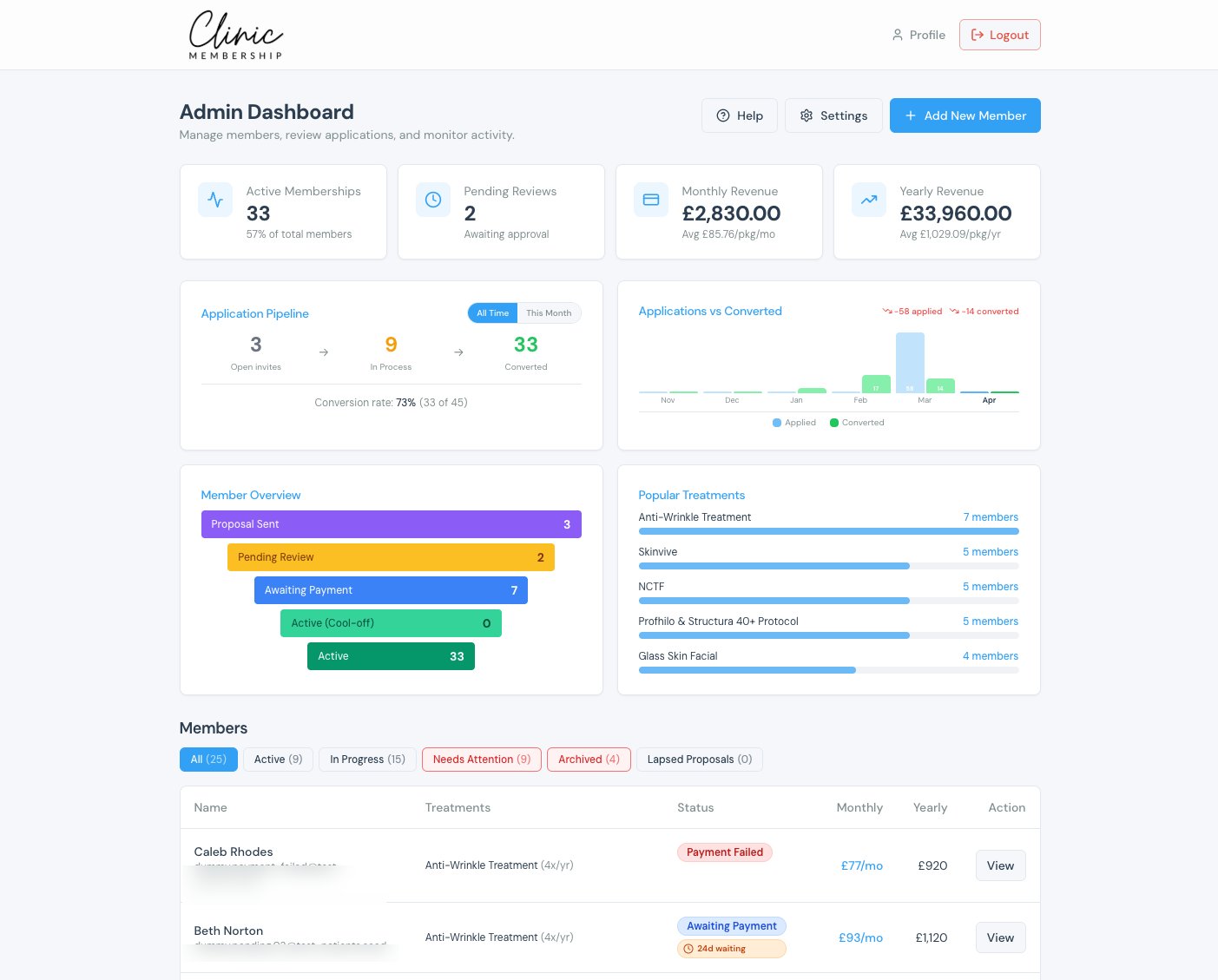
This is the real argument for treating your clinic's software as one connected system rather than a patchwork. When patients, the calendar, payments and memberships sit in the same place, the numbers above stop being a monthly archaeology project and become a dashboard you glance at over coffee. Real-time recurring revenue, active members, churn, conversion, visible, not reconstructed. That's the difference between knowing your clinic is growing and hoping it is.
It's also why I'd gently push back on judging clinic software by its review-collection features. Reviews are social proof, and they matter. But proof that patients liked you is not the same as proof that you're growing. The numbers are.
Start with what you can see today
You don't have to track all five from day one. Start with recurring revenue and churn: the floor and the leak. Get those two visible and updating on their own, and you'll already be ahead of most clinics, who are flying on turnover and a feeling.
Clinic Membership was built around exactly this: bespoke membership plans on one side, and real-time reporting (recurring revenue, active members, churn, conversion) on the other, so the numbers that tell you the truth are there without the spreadsheet. If you want to see how a connected system handles the reporting side, take a look at how Clinic Membership works or compare it against the other UK options.
Reviews will tell you your patients are happy. Your numbers will tell you whether your clinic is growing. Watch both, but trust the numbers. See plans and pricing.