

You are in a demo, and the feature list already says memberships. Packages too. Everyone's list says that now. The useful question is which aesthetic clinic software has built-in memberships and package features, meaning the plan, the diary, the till and the reports are one system, not a bolt-on that takes a card and leaves you to do the rest in a spreadsheet.
Take this list into the demo. Ask the person to show you each item on a live record, not on a slide. Ours is answered last, and briefly, so you can still use the list on software that is not ours.
Built-in is a test, not a word on a page
Built-in means a plan you create is something a patient can be enrolled in, billed for, booked under, and counted. The same person. The same record. If the membership lives in one tab and the diary lives in another, you are the integration layer after clinic.
Bolt-on usually started as a points scheme, a gift card, or a generic till add-on. It can take a recurring payment. It does not know what a clinical membership is. You will feel that on the first failed card, the first unused session, and the first month you cannot name your MRR without opening Excel.
This page is not a ranking. Rankings go stale the week they ship, and they tend to name vendors. You do not need names. You need questions that survive a sales call.
Which aesthetic clinic software has built-in memberships and package features?
Use these six checks. If the answer to any of them is "we export that", you are looking at a bolt-on.
1. Can you build a named package, not only a flat monthly fee?
A clinic membership is not one number leaving a card every month. You might run a monthly skin plan, a quarterly maintenance package, an annual plan, or a bundle of included treatments with its own name, duration and perks.
Ask them to build a package in front of you. Give it a name. Set a duration. Attach the treatments that belong on it. If the only control is "amount" and "repeat", that is a subscription pipe, not a membership.
The decisions underneath a plan (what it protects, who can join, what unused sessions do) live in our clinic membership plan template. This post will not restate that list. This post is about whether the software can hold the list you already made.
2. Does the diary know the plan?
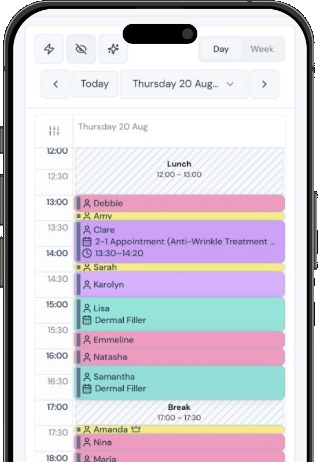
Enrol a test patient. Book the included treatment. Watch whether the appointment is aware of the membership, or whether you are expected to remember.
If the calendar is a separate product, you will double-book included sessions, or you will give away sessions the plan does not cover, and you will find out at the till. Built-in means the diary and the plan share a record. The receptionist should not be the person who knows which treatments are "on the membership this month".
3. Is the paperwork a digital membership agreement?
Memberships are commercial contracts. UK consumer law treats them that way. A bolt-on rarely covers this. You end up managing terms in a separate document tool and chasing signatures by email.
Built-in memberships put a digital membership agreement in the enrolment flow. The patient e-signs. A 14-day cooling-off period sits in as standard, and the clinic can extend it. That is a floor, not a ceiling.
This is not a clinical consent form. Consent lives with clinical notes. Mixing the two words is how clinics file the wrong document against the wrong visit. Ask to see the membership agreement, then ask separately where consent is stored. If the answer is one folder for both, keep asking.
4. Are recurring card payments actually recovered when they fail?
Taking the first payment is easy. Keeping a year of payments running is the job. You want plans that renew on their own, recurring card payments through a processor that is built for cards, and a path to recover a failed payment without a phone hunt.
Ask: show me a member whose card failed last week. Where does that sit, and what does one click do. If the answer is a CSV and a receptionist with a highlighter, the memberships are painted on.
If what you actually need is a card on file that retries, treat anything else as a different product. Recurring cards are the mechanism this product uses.
5. Can you see credit and deferred value?
Members pay and then skip a month. Courses are bought and redeemed later. That leftover is money you are holding for work not yet done. If the software cannot show the balance, you cannot either.
Ask: show me a member who has paid for three months and attended once. Where do I see what they are owed. The pause before the answer is the answer.
6. Can you report on it without building a spreadsheet?
MRR, active members, churn, how many consults become plans. If those numbers require an export, you do not have membership reporting. You have a transaction list.
A clinic that cannot name those numbers is running the programme on memory. Memory is how plans quietly die in month four.
What this is not
It is not a points scheme with a nicer name. We already drew that line on a live page, Loyalty vs Memberships: What UK Clinic Software Really Does. That page owns the other branch of this cluster. This page will not reopen it, and it will not borrow any of its figures.
It is also not a claim that nobody else has memberships. Plenty of software will take a recurring payment. The gap is whether the membership is the spine of the product or a module you switch on after the diary is already full of workarounds.
Do not take a vendor's "memberships" tile as the end of the conversation. Take this list.
How Clinic Membership answers the list
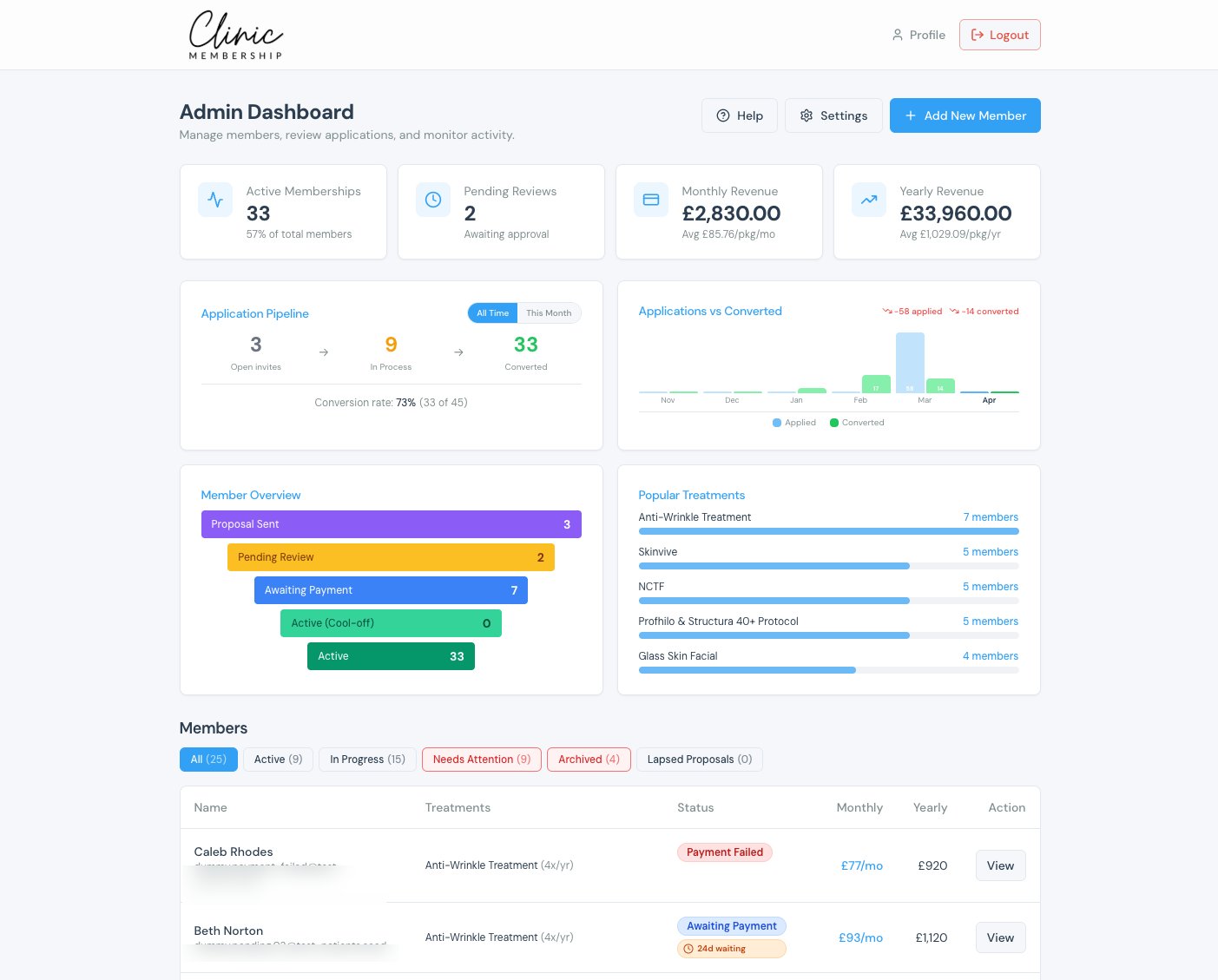
Clinic Membership is clinic management software for UK aesthetics clinics. Patients, calendar, memberships, payments and reports sit in one place.
On the six checks:
- You build named packages, with duration and included treatments, rather than a single repeating charge.
- The diary and the plan share the patient record, so a booking can honour what the membership includes.
- Enrolment carries a digital membership agreement, e-signature, and a 14-day cooling-off period as standard, which you can extend. That document is commercial. It is not consent.
- Recurring card payments run on the same record. Failed payments are a recovery job, not a surprise three months later.
- Credit and unused value are visible on the member, not buried in a separate wallet tool.
- Reports sit on the same data as the diary. You are not reconciling two systems on Sunday night.
Free covers up to 10 patient records, with no card required to start. Auto-onboarding runs on that plan the same as on a paid plan, paired with live in under 60 minutes. Amounts after that live on pricing. This post will not quote them.
If a demo cannot walk the six checks on a real record, you already know what you are buying. Built-in is the diary knowing the plan. Everything else is a caption on a feature page.