
Search "best aesthetic clinic software UK" and you'll find a stack of Top 10 lists. They're useful for a first scan, but they all tend to score the same things (booking, payments, a tidy calendar) and they all tend to bury the one question that decides whether your clinic grows or just stays busy. So rather than hand you another ranking, here's the buyer's checklist the lists skip: the criteria that actually separate a tool that runs your diary from a system that builds your business.
The honest starting point is that there is no single "best" platform. The best aesthetic clinic software is the one that fits how your clinic earns. A solo nurse prescriber, a three-room skin clinic and a multi-site group all want different things. What follows is a way to judge any shortlist against the work you actually do every day.
1. One connected system, not a patchwork of apps
The biggest hidden cost in a clinic isn't the software you pay for. It's the software that doesn't talk to each other. A booking tool here, a payments tool there, a spreadsheet for memberships, a separate reminder app. Every gap between them is somewhere a patient slips through.
The numbers back this up. Clinics running disconnected tools see around 45% more no-shows and billing errors than clinics on one connected system (ProspyrMed, 2026). That's the patchwork tax: time lost to copying details between apps, and revenue lost to the appointments and payments that fall down the cracks.
So the first criterion isn't a feature. It's a question. Does this platform replace the stack, or add to it? The strongest aesthetic clinic software for a UK clinic works as a full management system: patients, calendar, payments and reports in one place. (For the avoidance of doubt, that's clinic management software, not full medical-records or EMR software: a distinction worth confirming with any vendor.)
2. A patient record and calendar that stay in sync
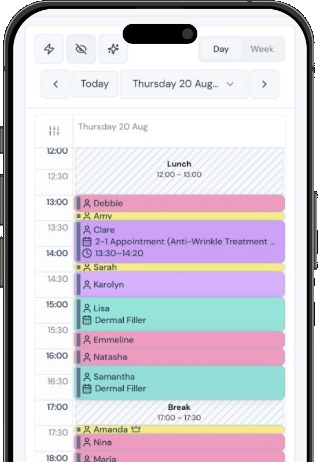
Look for one patient hub, proper patient management software, where contact details, history, invoices and membership status live together, not scattered across tabs. The clinic calendar, online booking and reminders should write straight back to that record, so the diary and the patient file are never out of step.
This is the unglamorous core, and it's where you'll spend most of your day. If the demo makes you click through three screens to see a patient's next appointment and last payment, imagine doing that two hundred times a week. For more on what to expect here, our guide to aesthetic clinic booking software walks through the booking-and-records basics.
3. Payments, POS and invoicing built in
Card payments are table stakes. What separates serious clinic software is whether it handles the whole money flow: point-of-sale checkout, invoicing, and recurring billing with card payments. Just as important is what happens when a payment fails: the best systems flag it and offer one-click recovery, rather than leaving you to notice a missing payment three weeks later.
Ask any shortlisted platform a simple test question: when a regular patient's card expires, what does the system do automatically? The answer tells you how much manual chasing you'll inherit.
4. Memberships and recurring revenue, built-in, not bolt-on
Here's the criterion the Top 10 lists almost always under-score, and it's the one that compounds. Plenty of platforms can technically take a recurring payment. Far fewer treat memberships as a real engine.
It matters because retention is the whole game. Around 65% of aesthetic patients are repeat clients (American Med Spa Association, 2026), so the platform that genuinely nurtures those relationships (rather than just charging a card each month) is the one that builds a base instead of churning through it.
The difference between built-in and bolt-on is concrete, and it's worth turning into its own mini-checklist. A purpose-built membership engine lets you:
- build bespoke treatment packages with your own names, durations and perks, with the monthly price calculated live;
- issue digital agreements with e-signature, versioned terms and a cooling-off period, so the paperwork is compliant without a filing cabinet;
- track membership credit and gift vouchers, so deferred value is visible rather than a liability you've lost sight of;
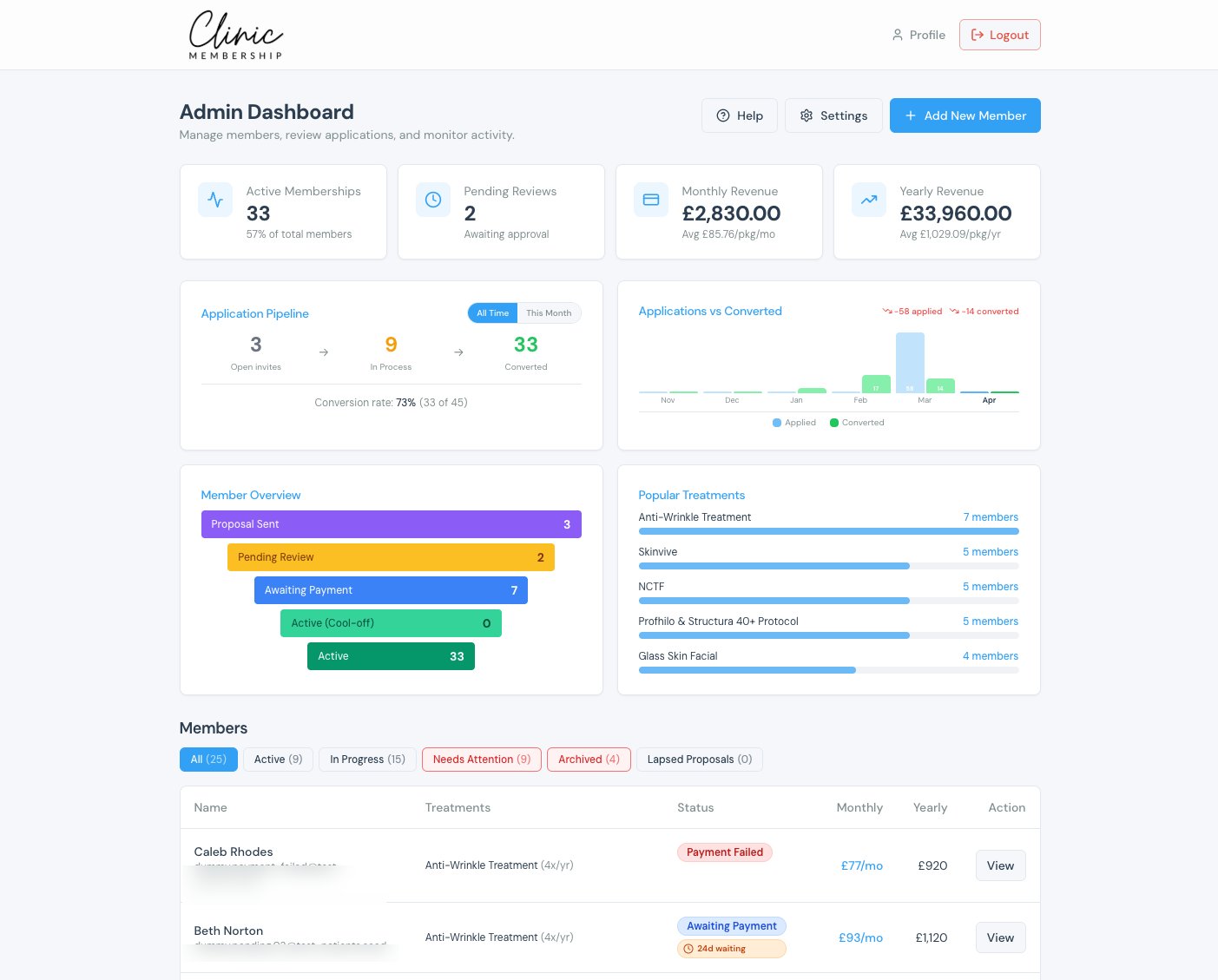
- report on the numbers that actually describe a membership business, recurring revenue, active members, churn and conversion.
A bolt-on, by contrast, usually means a recurring charge stapled to a booking calendar, with the agreements, credit tracking and reporting left to you and a spreadsheet. Both can bill a patient every month. Only one tells you whether your membership base is growing or quietly leaking. This is the question to lead with, not the one to leave for page two, and it's exactly the lens we apply in our breakdown of the best membership software for UK clinics.
5. Smart features that take admin off your plate
The newest dividing line in clinic software is how much of the busywork it does for you. When you're comparing platforms, ask what happens without anyone lifting a finger: does a freed-up cancellation slot get offered to the right waiting patient automatically? Does the system nudge a patient toward rebooking when they're due? Can you set minimum gaps between certain treatments so they can't be booked too close together?
Features like these (a smart wait list, automatic rebooking suggestions, treatment-spacing rules) are where "less admin for the owner" stops being a slogan. They vary a lot between platforms and aren't always spelled out on a pricing page, so it's worth asking each vendor exactly how their automation works rather than assuming.
6. Reports you'll actually use
If you can't see it, you can't grow it. Look for real-time dashboards covering recurring revenue, active members, churn, conversion and plan breakdown, with a plain CSV export when you want to dig in yourself. Reviews and a full diary feel like success; the dashboard tells you whether it is success.
7. White-label, setup speed and UK fit
Finally, the practical fit. Can you put your logo, colours and a clinic subdomain on the patient-facing side? How long until you're genuinely live: an afternoon, or a month of onboarding calls? And is the platform built for the way UK clinics actually operate, from GDPR-aware data handling to UK payment rails? A system that sets itself up (pulling your branding and settings so you only have to confirm them) beats one that needs a fortnight of configuration before it earns its keep.
Why getting this right matters now
The UK aesthetics market is worth roughly £3.6 billion and growing at around 8–9% a year (UCL, 2026). Demand is rising, but so is competition for the same patients, and the clinics that pull ahead aren't necessarily the busiest. They're the ones whose software turns one-off visits into predictable, recurring relationships. Your choice of platform is one of the few decisions that quietly shapes revenue for years.
How to run the decision
Don't buy from a feature list. Shortlist two or three platforms, then run each against the seven criteria above using your own clinic's real workflow: book a mock patient, take a payment, set up a membership, and see how the system behaves when something goes wrong. Pay closest attention to the membership question. It's the one that compounds, and the one the rankings rush past.
When you're ready to compare, our clinic management software for UK aesthetics clinics page lays out what one connected system looks like (memberships and recurring revenue included as standard, not as an add-on) and our pricing starts free.