
Ask most clinic owners where their patient information lives, and the honest answer is: everywhere. Contact details in one app, the diary in another, consent forms in a folder, payments in a card reader, treatment notes on paper. Each tool does its one job, but none of them talk to each other, and the patient sitting in your chair has no idea their record is scattered across five places.
That patchwork has a cost. Clinics running on disconnected tools see around 45% more no-shows and billing errors than clinics on one connected system (ProspyrMed, 2026). Every gap between apps is a place where a reminder doesn't send, a payment slips, or a follow-up never gets booked.
Good patient management software closes those gaps. Here's what it should actually do for a UK aesthetic clinic in 2026, and what to look for before you commit.
One patient hub, not five
The whole point of patient management software is a single place where a patient's full picture lives together: their contact details, their booking history, their invoices, their membership status, and their treatment history, all on one record.
When those things sit together, the everyday admin gets quietly easier. You can see when someone last came in, what they had done, whether their last payment cleared, and when they're due back, without flicking between tabs or asking a colleague to check another system. That's the difference between software that stores your data and software that actually manages your patients.
One thing worth being clear about: a patient hub is not the same as full medical-records or EMR software. Clinic Membership is a clinic management suite (patients, calendar, payments and reports in one place) rather than a clinical EMR. For most independent UK aesthetics clinics, that's exactly the level you need: organised, connected, and quick to run, without the weight and cost of a hospital-grade records system.
Booking and reminders that stay in sync
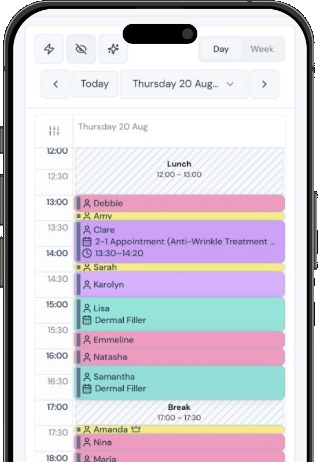
A calendar is only useful if it's connected to everything else. The booking should update the patient record automatically, reminders should go out without anyone remembering to send them, and the diary should reflect reality the moment something changes.
This is where smarter scheduling earns its place. The strongest patient management tools are starting to help with the bookings you'd otherwise chase by hand, quietly flagging when an earlier slot opens up for someone who wanted one, nudging patients toward sensible gaps between treatments, and prompting a rebooking when someone's due. The aim is simple: less time spent on the phone managing the diary, more time with patients. (These smarter booking features vary by platform, so it's worth asking exactly how each one works before you decide.)
For a clinic owner wearing every hat, that kind of automation isn't a luxury. It's the difference between a diary that runs itself and one that needs babysitting.
A portal patients can actually use
Patients increasingly expect to manage their own appointments the way they manage everything else, online, on their phone, whenever suits them. A self-service portal lets them see past and upcoming appointments, check when they last came in, and rebook without having to call during clinic hours.
Done well, the portal does some of your retention work for you. It can remind a patient of their last visit and gently suggest when the next one should be, turning a one-off treatment into an ongoing relationship. Every nudge that lands while you're in a treatment room is a booking you didn't have to chase.
Payments and reports in the same system
If your patient records and your payments live in different places, you're reconciling two sets of numbers and hoping they match. They often don't, and chasing the difference is exactly the kind of admin that disconnected tech creates.
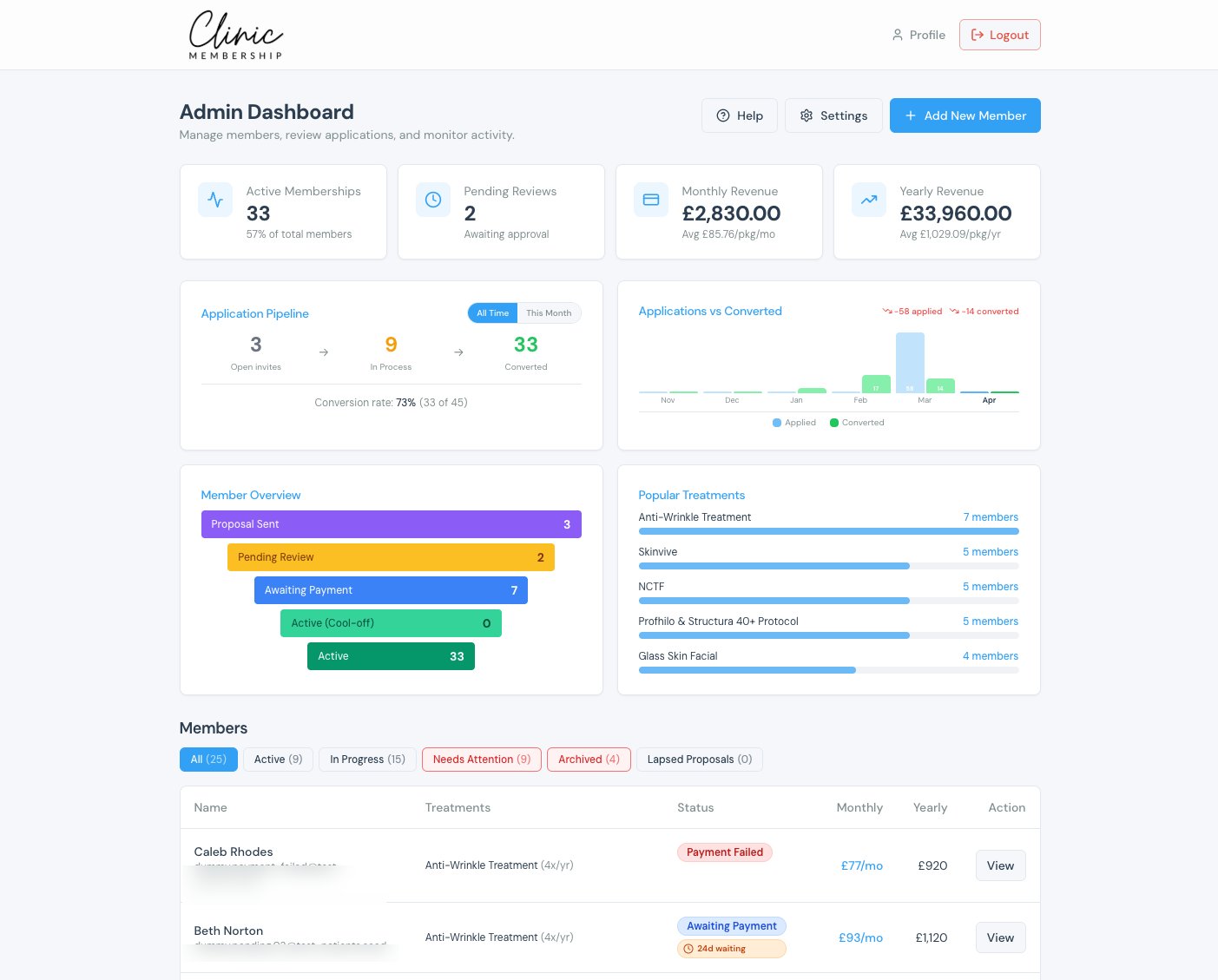
Patient management software that handles payments inside the same system gives you a cleaner picture: who's paid, who's overdue, and what each patient is actually worth to the clinic over time. Pair that with real-time reporting (active patients, repeat rates, revenue trends) and you stop guessing about the health of your business and start seeing it.
That visibility matters more than ever. The UK aesthetics market is worth around £3.6 billion and growing at roughly 8–9% a year (UCL, 2026). There's real demand out there, but the clinics that capture it are the ones that can see their numbers clearly enough to make confident decisions.
Where memberships change the maths
Here's the part most patient management tools miss. Managing patients well is one thing, but the biggest shift in clinic economics this year is the move from one-off treatments to ongoing, recurring relationships.
When your patient records, booking, and payments already sit together, memberships stop being a separate project and become a natural extension of the system you already run. You can build bespoke treatment packages, take recurring payments automatically, track what each member has used, and see your recurring revenue alongside everything else.
This is where Clinic Membership leads. It does the everyday patient management an aesthetics clinic needs, and it makes memberships and recurring revenue the standout core, rather than a bolt-on you have to wire up later. For a closer look at how that fits together, see our guide to clinic management software for UK aesthetics clinics and our overview of clinic membership software.
What to ask before you choose
Before you commit to any patient management software, a few questions cut through the marketing:
- Does everything (records, calendar, payments, reports) genuinely live in one system, or is it several tools stitched together?
- Will it help reduce admin, or just store information you still have to act on manually?
- Can patients book and manage appointments themselves?
- Does it support recurring revenue and memberships natively, or only as an add-on?
- How quickly can you actually be up and running?
If you're weighing up the options, our comparison of membership software for UK clinics walks through what to look for and how the categories differ.
The clinics that win in 2026 won't be the ones with the most software. They'll be the ones whose software finally works as one system, and whose patient relationships keep paying off, month after month.