

If you are looking for a clinic membership plan template, here is the honest answer. A template is not a form you fill in. It is a list of decisions you make once and then live with for a year, and the blank document cannot make any of them for you.
That is why most of the templates you can download feel oddly unhelpful. Search the phrase and the strongest results are built for dental practices, where the plan is usually a check-up and hygiene schedule bought on a fixed annual contract. Most of the rest were written for the American market, where the billing, the consumer protection rules and the treatment mix are all different. Neither shape survives contact with a UK aesthetics clinic selling anti-wrinkle treatments, skin boosters and peels on a cycle that varies by patient.
So this post is the list itself. Every decision a UK clinic has to make when it builds a membership plan, in the order you actually have to make them, with a note on what each one does to your diary and your cash flow. Where there is no right answer, this post says so rather than inventing a benchmark.
Why the structure matters more than the price
There is a reason to get this right that has nothing to do with admin.
Research from UCL, published in the Aesthetic Surgery Journal Open Forum on 11 February 2026, looked at what UK injectable practitioners charge. Compared with non-medical aestheticians, nurses charge only 2 to 4 per cent more per treatment. Dentists charge 28 to 33 per cent more and doctors 32 to 38 per cent more.
For a nurse-led clinic, that is close to no premium at all. Whatever pricing power qualification used to buy has largely been competed away at the level of the individual appointment. Which leaves two levers you still control: what a patient is signed up to, and how long they stay. Both of those are decided by the structure of your plan, not by the number on the price list.
That is the case for spending an afternoon on the decisions below rather than an afternoon on the price.
The nine decisions a clinic membership plan template actually asks you to make
1. Decide what the plan is protecting
Before treatments, before price, answer this: what is this plan for?
There are only a few honest answers. You want predictable income in your quiet months. You want to stop good patients drifting after their third visit. You want to fill weekday mornings. You want a reason for someone to commit to a course of treatment that only works as a course.
Write your answer down in one sentence. Every later decision gets checked against it. A plan built to fill quiet weekday mornings looks nothing like a plan built to protect a skin booster course, and clinics get into trouble by trying to build one plan that does both.
2. Decide which treatments go in, and how often
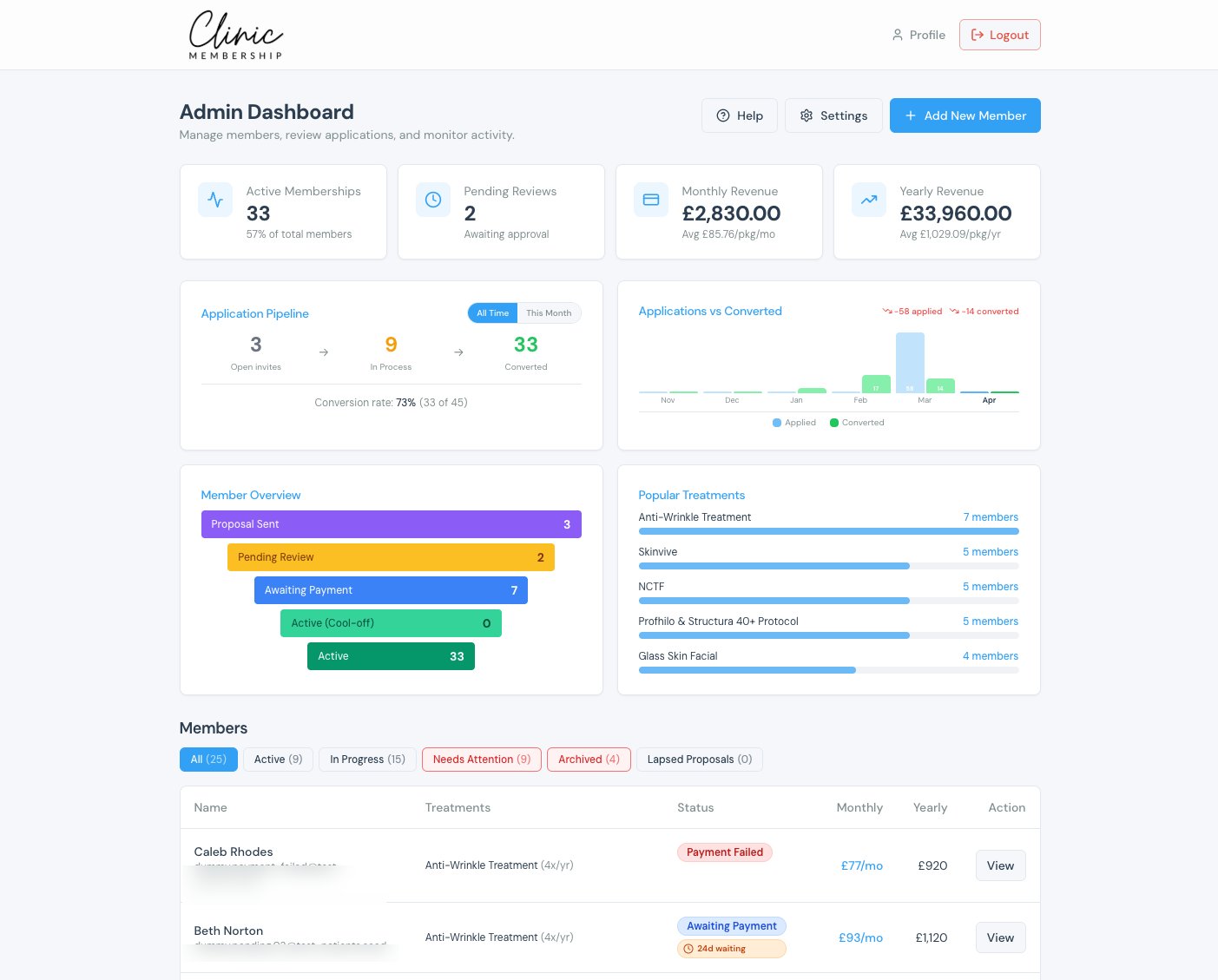
Now pick the treatments. In Clinic Membership this is set per treatment: you switch membership on for a service and configure either sessions per year or a loading protocol on that row, so the diary and the checkout stay in step with what the patient has bought.
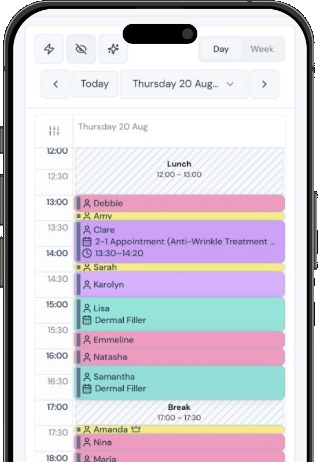
Two questions decide it. Which of your treatments genuinely benefit from a regular cycle, and which of them can you deliver at that cycle without your diary buckling in month four? A plan that promises more capacity than you have is not a revenue problem, it is a rota problem that arrives ten weeks late.
Be specific about frequency. "Regular anti-wrinkle treatment" is not a plan. Four sessions a year is a plan.
3. Decide whether you are selling tiers or building bespoke packages
The old advice was three neat tiers, usually named something like basic, plus and premium. We do not recommend that any more, and we have written up why in bespoke treatment packages versus tiers.
The short version: aesthetics patients do not arrive in three shapes. Fixed tiers force you either to publish a tier nobody wants or to sell someone a slot that fits them badly, and both cost you the patient eventually. A builder that lets a patient assemble the treatments they actually have, at the frequency they actually need, converts better and cancels less.
If you have already published tiers, this is the decision most worth revisiting.
4. Decide how patients join
This one is genuinely strategic and almost nobody writes about it.
You can make a plan Promoted, meaning patients can find it and start it themselves from the portal. Or you can make it Invite only, meaning you invite each member individually.
Promoted scales and works well when the plan is simple and the price is public. Invite only keeps the plan as something offered in the room, at the end of a consultation, by the person the patient trusts. Conversion in that conversation is usually far higher, but it only happens as often as you remember to have it.
Most clinics should start Invite only, learn what patients ask, then promote the plan once the answers are boring.
5. Decide your contract defaults
These are the settings that turn a plan into an agreement. In Clinic Membership they sit in one place and flow through to the terms and to the checkout screen, which matters because a term the patient never saw is a term you cannot rely on.
You are deciding four things: the cooling-off period you set, the contract length, the payment day and the cancellation fee.
On contract length, an honest note. You will see confident claims online about what most clinics do here. We have looked for the study behind them and there is not one, so we are not going to repeat a number we cannot attribute. Decide it from your own treatments instead. If the clinical result needs six months to show up, a three-month commitment sets the patient up to leave disappointed. If your quiet season is January and February, a contract that renews in November is doing useful work.
The payment day is worth a moment too. Aligning collections shortly after payday reduces failed payments, and a failed payment is the most common way a member quietly stops being one.
6. Decide your perks
Perks are reward tiers you add on the same settings page, for example a retail discount label or free treatments when a patient chooses a larger package in the builder.
Keep them cheap to deliver and easy to explain. Priority booking costs you nothing and is worth a great deal to someone who works full time. A retail discount is easy to run and easy for a patient to describe to a friend, which is the actual point of a perk.
7. Decide the price, and do not start here
Pricing deserves more than a paragraph, because doing it properly is arithmetic and not a rule of thumb. The method, briefly: work backwards from what the treatment costs you to deliver, including your time and your room, then work forwards from what the plan is supposed to protect, which you wrote down in decision one. The gap between those two numbers is where your price lives.
What you will not find in this post is a standard discount to aim for. There is a figure that circulates as though it were a rule, and nobody can tell you who counted. Your margins are not the same as the clinic down the road's, so a shared benchmark would be a coincidence rather than an answer.
If the maths is the part you want, how a membership compares with a prepaid credit plan covers the model choice underneath it, and the case for and against a first month free covers the discounting objection most patients raise.
8. Decide what happens to sessions a patient does not use
Every membership generates them. Someone books four sessions a year and takes two.
You have three options and they are all defensible: sessions roll over, sessions expire, or unused value converts to credit against something else. What is not defensible is having no answer, because the question always gets asked at the worst moment, which is when someone is cancelling.
Write the answer into the plan before you sell it.
9. Decide how you will know it is working
Pick two numbers you will look at monthly and ignore everything else for the first six months. Active members and monthly recurring revenue is a good pair. Cancellations in month three is the number that tells you whether decision five was right.
What to include in a clinic membership plan: the short version
If you want the clinic membership plan template as a checklist, this is it.
- What the plan protects, in one sentence
- Treatments included, and sessions per year or loading protocol for each
- Bespoke builder or fixed tiers, and why
- Promoted or Invite only
- Cooling-off period, contract length, payment day, cancellation fee
- Perks, and what each costs you to deliver
- Price, worked backwards from delivery cost
- What happens to unused sessions
- The two numbers you will review each month
Nine lines. That is the whole template, and every line is a decision rather than a blank.
Do you need software to run a clinic membership plan?
You can write the plan anywhere. Running it is the part that gets heavy: agreements, signatures, collections, renewals, failed payments and knowing who is currently a member.
In Clinic Membership, adding a member sends them a link to review, sign and pay, so the agreement and the first payment happen in one flow. The contract defaults you set earlier appear in the terms and at checkout. If you want the practical walkthrough, the help centre guide to setting up membership plans has the actual screens, our guide to standing a programme up covers the week around it, and the membership agreement guide covers the legal document itself. Plans and what each includes are on pricing and features.
But make the nine decisions first. They are yours either way.
Sources
- UCL / Aesthetic Surgery Journal Open Forum, 11 February 2026, DOI 10.1093/asjof/ojag006. UK national cohort of injectable aesthetic practitioners. Nurses charge 2 to 4 per cent more per treatment than non-medical aestheticians; dentists 28 to 33 per cent more; doctors 32 to 38 per cent more.