
There's a line item that turns up again and again when a UK aesthetic clinic prices up its software: the integration fee. Pay a bit more to connect the booking tool to the payments tool. Pay again to sync the records into the marketing platform. Add a connector so the calendar talks to the till.
It's easy to read that as a feature, look how well everything plugs together. It's worth reading it the other way. If you have to pay to make two parts of your clinic software talk to each other, someone is telling you they were never one system to begin with.
That's the quiet admission behind most integration charges. And in a market growing as fast as UK aesthetics, now worth around £3.6 billion and expanding 8–9% a year (Source: UCL / Aesthetic Surgery Journal Open Forum, 2026). It's a confession worth listening to before you sign anything.
What "integration" is really charging you for
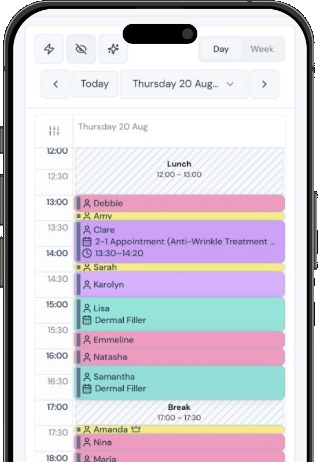
When software is built as one system, the calendar, the patient record, the payments and the reports share the same underlying data. A booking updates the record. A payment updates the record. The membership status sits on the same page as the last appointment and the next one. Nothing needs to be "connected" because nothing was ever apart.
When software is built as separate products stitched together, that shared spine doesn't exist. The booking tool holds one version of the patient. The payments tool holds another. The marketing tool holds a third. An integration is the bridge between them, and bridges cost money to build, money to maintain, and they break in ways that a single system simply can't.
So the integration fee isn't buying you connection. It's charging you to paper over a gap that shouldn't be there. The more separate the underlying products, the more bridges you need, and the more each one costs.
The hidden bill: the owner becomes the integration layer
Here's the part that never appears on the invoice. When the tools don't truly share data (or when the integration only syncs some of it) the missing connection doesn't vanish. It lands on you.
You become the integration layer. You're the one checking that a new patient in the booking system also exists in the payments system. You're the one who notices a membership renewed but the record still says lapsed. You're the one copying a phone number from one screen to another because the "integration" only carries names and dates, not the field you actually needed.
That work is invisible until you add it up. Twenty minutes here reconciling two lists, ten minutes there chasing a payment that shows as paid in one place and pending in another. It's not a software cost. It's a time cost, paid by the person the clinic can least afford to have doing admin, usually the owner or the lead clinician.
This is the real fragmentation problem, and it's why getting your patient records into one place does more for a busy clinic than almost any single feature. Not because consolidation is glamorous, but because it deletes an entire category of unpaid work.
Why this matters more in aesthetics than almost anywhere
Most clinics that are growing right now aren't growing gently. They're adding treatments, adding clinicians, adding members. Every new moving part multiplies the number of places a patient's information can live, and every integration you're relying on has to keep up.
Aesthetics is also a relationship business. The value isn't in a single treatment; it's in the patient who comes back four times a year, on a plan, for years. That relationship is only as strong as the record behind it. If the membership lives in one tool, the treatment history in another and the payment in a third, then the one thing you're actually selling (continuity) is the thing your software is worst at holding together.
A clinic that runs on connected-but-separate tools can look fine on a quiet Tuesday and fall apart on a fully booked Saturday, precisely when the cracks between the systems get stress-tested.
What to look for instead
You don't need to become a software architect to spot the difference. A few questions do most of the work:
- Is the patient record the centre of the system, or a copy that has to be kept in sync? Ask to see one patient with their details, appointments, membership status, invoices and history on a single page. If that view has to be "integrated" from several products, you have your answer.
- What has to be connected, and what does connection cost? If booking, payments, memberships and reporting are all separate purchases that then need connectors, you're buying a kit, not a system. Ask what happens to your data when one of those connectors breaks.
- Where do memberships and recurring revenue actually live? This is the tell in aesthetics specifically. A membership isn't a payment setting bolted onto a calendar; it's an ongoing relationship that needs bespoke packages, e-signed agreements, credit tracking and clear reporting, all tied to the same patient record. A purpose-built system keeps that in one place; a stack of integrated tools scatters it.
Some of the smartest work in modern clinic management software and patient management software is invisible: it's the admin that never has to happen because the data was never split up in the first place.
The bottom line
An integration fee is not a sign of how well-connected a product is. It's a receipt for the gap between two products that were sold to you as one. In a market moving as quickly as UK aesthetics, the clinics that stay calm as they grow will be the ones whose software was one system from the start, where a booking, a payment and a membership all land on the same patient record, and nobody has to pay extra to make them agree.
If you'd rather your patient records, memberships and payments started life in one place instead of being bridged together after the fact, see how the plans work.