
Something has shifted this year. Watch the big booking and beauty platforms (the ones most UK clinics have heard of) and you'll notice memberships turning up on nearly every roadmap. One's rolled out "flexible plans with perks and discounts." Another has added buy-now-pay-later so patients can spread the cost of a treatment. A third has "wallets, memberships and Klarna" pencilled in as things it plans to build.
I've been building a membership platform for aesthetics clinics for a while now, so I could be forgiven for feeling nervous about all this. I'm not. If anything, watching everyone reach for the same feature list has made me more sure of the decision to build Clinic Membership as purpose-built clinic membership software in its own right, rather than a billing toggle bolted onto a calendar. This is a founder's take on why.
Adding a membership button is not the same as running memberships
Here's the distinction that gets lost when memberships show up as a line item on a big platform's roadmap. Letting a patient pay a recurring fee is the easy 10% of the problem. It's a button and a recurring card payment. Anyone can add it, and this year, everyone is.
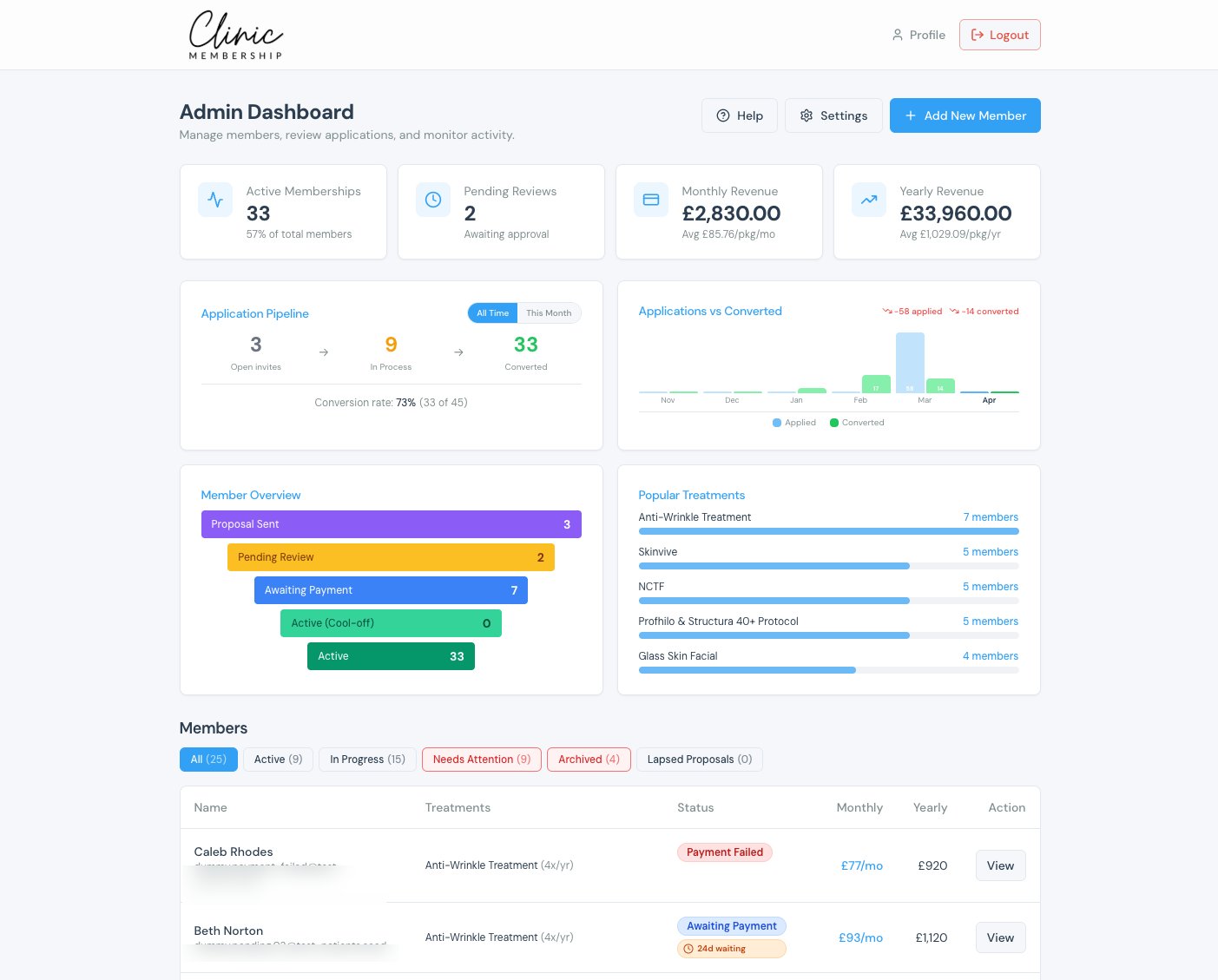
The hard 90% is everything that happens after the patient signs up. What are they actually entitled to each month, and how do you track it as it's used? What happens when a card fails, does anyone chase it, or does that member quietly churn without meaning to? How much unredeemed value is sitting in your programme right now? Which members have gone quiet and are three weeks from cancelling? When you build a membership plan, what does the agreement say, and can you prove the patient signed the version that was live on the day?
A payment feature answers none of those questions. It takes the money and stops there. A membership engine is built around them.
What a bolt-on quietly leaves on your plate
When memberships are a feature inside a tool built to do something else (take bookings, run a marketplace, sell one-off treatments), the membership part gets the shallow version. You can usually collect the payment. Everything around it lands back on the clinic owner.
You end up keeping the real membership programme in your head and a spreadsheet: who's owed what, who hasn't been in, whose payment bounced last week. The software shows you today's diary; you're left being the integration layer for everything the diary can't see. That works while you have a handful of members. It stops working at exactly the point memberships are supposed to be making your life easier: when there are enough of them to matter.
There's a reason this bites in aesthetics specifically. Roughly a third of first-time patients never come back (American Med Spa Association), so the whole point of a membership is to turn one-off visits into a relationship the clinic can rely on. If your membership tool can't see who's drifting, it can't help you keep them, and keeping them was the entire reason you started.
Buy-now-pay-later is the clearest tell
The move I keep coming back to is pay-later financing. Several platforms have added it, and I understand why it's attractive. It lifts conversion on a higher-value treatment by letting the patient spread the cost.
But look at what it optimises for. Buy-now-pay-later is built to get a patient through the door once. It finances a single transaction. A membership is the opposite instinct: it's built to bring the same patient back, on a schedule, for years. One is a clever way to close a sale; the other is a way to build a business that doesn't start from zero every January. I wrote about that contrast in more detail in recurring billing versus pay-later for aesthetic clinics, but the short version is this: when a platform's answer to "help me grow" is instalment financing, it's telling you what it was built to do. And it isn't recurring revenue.
Why we built purpose-built clinic membership software
I made a deliberate choice not to bolt memberships onto something else, and to build the boring, unglamorous 90% first.
That means the credit and perks each member is owed are tracked live, visible to you and to them, so nothing accumulates unseen. It means a failed payment triggers a recovery flow instead of a silent cancellation. It means membership agreements are e-signed, versioned and time-stamped, so you can always show what a patient agreed to. It means the reporting leads with the numbers that actually run a membership (recurring revenue, churn, conversion, outstanding value) not just what came in this week. And because memberships are the point rather than an afterthought, the whole thing sits on one patient record instead of being scattered across apps that don't talk to each other.
None of that is flashy. You can't demo "we chase failed payments so you don't churn a member by accident" as neatly as "now with Klarna." But it's the part that decides whether a membership programme quietly grows or quietly falls apart.
The honest version
I'm not going to pretend the big platforms won't sell plenty of memberships. They will, on the strength of already being installed. If all you want is to take a recurring payment, a bolt-on will do it, and you should use whatever you already have.
But if memberships are how you plan to build a clinic that isn't at the mercy of next month's diary, the tool matters. The difference between a membership button and a membership engine doesn't show up in the demo. It shows up eighteen months in, in your churn rate, your renewal rate, and how many evenings you spend reconciling a spreadsheet. Purpose-built wins slowly, and then all at once.
If you want to see what the full checklist looks like, we've written up what actually separates a real membership engine from a bolt-on.
Clinic Membership is clinic management software for UK aesthetics clinics: patients, calendar, memberships, payments and reports in one place, with recurring revenue as the core. See how it works as purpose-built clinic membership software, and compare plans at clinicmembership.co.uk/pricing.