

Picture the member who signed up six months ago. They've never cancelled, never complained, never missed an appointment. Then one month their payment quietly fails (a card expired, a bank reissued it) and nobody notices. By the time anyone does, they've drifted, and you've lost a member who never actually decided to leave.
That's the uncomfortable truth about a lot of membership "churn": it isn't a decision at all. It's an admin oversight wearing the costume of a cancellation. The good news is that it's also the most preventable kind of loss there is. If your system can recover failed membership payments before they turn into goodbye. Here's how that works, and why catching even one of them matters more than you'd think.
The member who never meant to leave
There are two ways a clinic loses a member. The first is voluntary: the person weighs it up and decides the value isn't there any more. Those are the ones worth watching for, fewer visits, unused benefits, the early signs a member is about to cancel. You can often win them back with a well-timed conversation.
The second way is involuntary, and it's far quieter. The member still wants what you offer. Their payment just stopped going through, usually a card that expired or was replaced by the bank. No one chose anything. The money simply stopped arriving, and unless someone is watching closely, the relationship fades by accident.
This matters because you're already losing patients you don't need to. Roughly 35% of first-time patients never return for a second visit (American Med Spa Association, 2026). You can't always control that first-visit drop-off. But handing back members you've already won (over something as fixable as an expired card) is a loss entirely within your power to stop.
How automatic failed-payment recovery works
The old way of handling this is painfully manual: spot the failed payment in your bank feed (eventually), dig out the member's number, send an awkward "your payment didn't go through" message, and hope they reply. Most clinics simply don't have time, so failed payments pile up unchased.
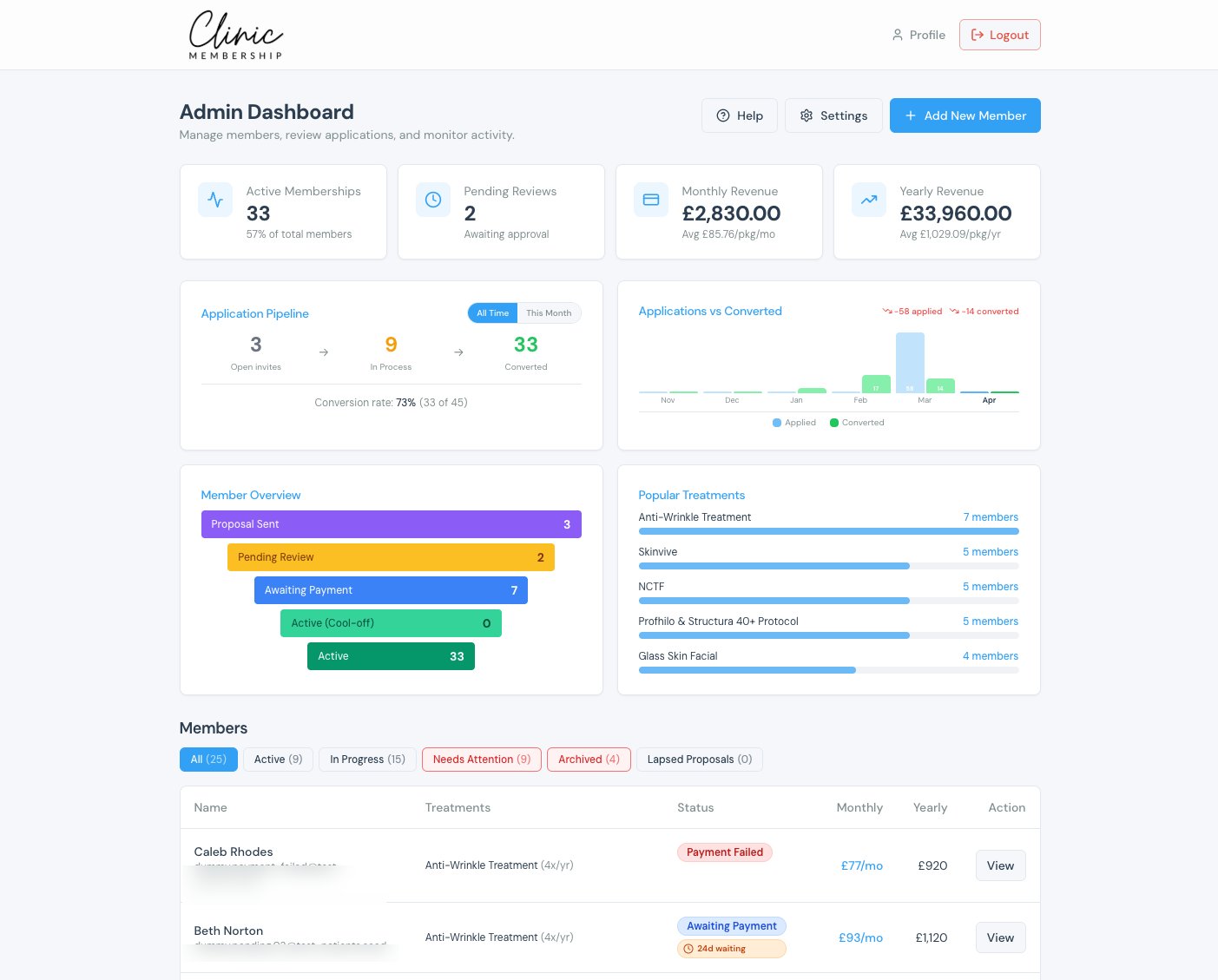
Clinic Membership is built to close that gap. When a membership payment fails, the system flags it straight away and lets you recover it in a single click: no spreadsheet reconciliation, no detective work. Memberships run on Stripe-backed billing, so the moment a card is declined or expires, the failure surfaces on the member's record rather than disappearing into a statement you'll read next month.
A few things make this practical rather than just possible:
It runs on recurring card payments (the billing method most UK clinic members already expect) so the money comes in automatically each month, and a single declined card doesn't have to quietly become a lost member.
Everything sits on the same patient record. The failed-payment alert, the recovery action, the member's history and their membership status all live in one place, not in a separate billing app you have to cross-reference. When you see the flag, you also see exactly who it is and what they're worth.
And because recovery is one action rather than a chase sequence you run by hand, a busy front desk can clear failed payments in the gaps between appointments instead of letting them rot. Automated billing also lifts a lot of the routine admin off your team's plate, fewer manual invoices, fewer awkward reminder messages, less month-end reconciliation.
This is the unglamorous infrastructure that makes recurring revenue actually recur. It's the same reason we're so particular about the billing model behind your memberships: predictable income only stays predictable if the payments behind it are protected.
Why one recovered payment matters more than you think
It's tempting to treat a single failed payment as small change. One member, one missed month: how much can it really cost? Quite a lot, once you follow the maths through.
A 5% increase in customer retention can raise profits by anywhere from 25% to 95% (Bain & Company / HBR, 2026). Retention compounds: a member who stays isn't worth one month's payment, they're worth every month they would have continued, plus the add-on treatments and referrals that come with a loyal patient. Recovering a failed payment doesn't just save this month's fee. It protects the entire future relationship.
There's a cost argument too. Retaining an existing patient is somewhere between 5 and 25 times cheaper than acquiring a new one (Bain & Company / HBR, 2026). So the member whose card just expired is, pound for pound, the most valuable person you could possibly keep. They're already sold, already booked in, already part of your routine. Letting them slip away over a payment glitch and then paying to replace them with a brand-new lead is the most expensive way to run a clinic.
This is really what a membership is for: turning one-off visits into predictable recurring revenue you can plan around. Failed-payment recovery is simply the quiet guardrail that keeps that revenue from leaking out the back.
What happens when a membership payment fails?
If you take one thing from this, make it this answer. When a member's payment fails in Clinic Membership, the system flags it for you and gives you a one-click way to recover it, instead of leaving you to discover the problem weeks later in a bank statement. Because it runs on Stripe-backed recurring card payments, and everything lives on the member's record, you see the failed payment, who it belongs to and how to fix it all in one place.
The result is fewer members lost by accident, less time spent chasing money manually, and a recurring revenue line you can actually trust. For a fuller picture of how the platform handles memberships end to end, see how Clinic Membership works or compare it against the best membership software for UK clinics.
You'll never stop every member from leaving, and you shouldn't try to. But the ones who never meant to go? Those you can keep. It just takes a system that's paying attention when the payment doesn't go through. See plans and pricing to get started.