

I've spent a lot of this year talking to clinic owners, and there's a mood I keep running into. The diary looks busy. The treatments are good. The reviews are glowing. And yet the numbers at the end of the month feel harder to move than they did a year ago.
It turns out that feeling isn't just in your head.
Zenoti's 2026 "Check-In" report on UK aesthetic clinic profitability put some figures on it. Across the clinics they looked at, revenue growth had cooled to around 7%, and like-for-like revenue was actually down about 2%. On the face of it, that reads like bad news. But there was one number pointing the other way: visits from existing guests were up around 4%.
Read those three figures together and they tell a story about patient retention. New money is getting harder to win. The patients you already have (and how many of them you keep) are quietly becoming your most reliable source of growth. And the UK aesthetic clinics that pull ahead in the next twelve months will be the ones that treat patient retention as the number that matters, not new bookings alone.
The growth engine everyone leans on is getting more expensive
For years, the default answer to "how do we grow?" has been "get more new patients." More ads, more offers, more first-time bookings. It works, right up until it doesn't. Ad costs climb, the market gets busier, and every new face costs a little more to win than the last one.
Here's the part that stings: a lot of those hard-won new patients don't come back. Figures from the American Med Spa Association suggest roughly a third of first-time patients never return for a second visit. So you pay the highest price you'll ever pay to acquire someone, they have one treatment, and then they drift.
Bain & Company have shown for decades that keeping an existing customer is somewhere between five and twenty-five times cheaper than acquiring a new one. When your growth cools and your acquisition costs rise at the same time, that maths stops being a nice-to-know and starts being the whole game.
Patient retention is the one number that predicts who pulls ahead
If I had to pick a single metric to watch this year, it wouldn't be new bookings. It would be the share of patients who come back.
The reason is simple. Small improvements in retention compound in a way that new-patient wins never quite do. Bain and Harvard Business Review's work on this is well known: even a modest lift in retention can translate into a disproportionately large lift in profit, because you're keeping the patients you already paid to acquire and earning from them again and again with almost none of the upfront cost.
That's exactly what the "guest visits up 4%" figure is hinting at. The clinics holding their ground aren't necessarily winning more new faces. They're getting more out of the ones they've already got.
The problem is that most clinics can't actually see this number. Retention hides between disconnected tools: bookings in one app, payments in another, patient history in a spreadsheet. If you can't see who's drifting, you can't do anything about it until they're already gone.
Why memberships are the practical fix
This is the bit I care about most, because it's why I built Clinic Membership in the first place.
A membership turns a one-off treatment into a relationship with a rhythm. Instead of hoping a patient rebooks, you've agreed a plan together: a monthly amount, a set of treatments, a reason to come back on a schedule rather than on a whim. The patient gets better continuity of care and better value. You get predictable, recurring income and a patient who's far more likely to still be with you next year.
It's the difference between waking up on the first of the month not knowing what you'll earn, and waking up already knowing a solid chunk of it is banked. That predictability is what lets you plan, hire, and invest with a bit of confidence instead of crossing your fingers.
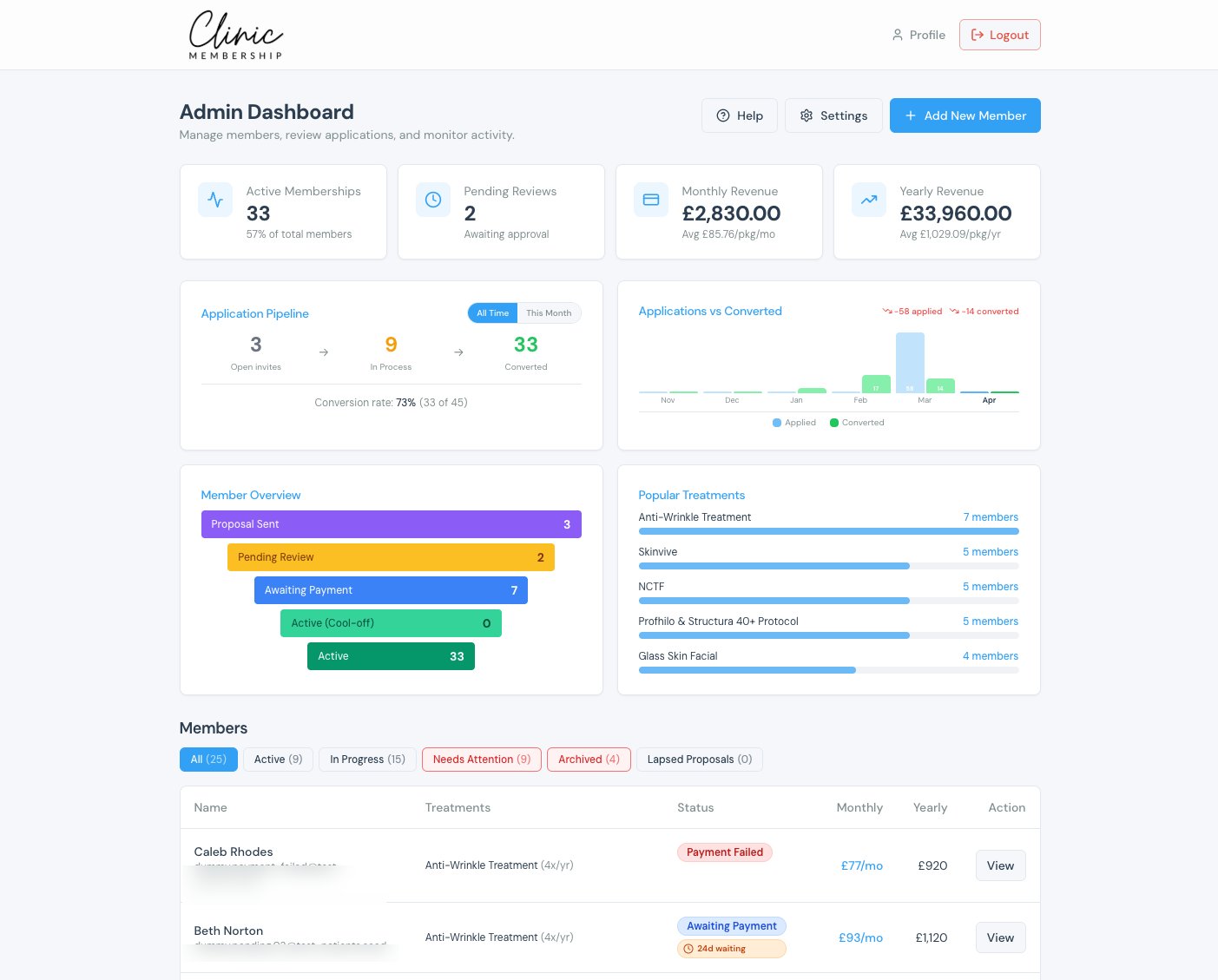
And crucially, it makes retention visible. When patients are on plans, you can see your recurring revenue, your active members and your churn at a glance, which means you can catch someone who's about to drift before they've gone, rather than reading about it in a quiet week three months later.
What I'd do if I ran a clinic in 2026
I'm not going to pretend memberships are the only answer. But if the market is telling us that new-patient growth is getting harder and repeat visits are where the momentum is, then the sensible move is to build for repeat visits on purpose.
That means three things. First, actually measure the share of patients who come back. You can't improve a number you never look at. Second, give your best patients a reason and a structure to return, rather than leaving it to chance. Third, put your bookings, payments and patient history in one place so retention stops being invisible.
I'd start smaller than most people expect. Pick a handful of your most loyal patients (the ones already coming in every few weeks) and offer them a simple plan that matches what they're doing anyway. You're not inventing new demand; you're putting a rhythm and a card on file around demand that already exists. Watch how many take it up, watch how their return rate compares to everyone else, and let the numbers make the case for rolling it out wider. That's a week's work, not a quarter's project, and it tells you far more than any amount of theorising about whether a membership model fits your clinic.
None of that requires ripping everything out overnight. It's the opposite of a grand reinvention. It's noticing where the growth actually is (the patients already sitting on your list) and building a simple system around keeping them.
The clinics that do this won't necessarily be the loudest ones. They'll just be the ones whose numbers quietly hold up while everyone else wonders why "busy" isn't turning into "growing."
Ben Norman is the founder of Clinic Membership, clinic management software built for UK aesthetics clinics with memberships and recurring revenue at its core. If you want to see how a membership model would work for your clinic, take a look at what's included on each plan or read more on why a third of first-time patients never come back.