

You run a UK aesthetics clinic. Your diary is full, or full enough, and almost every appointment in it was won separately. Someone found you, enquired, booked, came in, paid once and left. Then the whole thing started again from nothing. So it is a fair question to ask before you change anything at all: do patients pay monthly for aesthetic treatments, or is that a model that works everywhere except here?
Before you answer from your own experience, look at what the same people are already doing with the rest of their health spending.
Paying monthly for your health is already normal in the UK
18.0% of UK adults aged 16 and over hold a gym membership. Nobody obliges a UK gym or health club member to buy one, and nothing stops them paying for a single session instead. The membership is the format the market settled on anyway.
Nobody had to be taught how it works, either. There was no education campaign explaining that a monthly figure buys continuity, or that the alternative is deciding all over again every time, which is tiring and which people quietly stop doing.
That is the market your patients live in. They are not being asked to learn a new idea when you offer them a plan. They are being asked to apply an old one to you.
Do patients pay monthly for aesthetic treatments? Look at what they already do
The honest answer is that most UK aesthetics clinics have never found out, because most have never asked.
This is worth separating carefully, because the two questions get muddled and only one of them is actually hard. "Will patients pay monthly?" is close to settled: they demonstrably do, across the rest of consumer health, in numbers that make it the ordinary way to buy an ongoing service. "Will patients pay monthly to me, for what I do, in a way I can run without drowning in admin?" is a real question, and it is a question about your clinic rather than about your patients.
Which is good news, because the second one is inside your control.
Why UK aesthetics still sells one appointment at a time
It is not stubbornness. It is structure.
In a nurse-led or single-room clinic, the person who answers the phone is the person holding the needle. There is no front-of-house team to run a plan, chase a failed payment, or explain what is included. Anything that adds a weekly admin job is not a growth idea, it is a tax on the only pair of hands in the building.
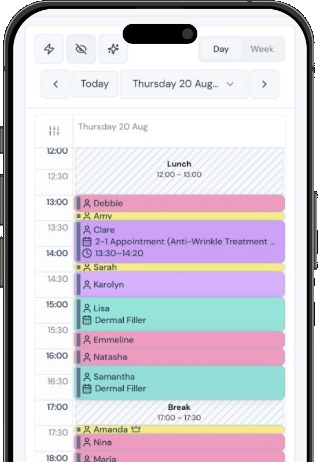
Most clinic software has quietly reinforced this. It was built to bill an appointment. The appointment is the unit, the diary is the ledger, and revenue is whatever the diary happened to contain that month. Sell that way for long enough and the model stops looking like a choice and starts looking like the nature of the work.
It is not. It is a billing habit, and our earlier piece on UK clinics moving to memberships is a look at what happens when owners notice that.
The objection that actually matters: treatment spacing
Here is the real reason aesthetics has been slower than the rest of consumer health, and it is a good reason, not an excuse.
A gym membership is open access. Turn up as often as you like. Aesthetics is not open access and must never behave as though it is. Patients return on a rhythm the practitioner sets, and any system that lets a member book whatever they want whenever they want is not a growth tool, it is a clinical governance problem you have paid for.
So the objection is correct, and it is also solvable, because it is an operational problem rather than a philosophical one. A membership does not have to mean unlimited access. It can mean a defined set of treatments held as credit, released on the schedule you decide, with minimum gaps between appointments enforced automatically at the point of booking so the software refuses what you would have refused. The plan carries the commercial relationship. You keep every clinical decision that was yours before.
Once that is true, the fear goes, and what is left is a billing choice.
What changes in the clinic on the Monday after
Not very much, on the surface, which is rather the point.
The phone rings less, because members already know what they have and when it is due, and the ones who use a self-service portal answer their own questions at ten at night without involving you or your call-answering service. Money arrives on a date you can name rather than a date the diary decides. Recurring card payments run in the background, failed ones surface as an alert with one-click recovery instead of as a gap you notice six weeks later, and the membership agreement is signed digitally with a 14-day cooling-off period as standard, which you can extend if you would rather give people longer, so the commercial side is documented without a printer being involved.
And you can finally see it. Active members, monthly recurring revenue (MRR), churn and plan breakdown on one screen tells you within a fortnight whether the plan you designed is the plan people want, which is a much faster feedback loop than waiting to see whether the diary fills. That visibility is most of the argument for running memberships, patients, calendar and payments in one connected system rather than three that do not speak to each other.
How to test this without rebuilding your clinic
You do not need a strategy. You need one plan and a handful of patients.
Pick the treatment family your patients already come back for, because you are formalising a pattern rather than inventing one. Write down what a member gets, over what period, and what it costs. Set the minimum gaps. Offer it to the patients who would have rebooked anyway, which feels like leaving money on the table and is actually the cheapest possible way to find out whether the mechanics work before you put it in front of someone new.
Then watch two things for a month: whether members use what they bought, and whether anyone asks you a question the plan should have answered. Fix those, and only then market it.
You can build that on a free plan with up to 10 patient records, which is enough to run a real pilot with real money moving, and you can look at the plans and pricing whenever you are ready for more.
The short version
A monthly membership is not a new idea to anybody in this country, and 18.0% of UK adults aged 16 and over hold one at a gym. UK aesthetics is not behind because its patients are different. It is behind because its clinics have been selling one appointment at a time, on software built to do exactly that, while the objection that made everyone cautious turned out to be a setting rather than a wall.
Ready to see the whole clinic in one place?
Clinic Membership helps UK aesthetics clinics run patients, calendar, memberships, payments and reports in one place. Start free at clinicmembership.co.uk.
Sources
- ukactive, UK Health and Fitness Market Report 2026, with Sport England and 4GLOBAL, analysis by Grant Thornton UK, 9 April 2026. 18.0% of UK adults aged 16 and over hold a gym membership. UK, health and fitness clubs.