
If you run a UK aesthetics clinic, you have never had more software to choose from, or more ways to end up with the wrong stack. The market is growing fast: UK aesthetics is now worth around £3.6 billion and growing 8–9% a year, and the number of practitioners has jumped 437% in two years to nearly 20,000 across some 5,589 clinics (UCL / Aesthetic Surgery Journal Open Forum, 2026). More clinics means more vendors chasing them, and more "all-in-one" claims that don't survive contact with a busy Tuesday.
This guide is a plain-English checklist for choosing aesthetic clinic software in 2026: what genuinely matters, what to test in a demo, and the one feature most platforms still treat as an afterthought.
Start with the problem, not the feature list
The single most expensive mistake is buying software that adds a tab instead of removing one. Most clinics don't have a software shortage. They have a fragmentation problem: booking in one place, patient notes in another, payments in a third, and membership tracking in a spreadsheet nobody trusts. That patchwork has a measurable cost. Clinics running on disconnected tools see 45% more no-shows and billing errors than clinics on a single connected system (ProspyrMed, 2026).
So the first question isn't "what can this do?" It's "how many of my current tools does this actually replace?" Good aesthetic clinic software should let you retire the patchwork (patients, calendar, payments and reports living in one place) not sit awkwardly alongside it.
The core checklist
Before you look at anything clever, confirm the fundamentals are genuinely joined up:
One patient record. Contact details, treatment history, membership status and invoices should sit on a single patient hub, not scattered across apps that don't talk to each other. If the demo needs three screens to answer "when did this patient last come in?", that's your answer.
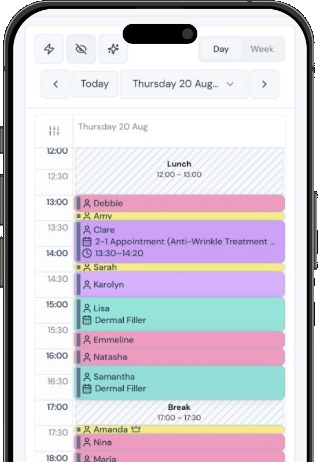
Calendar and online booking that sync. The diary should update the patient record automatically, with online booking and reminders built in. A calendar that lives apart from your notes is how visits go unrecorded and follow-ups get missed.
Payments that don't leak. Look for Stripe-backed card payments, point-of-sale checkout, and invoicing in the same system, plus automatic alerts and one-click recovery when a payment fails. Failed and forgotten payments are quiet revenue drains; recovering them shouldn't be a manual chase.
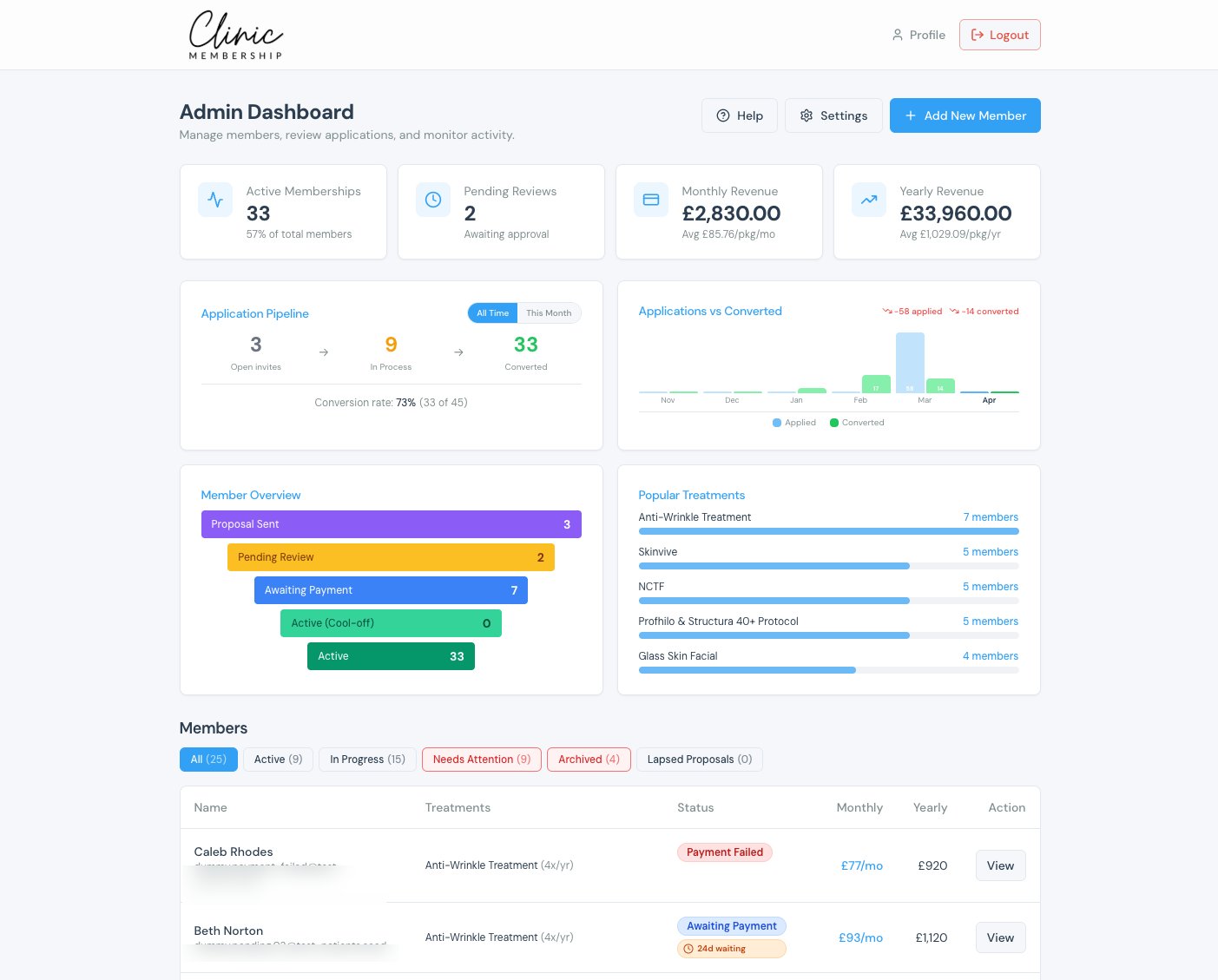
Reports you'll actually use. Real-time dashboards for recurring revenue, active members, churn and conversion (with CSV export) turn your clinic's data into decisions instead of guesswork.
Security and setup you can trust. Encryption at rest, GDPR-aware handling, Stripe tokenisation (so card data is never stored by the software), and a setup you can complete in under an hour rather than a quarter.
A quick note on scope: strong clinic management software covers patients, calendar, payments and reporting. It is not the same as full medical-records or EMR software, and any vendor claiming to be everything to everyone is worth a second look.
The feature most platforms still bolt on: memberships
Here's where 2026 buyers should slow down. Around 60% of UK clinics are now building membership or subscription models (Consulting Room / Anti-Wrinkle Clinic / PolicyBee, 2026), because recurring revenue is what stops quiet months from resetting the books. Retention is simply better economics than acquisition: a 5% lift in retention can raise profits by 25–95% (Bain & Company / HBR), and roughly 35% of first-time patients never return at all (American Med Spa Association, 2026).
The problem is that most general platforms treat memberships as a loyalty button (bank a bit of credit, stamp a virtual card) rather than a proper recurring-revenue engine. When you're comparing software, test the difference directly. Ask whether the platform can:
- Build bespoke treatment packages with your own names, durations and pricing, not just fixed tiers.
- Handle digital membership agreements with e-signature, versioned terms and a cooling-off period.
- Run recurring billing with automatic failed-payment recovery.
- Report on recurring revenue, active members and churn out of the box.
If the honest answer is "sort of," you've found a bolt-on. A built-in membership engine is the difference between offering memberships and actually running them.
Automation: the part that gives you your evenings back
The best aesthetic clinic software in 2026 does the admin you're currently doing by hand. Worth asking about in a demo: a smart wait list that automatically notifies a patient when an earlier slot opens (and lets them rebook themselves, with no phone-round from you); treatment-spacing rules that stop patients booking sessions too close together; and a patient self-service portal that nudges people to rebook when they're due. These aren't gimmicks. They're hours back in your week and fewer gaps in your diary.
White-label and growth
If your brand matters (and in aesthetics it always does) check how far the platform lets you make it yours: your logo and colours as standard, and, when you're ready, a custom domain, custom email sending domain and a fully branded patient portal so the whole experience feels like your clinic, not your software vendor's.
How to run the demo
Bring a real scenario, not a feature list. Walk one patient from first enquiry, to booking, to a signed membership, to a failed payment, to a monthly report, and count how many separate systems it took. The right software makes that a single, connected story. Clinic Membership is built exactly for that story: a full clinic management suite for UK aesthetics clinics, with memberships and recurring revenue as the core rather than the afterthought.
If you're weighing up options, our guide to the best aesthetic clinic software in the UK and our built-in-memberships checklist are good next reads, and you can see how the membership software compares for UK clinics or check current plans on the pricing page.
Aesthetic clinic software should quietly run the parts of your clinic you'd rather not think about, so you can spend your time with patients, not tabs.