
Think about where you were the last time your clinic phone rang.
If you run a nurse-led or single-room clinic, there is a fair chance you were in the treatment room with gloves on. You heard it ring. You could not answer it, because in a lot of UK aesthetic clinics the person who answers the phone is the same person holding the needle.
Or you have solved that, and a virtual assistant picks up for you. Plenty of UK clinics do, and it is a sensible answer to a real problem. But it solves a different problem from the one in this post, because a virtual assistant is still a phone line. It answers during the hours you pay it to answer, and your patients are not deciding during those hours.
Either way, the telephone is a strange thing to have made the only way into your diary.
There is a better way, and it is not complicated. This is how to take aesthetic clinic bookings out of hours: let patients book, move and cancel their own appointments, at the hour that suits them.
More than half of bookings happen when your line is closed
Here is the number that makes the case.
More than half of UK beauty and wellness appointments, 52% of them, are booked outside standard working hours. Sunday evening is one of the busiest moments of the entire week for arranging a treatment. That is a large UK booking platform's own data covering 2025 and 2026, reported by Professional Beauty in August 2026.
If your line is answered nine to five, that is the window you are shut for.
It gets sharper alongside the second figure from the same data: 47% of appointments are booked within 24 hours. So a large share of bookings are both late and out of hours, which is precisely the combination a phone line handles worst. Someone deciding on Sunday night wants an answer that night, not on Monday when the slot may already be gone.
In aesthetics, a missed call is a missed treatment window
This is where aesthetics differs from most appointment businesses, and it is the part generic booking advice always misses.
Your patients do not return when they happen to feel like it. They return on a rhythm your practitioners have set, at the review point written into their treatment plan. That schedule is the whole basis of a maintained result, and it is the whole basis of your recurring revenue.
So when a returning patient cannot get through to book their review, you have not lost a phone call. You have let a treatment window drift. And patients rarely blame the booking process for that. They blame the outcome, and quietly try somewhere else.
Around one in three first-time patients never return, according to the American Med Spa Association. The moment somebody decides to come back is short, and it very often lands on a Sunday evening.
The bookings you never even hear about
When your number goes to voicemail, or reaches an assistant who has to take a message and pass it on, one of four things happens.
They leave a message. You call back between patients, they are at work, you leave a message, they call at lunch, you are treating. Three days to book an appointment the patient decided on in nine seconds.
They try again later and forget. The most common outcome, and the one you will never see, because a booking that never happened leaves no record in your system.
They book somewhere else. The decision was already made. All that was left was somewhere to put it.
They do nothing and the intention fades.
Only the first is visible to you. That is exactly why phone-dependent booking feels like it is working. You can only count the calls you answered.
How to take aesthetic clinic bookings out of hours
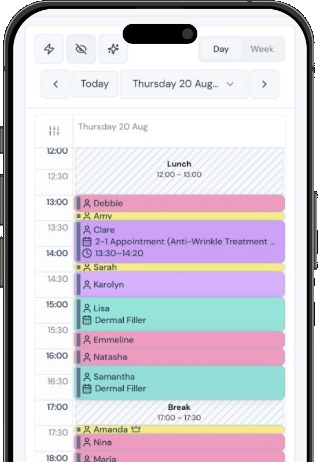
Put real, live availability on your website and let patients commit to it themselves, without a conversation and without waiting for you.
That means a page showing genuine open slots, not a "request an appointment" form. A form promising someone will be in touch is a phone call with extra steps: the patient has not booked anything, and you still owe them a callback during clinic hours.
Aesthetics also has an unusually clean split that makes this easier than owners expect. A nervous first-time enquiry about a treatment they have never had genuinely needs a human being, and should. A returning patient booking a review does not. Handing the second group a link protects your time for the first.
"But I cannot let patients book whatever they like"
This is the real objection in aesthetics, and it is a good one. It is also why plenty of clinic owners have tried online booking, been alarmed, and switched it off within a fortnight.
You cannot have a patient booking a treatment too soon after the last one, or booking something out of sequence, or booking with a practitioner not qualified to deliver it. In this sector, availability is not simply whether the room is free.
Which is why booking for an aesthetic clinic has to enforce your clinical rules at the point of booking, not correct them afterwards. Minimum intervals between treatments, sequencing, and practitioner qualification, applied automatically so the wrong appointment cannot be made in the first place. We covered how treatment spacing rules work separately.
Get that right and the objection disappears, because patients can only book what you would have said yes to anyway.
It also has to know who is booking. A new patient, a lapsed patient and a plan patient with treatments remaining are three completely different jobs, and patient-aware booking handles each differently.
Booking is the easy half. Rescheduling is the rest
Ask whoever answers your phone what proportion of calls are actually new bookings. In most clinics the majority are patients moving, cancelling or amending something they already have.
Every one of those is an interruption, often mid-treatment, and every one is a job the patient could finish alone in under a minute. So let them:
- Book against live availability
- Reschedule into another genuinely open slot
- Cancel within your notice period, freeing the slot while it can still be refilled
- See what they already have booked, and what remains on their plan, without ringing to ask
That last point matters for any clinic running membership or treatment plans. A patient who can see their remaining treatments does not call to check, and a patient who cancels at 10pm frees a Thursday slot you can still fill. A patient who cannot reach you simply does not turn up, and we covered what a no-show actually costs a UK clinic separately.
What if you already use a virtual assistant?
Then you have already fixed the half of this that a person can fix, and you should keep them.
Outsourced reception solves a real problem and solves it properly. Someone who knows your clinic and handles an anxious first-time enquiry with warmth will beat a booking form on that job every time, and for consultations that is worth paying for.
But be clear about which half you have bought. A virtual assistant extends who answers the phone. It does not change the fact that the phone is still the door. The patient still has to want to ring, still has to ring during the hours the service runs, and still has to hold a conversation to do something that takes seconds alone.
There is also what happens between the call and your diary. If whoever answers cannot see live availability, cannot see that this patient has two treatments remaining on their plan, and cannot enforce your treatment spacing, the call produces a message rather than a booking, and someone in your clinic still has to do the work.
These are complements, not substitutes. The mistake is paying a person to be the only door, when most of the traffic arriving at it does not need a person at all.
What to check this week
Three things, none of which need new software to find out.
- Look at your call log for last Sunday evening, 6pm to 10pm. Count the missed calls, then count how many became a booked appointment.
- Try to book a review appointment at your own clinic, as a patient, at 9pm on a phone. If you cannot finish it, neither can they.
- Ask whoever covers your phone what proportion of calls are reschedules and cancellations. That proportion is the part of the job the phone should never have been doing.
The clinics that get this right have not replaced their people. They have stopped spending them on the bookings that never needed a conversation, which frees them for the ones that genuinely do.
Ready to see the whole clinic in one place?
Clinic Membership helps UK aesthetics clinics run patients, calendar, memberships, payments and reports in one place. Start free at clinicmembership.co.uk.
Sources
- Professional Beauty, "Nearly half of beauty appointments are booked within 24 hours, new data reveals", 3 August 2026, reporting a UK beauty and wellness booking platform's internal booking data covering 2025 to 2026: 47% of appointments booked within 24 hours, and 52% booked outside standard working hours.
- American Med Spa Association: approximately one in three first-time patients never return.