

If you run a UK aesthetics clinic, you can probably tell me how last week felt. Busy. Quiet. A couple of no-shows. A membership sign-up that made your day. What most owners can't tell me, without opening a spreadsheet or three, is the number that actually matters: how much predictable revenue is coming in next month, and whether it's going up or down.
That gap is exactly what built-in reporting is meant to close. And it's a fair question to ask of any platform before you commit, because "has reporting" can mean anything from a proper live dashboard to a single export button buried in a settings menu. Here's what good reporting looks like for an aesthetics clinic, and the numbers your software should be handing you without you asking.
Why reporting is a growth tool, not an admin chore
It's easy to file reporting under "accountant stuff" and move on. But in a clinic that runs memberships and recurring treatments, your numbers are the earliest warning system you've got.
Consider the shape of the problem. Around a third of first-time aesthetic patients never come back after their initial visit (American Med Spa Association). Winning a brand-new patient costs somewhere between five and twenty-five times more than keeping one you already have (Bain & Company). And in a market worth roughly £3.6 billion and still growing 8–9% a year (UCL and industry reports), the clinics pulling ahead aren't necessarily the ones with the most footfall. They're the ones who notice a slow leak before it becomes a flood.
You can't notice a leak you can't see. That's the whole case for reporting: it turns a vague feeling into a number you can act on this week, while it's still cheap to fix.
The five numbers your dashboard should show
When you're comparing platforms, look past the word "reporting" and ask what's actually on the screen. For an aesthetics clinic, five figures earn their place on the front page.
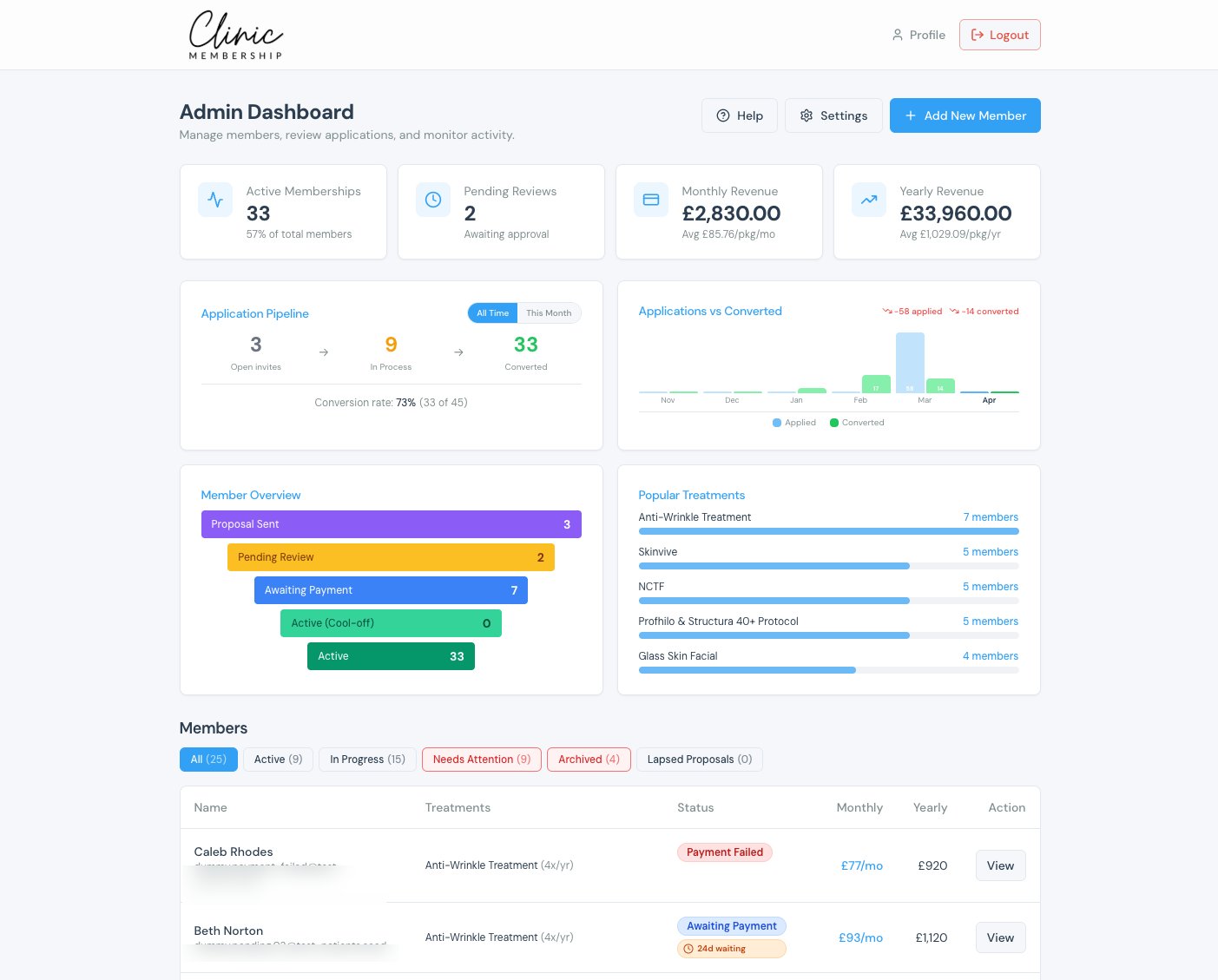
Recurring revenue (MRR). The single most important number in a membership clinic: the predictable income you can count on before a single walk-in books. If your software can't show you this at a glance, it isn't really running your memberships; it's just storing them. (That gap between a real membership engine and a booking tool with a toggle bolted on is worth understanding in its own right.)
Active members. How many members you have right now, trending over time. A headline count is nice; a trend line is what tells you whether your membership scheme is a growing asset or quietly stalling.
Churn. The members leaving, and when. Churn is the number owners least want to look at and most need to. Catch a rising trend early and you've usually got time to fix the cause: a clunky renewal, a payment that keeps failing, a plan that stopped feeling worth it.
Conversion. How many enquiries and first-visit patients turn into members. Given how expensive new patients are to win, knowing where they drop off is often worth more than any ad budget.
Payment history and plan breakdown. Which plans are actually selling, and which payments went through, failed or recovered. This is where you spot the plan nobody's buying and the revenue slipping through failed cards. It's also where a good dashboard surfaces the future revenue already committed in your active plans, money you've earned but not yet collected.
If a platform gives you those five live, not as a monthly PDF you have to request, but as a dashboard you can open between patients. That's built-in reporting doing its job.
Live dashboard vs "you can export a CSV"
Here's the distinction worth pressing on. A lot of general software will happily tell you it has reporting, and technically it's true: you can export a spreadsheet and build your own charts. That's fine if you enjoy spreadsheets. Most clinic owners don't have a spare afternoon for pivot tables.
The difference that matters is whether the numbers are there when you look, updated in real time, on a screen designed for a clinic, showing recurring revenue and churn without any assembly required. Clinic Membership is built around that idea: real-time dashboards for MRR, active members, churn, conversion, payment history and plan breakdown, with a CSV export for the times you genuinely do want the raw data (or your accountant does). You get the at-a-glance answer first, and the export as a backup, not the other way round.
It's the same reason clinics increasingly want memberships, POS, invoicing and reporting living in one system rather than stitched across a booking app, a payment tool and a spreadsheet: every join between systems is a place where numbers stop agreeing with each other. When your patients, payments and plans sit in one place, the dashboard can actually be trusted, because it's reading from a single source rather than guessing across three.
What to ask before you commit
Before you sign up to any aesthetic clinic software, a few plain questions will tell you whether its reporting is real:
Can I see my recurring revenue right now, on one screen? Does it show churn as a trend, not just a total? Can I tell which membership plans are selling? Will it flag a failed payment before the member drifts away? And can I get the underlying data out when I need it?
If the honest answer to most of those is "sort of, if you export it," the software has a reporting feature. If the answer is "yes, it's on the dashboard," it has reporting you'll actually use, and that's the version that helps you grow.
Your numbers are already telling a story about your clinic. Good reporting just makes sure you're the first to hear it, not the last.
Curious what a real clinic dashboard looks like? See how Clinic Membership brings memberships, payments and live reporting into one place, take a look at the membership features checklist, or compare the best membership software for UK clinics. Plans and pricing are on our pricing page.