

It is one of the most reasonable questions a clinic owner can ask, and one of the hardest to get a straight answer to. You want to know whether your clinic cancellation rate is normal for a UK clinic. You lost four appointments last week. Was that a bad week, or just Tuesday?
Here is the honest answer, and it is worth saying plainly before anything else: there is no published, independent cancellation-rate benchmark for UK aesthetics. Not a good one. Not one with a named author, a stated method and a sample you could check.
That matters, because the internet is full of numbers that look like one.
Why the figures you find online don't hold up
Search for a UK clinic cancellation benchmark and you will be offered percentages inside the first thirty seconds. Rebooking rates. Did-not-attend rates. Neat, confident, oddly specific.
Follow them back and they tend to dissolve. The page citing the figure cites another page, which cites a third, and none of them names a study, a survey size or a year. Several of the most widely repeated "UK aesthetics benchmarks" in circulation this year trace back to content-marketing pages with no primary source at all.
So: what can we say?
The nearest reliable data
The most robust missed-appointment data available to us does not come from aesthetics. It comes from NHS England.
Around 5% of general practice appointments in England (roughly one in twenty) are missed without enough notice for the slot to be reused. In March 2026 alone that was 1.4 million appointments (NHS England Digital, Appointments in General Practice, 2026).
Two things must be said about that number, and they are the reason it is useful rather than the reason to ignore it.
First, the scope is narrow in two directions at once. It is general practice, not aesthetics, different patients, different motivations, different cost of not turning up. And it is England only: Appointments in General Practice does not cover Scotland, Wales or Northern Ireland, so it is not a UK figure and we are not going to present it as one. A free GP appointment and a paid aesthetic treatment are not the same commitment either. It would be dishonest to hand you this number as your benchmark.
Second, it is still useful, as a floor. A system operating at that scale still loses about one appointment in twenty. If that is roughly the rate across a national service, a single-site clinic quoting itself a 1% cancellation rate is almost certainly measuring something narrower than it thinks.
Use it that way: not as a target, but as a sanity check on your own definition.
The number that actually decides your year
There is a bigger reason not to obsess over the cancellation percentage, and it is this: cancellations are visible, and the more expensive problem is not.
Around 35% of first-time patients never return at all (US data from the American Med Spa Association). Those patients did not cancel. They did not do anything. They completed a treatment, said something pleasant on the way out, and simply never came back, and nothing in your diary flagged it, because nothing was ever booked to flag.
A cancellation is a loss you can see and, with the right system, refill. A patient who never rebooks is a loss you only notice at the end of the quarter, if at all. We have written separately about what happens to first-time patients after visit one, and the pattern is consistent: the gap between a good year and a flat one is usually made of appointments that were never in the diary, not appointments that were removed from it.
That is also why the raw cancellation percentage is a weak management number on its own. Halve it and you have improved one week. Fix the return path and you have changed the shape of the year.
How to measure your own clinic cancellation rate
Since no one is going to hand you a trustworthy benchmark, build your own. Four rules make the number honest:
- Fix the definition before you count. A cancellation with a week's notice, a cancellation two hours out, and a patient who simply doesn't arrive are three different events with three different costs. Most clinics blend them, then wonder why the figure never moves.
- Count against slots offered, not appointments kept. Ten cancellations out of 200 booked is 5%. Ten out of 60 is not the same business.
- Segment by patient type. New, returning, and plan or membership patients cancel at different rates for different reasons. A single blended figure hides the only comparison worth making. If you are not sure whether your current system can even tell those groups apart, Loyalty vs Memberships: What UK Clinic Software Really Does is the checklist for that question.
- Measure the same way for at least a quarter. Your own rate in Q1 versus your own rate in Q2 is a real benchmark. Somebody else's undated percentage is not.
Once the definition holds still, the question changes from "is 6% normal?" to "is 6% better than we were, and which segment is carrying it?", which is a question you can actually act on. Reporting that separates cancellations by patient type, alongside rebooking and retention figures, turns a vanity percentage into an operational one.
Two things worth doing this week
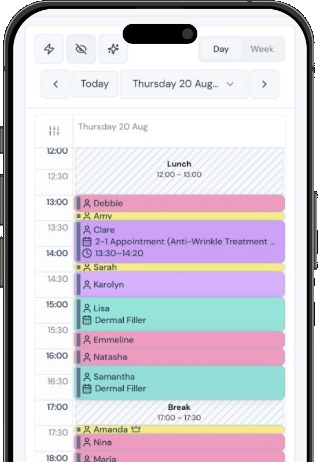
Refill the gap automatically. A cancelled slot has value for about as long as it takes someone to notice it. If refilling depends on a person phoning down a list, most of that value has already gone. A waiting list that notifies the right patient the moment a slot opens (and lets them take it without anyone at the clinic lifting a finger) recovers revenue that a benchmark discussion never will.
Then look at what is already committed. With 19,701 practitioners now working across 5,589 UK clinics: a 437% increase in practitioners since 2023 (UCL, Aesthetic Surgery Journal Open Forum, February 2026), the market is not short of supply. In a market like that, the clinics that stay calm through a bad week are the ones where a meaningful share of next month is already committed before the month starts. Cancellations still sting. They just stop deciding the month.
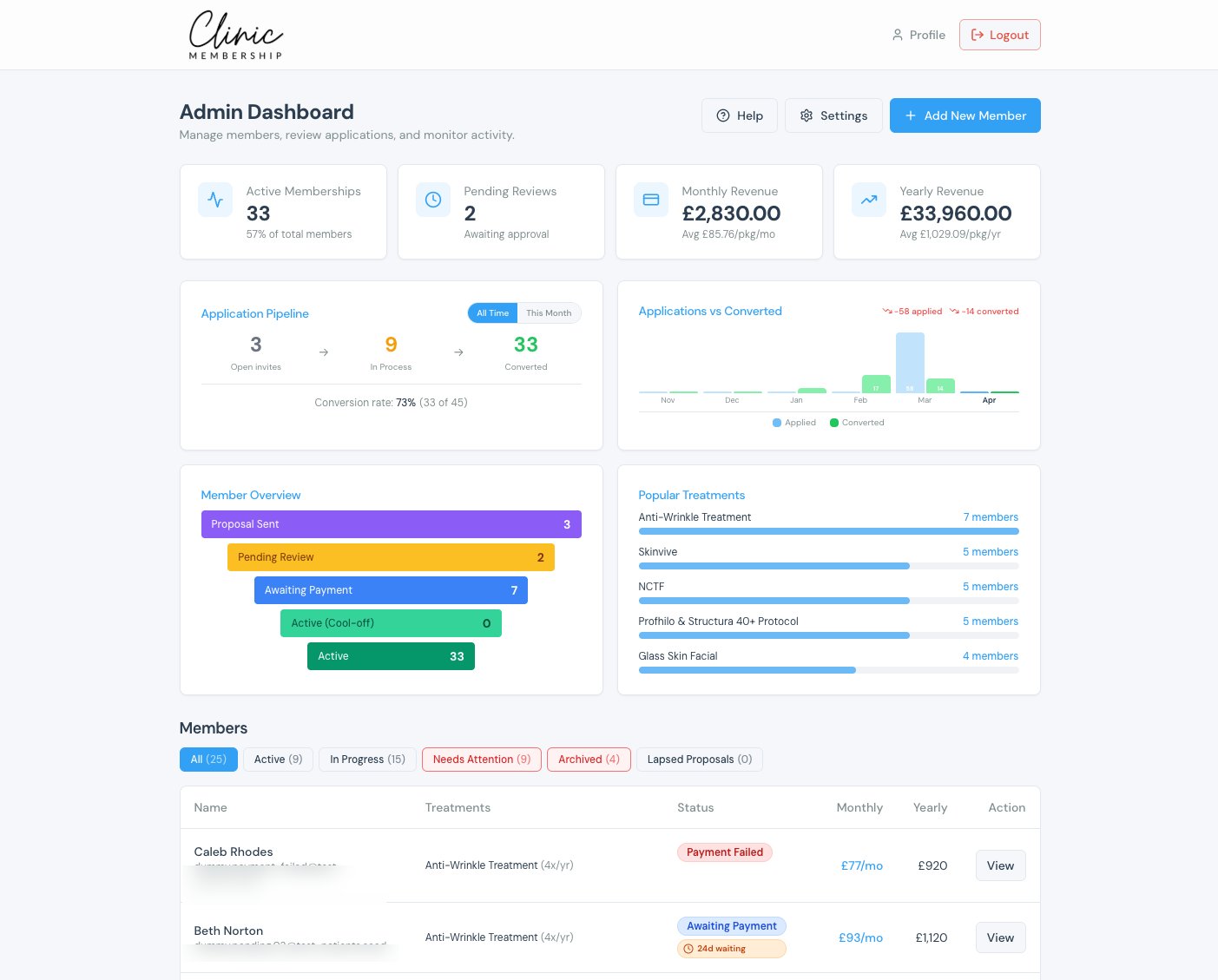
Clinic Membership handles cancellations, waiting lists and recurring revenue in one place, including the reporting that shows what is already committed rather than only what has already happened. If you want the wider picture first, the monthly revenue benchmarks piece is a good next read.
Sources
- NHS England Digital, Appointments in General Practice, 2026, approximately 5% of general practice appointments missed; 1.4 million missed appointments recorded in March 2026. England only, general practice (explicitly not aesthetics, and not a UK-wide dataset).
- American Med Spa Association, approximately 35% of first-time patients do not return. US data (labelled as such in the body).
- UCL / Aesthetic Surgery Journal Open Forum, DOI 10.1093/asjof/ojag006, published 11 February 2026 (lead author Dr Alexander Zargaran, UCL): 19,701 practitioners administering botulinum toxin across 5,589 UK clinics, a 437% increase in practitioners (and 357% increase in clinics) since 2023.