

What patients pay upfront to join a clinic membership is the question they are all really asking, and they usually ask it in three parts. What do I pay today? What happens next month? And what if I change my mind?
Most of the time only the first one gets said out loud. The other two go home with them.
None of these are hard questions. Every one has a clean, boring, correct answer. The trouble is that in a lot of clinics those answers live in someone's head (the owner's, usually) rather than on a screen the patient can see.
And an answer that has to be fetched always sounds less certain than an answer that was already there. So this is a post about the machinery that makes the honest answer easy to give: what's taken on day one, what recurs, and what happens if the patient walks it back.
The joining conversation is the one you get to have once
Here is the number that makes this worth getting right. Across beauty and wellness, 72% of appointments that were rebooked once were later cancelled (Zenoti, 2026 Beauty and Wellness Benchmark Report, via The Check-In, 29 April 2026). That figure covers beauty and wellness broadly rather than aesthetic clinics specifically, so read it as a direction of travel, not a benchmark for your diary.
What it tells you is simple enough: a booking with nothing behind it is an intention, not a commitment. The date in the calendar was never the thing holding the patient there.
Memberships are the obvious answer to that, and they work, but only if the joining moment is clean. Roughly one in three first-time patients never return (American Med Spa Association). You get one run at explaining what joining costs, and if that explanation is vague, the patient does what people always do with vague financial commitments: they say they'll think about it.
Taking a deposit does not cause retention, and it would be wrong to suggest it does. Nobody stays because you held their card. But a patient who knows exactly what they have agreed to is a patient who can actually agree to it, and that is a very fixable thing.
Question one: what does a patient pay upfront to join a clinic membership today?
There are two honest answers, and which one applies is a decision you make once in settings.
The first is nothing yet. With card on file switched on and left on Hold card, the patient saves a payment method when they book online and nothing is charged at that moment. You set a notice window in hours and a fee that applies inside it, so if they cancel or move the appointment late, there's a card to charge. Staff can also email a payment link for prepaid treatments.
The second is a deposit. Switch the setting to Take deposit on online booking and the fee amount is charged when they book. If they attend, that deposit is applied at checkout. If they cancel late or don't show, you keep it, and there's no awkward second charge to chase.
Either way, the patient sees a booking deposit step before the appointment is confirmed. Nothing is inferred and nothing is assumed.
You can also switch on a cancellation policy consent, so the patient reads and agrees to your notice period and late fee at the point of booking rather than meeting both for the first time in an email. The full setup is documented in our guide to card on file and online deposits.
Question two: what happens next month?
For a membership, the first payment isn't really the point: the second one is.
When you build a membership plan you set the contract length, the payment day and the perks. The patient then receives a link to review the package, sign it and set up payment. They see the plan and the money before they commit to either, which is the whole trick: the signature comes after the numbers, not before them.
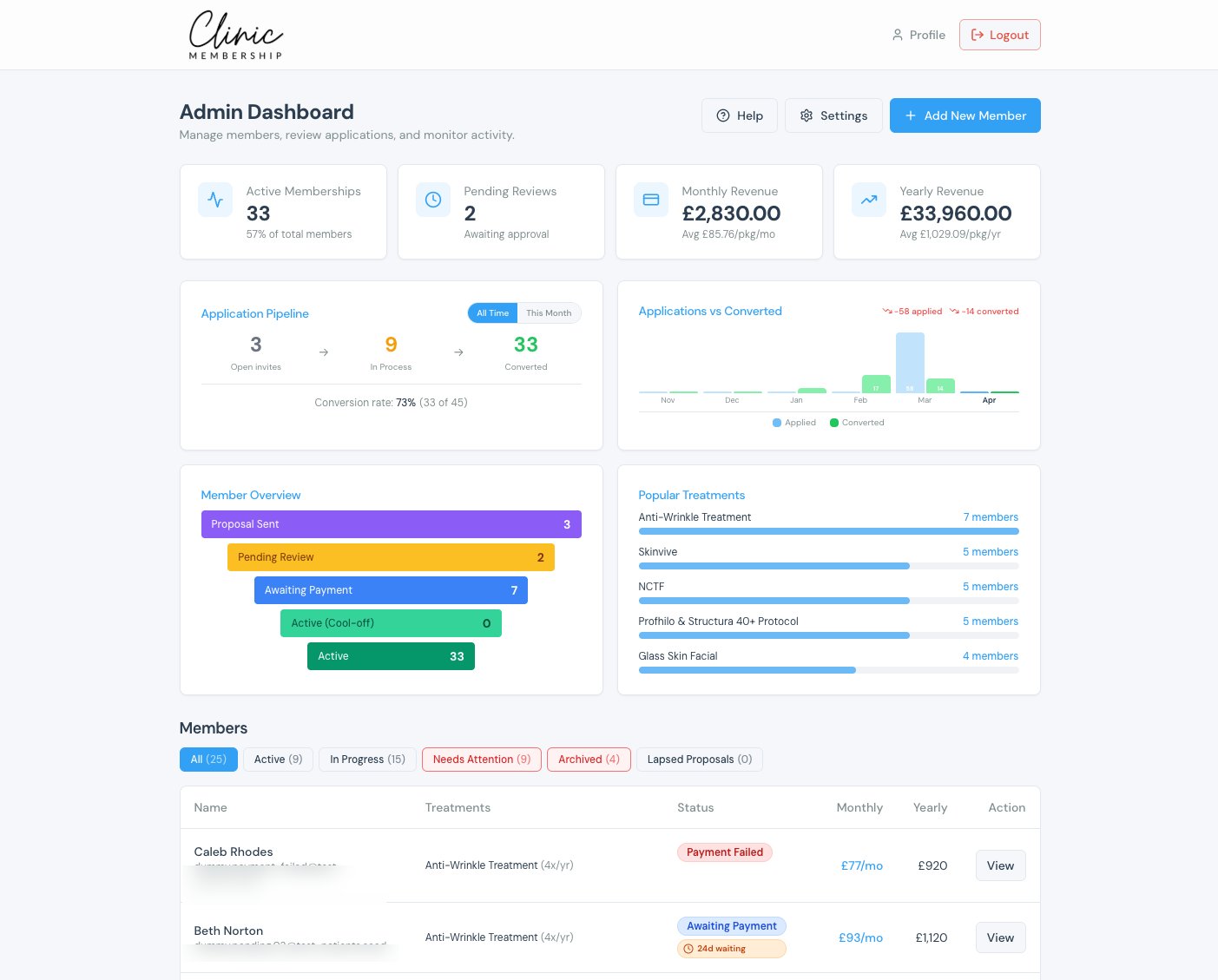
From there it recurs as a card payment through Stripe. Cards expire and get replaced, so a failed payment lands in a Needs Attention list alongside renewals due and cancelled applications, and the patient is emailed automatically with a link to update their card and retry. That's a member kept without anyone at the front desk noticing there was a problem. We've written more on recovering failed membership payments.
If your plans bundle a course of treatments rather than a flat monthly perk, how package billing works across ongoing treatments covers the mechanics in more depth.
Question three: what if I change my mind?
This is the question that the "hidden fees" searches are really asking, and it deserves a straight answer rather than a reassuring one.
When you set up a membership plan you set a cooling-off period, a contract length, a payment day and a cancellation fee, and those terms appear in the terms and at checkout.
Not in a follow-up email, and not on request. On the screen, at the moment the patient is deciding.
That's the difference between a patient changing their mind as a process and changing their mind as an argument. The first is a five-minute admin job and a patient who may well come back. The second is the version nobody enjoys.
What this looks like at the front desk
The joining conversation is only half of it. The other half is what reception can actually do when the patient is standing there.
Reception builds a basket in Sales (treatments, products or custom lines) applies a discount or an extra amount off, applies any account credit the patient has, and turns it into an invoice. Payment can be taken by card terminal, by charging a saved card, by emailing a payment link, or recorded as cash or another offline method. Split payments across two cards, or card and cash, are handled by taking part of the balance and then the rest.
Account credit is issued on the patient's card as goodwill or a correction and shows a running balance with dates and notes. Refunds are a normal operation rather than a crisis: void the invoice, tick refund via Stripe, and the invoice stays on record with a void banner so your audit trail survives. If you're VAT registered, you set that once and new catalogue items default correctly.
Our reception POS walkthrough covers the full flow. If you want the wider case for putting memberships, walk-ins and retail through one checkout tied to the patient record, that's a separate piece. This one is about the patient's side of the counter.
And if you're a clinic owner asking what the software costs to start
Same question, different side of the counter, so here's the plain answer.
There are no setup fees, no per-member surcharges on paid plans, and no long-term contract. You can cancel whenever you like, there's a free tier to start on, and no card is needed to try it. For the actual numbers, see our pricing page, where they live and stay current, and our FAQs cover the billing questions that usually come next.
If you're still working out what to compare, our checklist for built-in memberships is the short version and the full feature list is the long one. One clarification while we're here: this is clinic management software (patients, calendar, memberships, payments and reports in one place) rather than full medical records software.
The clinics whose plans get signed aren't the ones with the best pitch. They're the ones where nothing about the first payment is a surprise.
Sources
- Zenoti, 2026 Beauty and Wellness Benchmark Report, reported via The Check-In, 29 April 2026: 72% of once-rebooked appointments later cancelled (beauty and wellness scope).
- American Med Spa Association (AmSpa), approximately one in three first-time patients never return.